Written By: Steve Skillern | May 15, 2026
Time to Read 12 Minutes
What Actually Matters When Choosing a Fix and Flip Loan
Most investors spend too much time shopping for the lowest interest rate and not enough time thinking about execution.
If you’re running multiple rehab projects at once, the real questions are:
• Can the lender close fast?
• Will they fund draws quickly?
• Are they going to retrade the deal halfway through underwriting?
• Do they understand ARV and rehab risk?
• Can they handle investors doing multiple flips simultaneously?
A lender that saves you 1% in interest but delays your draw for two weeks can easily cost far more in holding costs, contractor delays, and resale timing.
I’ve seen investors lose contractors because a lender took 10–12 days to reimburse a relatively small draw request. I’ve also seen investors win deals because a bridge lender closed in five days while everyone else was still asking for updated bank statements.
That’s why the best fix and flip loans in 2026 are built around:
• speed
• leverage
• asset-based underwriting
• interest-only payments
• reliable construction draws
—not just rate.
This guide compares the most common financing options for active rehab investors using a scoring framework focused on what actually matters in the field.
Who This Guide Is For
This is written for:
• small real estate investors
• active house flippers
• BRRRR investors
• investors running multiple rehab projects simultaneously
Especially investors trying to scale beyond:
• one flip at a time
• local bank financing
• traditional mortgage underwriting
Scoring Framework
Each loan type is graded from 1–10 based on what active investors actually care about.
Why It Matters?
Interest-Only Terms Keeps monthly payments lower while rehabs are in progress
Asset-Based Underwriting allows approval based on the property instead of tax returns
|
Speed to Close |
Helps investors compete for deals and close quickly |
|
Leverage |
Determines how much cash stays in your pocket |
|
Draw Process |
Impacts how quickly contractors get paid and projects move |
Rank Loan Type Overall Score
⭐ BEST OVERALL OPTION FOR ACTIVE FLIPPERS
This is where most experienced rehab investors eventually land.
Traditional “hard money lenders” have evolved into full-service rehab lenders specifically built for:
These lenders understand:
And honestly, that matters a lot.
A traditional bank underwriter may not understand why a $150K house can realistically be worth $300K after renovation. A specialized rehab lender looks at those deals every day.
Lenders like Jet Lending have become popular with active rehab investors because they’re built around investor execution instead of traditional mortgage underwriting. That includes:
For investors running multiple rehab projects at once, having a lender that understands construction timelines and investor operations can make a huge difference.
✅ Interest-only rehab loans
✅ Fast underwriting lenders
✅ Asset-based lending
✅ High leverage options
✅ Faster draw releases
✅ Repeat borrower flexibility
Some lenders get aggressive with fees
Draw inspections can still slow projects
Inexperienced investors may get lower leverage
One investor I worked with had four active rehabs and switched lenders purely because his prior lender kept delaying inspections. The rate was slightly better, but the operational headaches were crushing his timelines.
Investors doing:
⭐ BEST FOR URGENT DEALS
These lenders are built for speed.
If you’re buying:
Private bridge lenders care far more about:
Some can close in just a few days if the title and valuation are clean.
✅ Extremely fast closings
✅ Flexible underwriting
✅ Works around credit issues
✅ Excellent for distressed situations
Higher rates
Higher points
Lower leverage than rehab lenders
A lot of investors complain about pricing here, but if a fast close helps secure a great deal, the speed can easily outweigh the extra interest cost.
⭐ BEST FOR BRRRR INVESTORS
These programs work really well for investors who might:
That flexibility is valuable right now.
Instead of forcing a sale, these programs let investors pivot into a rental exit strategy.
✅ Multiple exit options
✅ Strong leverage
✅ Interest-only payments
✅ Built-in refinance path
More underwriting overlays
DSCR refinance still has to work
These are the large national lenders backed by:
They operate more like finance companies than traditional hard money lenders.
The upside is consistency.
The downside is they can feel corporate and rigid.
✅ Large lending capacity
✅ Predictable underwriting
✅ Nationwide coverage
✅ Technology-driven systems
Less flexible
More layers of process
Slower exception approvals
If your deal fits perfectly inside the box, these lenders can work well. If the deal gets complicated, things can bog down quickly.
Some local lenders are still excellent because they actually understand the market they lend in.
That matters more than people think.
A local lender may understand:
✅ More flexible decisions
✅ Easier communication
✅ Local market knowledge
✅ Faster relationship-based approvals
Smaller lending capacity
Less scalable
Inconsistent processes
These loans are built for wholesalers and double closings.
The loan may only exist for:
This is not rehab financing. It’s transactional capital.
Speed.
Some transactional lenders can fund almost immediately if the end buyer is already lined up.
These work best for experienced investors who already have:
Instead of applying for every deal individually, investors can recycle a line of credit across multiple projects.
✅ Faster reuse of capital
✅ Less repetitive underwriting
✅ Better for scaling operations
Biggest Problem
Getting approved initially can be difficult unless you already have experience and liquidity.
Community banks can offer decent rates, but most active rehab investors eventually get frustrated with the pace.
Banks are usually not designed for:
✅ Lower rates
✅ Relationship banking
✅ Long-term financing potential
Slow underwriting
Heavy documentation
Less rehab experience
One investor told me his bank loan took so long that the seller backed out before closing. That’s a brutal lesson when you’re trying to scale.
Credit unions can work for lower-risk projects, but they’re generally not ideal for investors trying to scale aggressively.
✅ Lower rates
✅ Lower fees
Slower closings
Traditional underwriting
Less flexibility
These loans are really designed more for homeowners than active investors.
Trying to run multiple flips using conventional renovation financing usually becomes painful very quickly.
Slow closings
Full income qualification
Heavy paperwork
Poor scalability
Most active rehab investors move away from these pretty quickly once they start doing volume.
A lot of investors obsess over:
That’s backwards.
A lender that delays your draw for 10 days can cost more than a full point in interest.
The investors who scale successfully usually prioritize:
Most experienced investors eventually use multiple lending relationships.
A common setup looks like this:
Need Best Loan Type
Standard Fix & Flip Deals Specialized Rehab / Hard Money Lender
Distressed or Urgent Closings Private Bridge Lender
Rental Exit Strategy DSCR Hybrid Lender Wholesale / Double Close Transactional Funding
That combination gives investors:
The best fix-and-flip loans in 2026 are the ones that help investors move quickly and execute consistently.
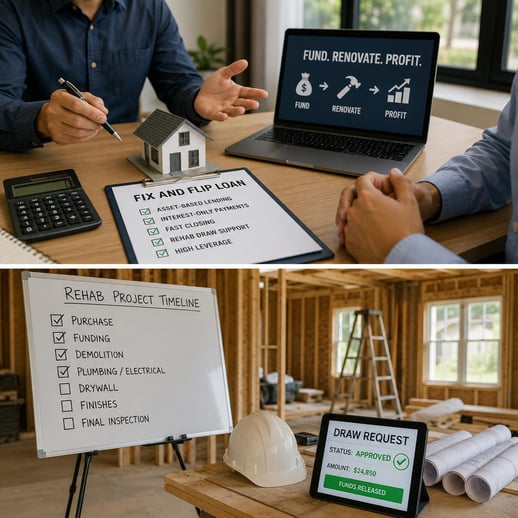
The lenders winning in today’s market are the ones offering:
That’s why specialized rehab lenders like Jet Lending continue gaining traction with active investors looking for a lender that understands rehab execution — not just loan origination.
Because at the end of the day, active rehab investing is not just about finding deals.
It’s about keeping projects moving.
Contact me to get started:
Steve Waller
(281) 975-1670
Tags: Loans, houston, real estate