
Written By: Steve Skillern | July 16, 2026
Time to Read 13 Minutes
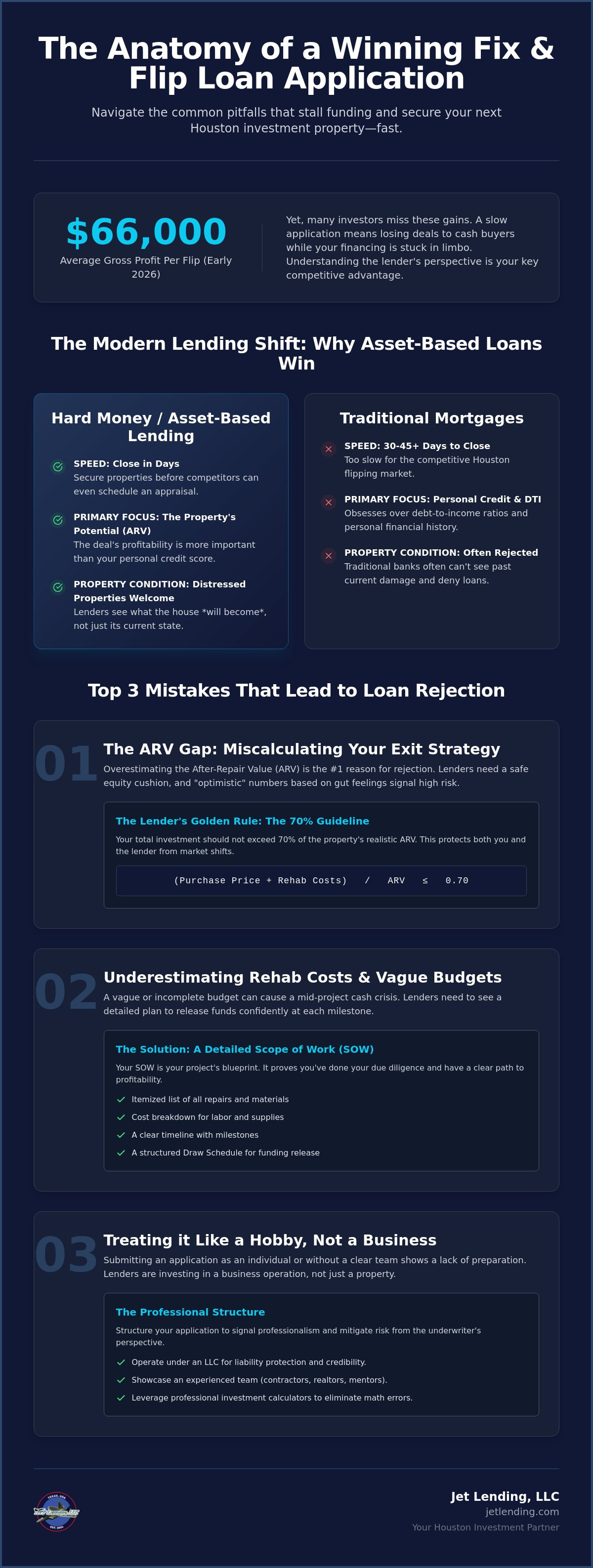
Did you know that the average gross profit for a flip hit $66,000 in early 2026, yet many investors still miss out on these gains because of avoidable paperwork hurdles? It's incredibly stressful to find a promising property in Houston only to lose it to a cash buyer while your financing sits in limbo. Understanding the common mistakes with fix and flip loan applications is the difference between a stalled project and a successful closing. You deserve a lending partner who treats your deal with the same urgency you do.
We know how much is on the line when you're crunching numbers on a tight deadline. You want to move fast, but you also need to know your budget is airtight and your profit margins are protected. This guide shows you the critical errors that lead to loan rejections and how to structure a professional application that secures fast funding for your next project. We'll walk through exactly how to master your ARV predictions, avoid hidden costs, and present a renovation scope that makes lenders want to say yes. Let's get your next Houston flip funded in days, not weeks.
Fix and flip loans are specialized, asset-backed tools designed for speed. They provide short-term financing to cover both the acquisition of a property and the cost of renovations. In 2026, the lending landscape has shifted significantly. While traditional lenders still obsess over debt-to-income ratios and personal history, modern asset-based lending prioritizes the property's potential. This means your lender is looking at the deal's profitability more than your personal balance sheet.
While this asset-focused approach is ideal for rapid investment growth, those looking for traditional home financing for a primary residence may want to learn more about Residential Mortgage Lending to understand the different criteria used by standard lenders.
One of the most common mistakes with fix and flip loan applications is treating the process like a standard home mortgage. It isn't. When you're Flipping houses, you're running a business. Traditional banks often reject applications for distressed properties because they can't see past the current damage. Hard money lenders look at what the house will become. If your application stalls, it's usually because you haven't proven that the property itself can support the debt. In a fast-moving market like Houston, a slow application doesn't just mean a delay. It often leads to lost earnest money and missed opportunities when a more prepared investor swoops in.
Speed is your greatest competitive advantage. A traditional mortgage can take 30 to 45 days to close, which is a lifetime in the investment world. Hard money loans allow you to close in days. This efficiency is possible because the focus remains on the After-Repair Value (ARV). Understanding what is a hard money loan helps you realize why these are the standard for Texas flippers. They provide the liquidity needed to secure a deal before the competition even gets an appraisal scheduled.
Think of your lender as a mentor and a second set of eyes on your deal analysis. We know the Houston streets, the foundation issues common in specific neighborhoods, and the realistic costs of local labor. When you submit your application, transparency is vital. Being upfront about your experience and your project's challenges builds trust immediately. Local expertise helps us identify hidden risks that a national lender might miss. We want your project to succeed because our success is tied directly to yours. Avoid the common mistakes with fix and flip loan applications by viewing the submission as the start of a long-term partnership rather than a one-time transaction.
One of the most common mistakes with fix and flip loan applications is overestimating the After-Repair Value (ARV). ARV is the projected market value of a property once all planned renovations are finished and it is ready for resale. It's the foundation of your entire deal. Lenders use this number to determine how much they can safely lend you. If your estimate is based on "optimistic" comps that don't reflect the actual neighborhood reality, your application will likely be rejected. Lenders prioritize deals with a safe equity cushion to protect against market shifts.
In 2026, successful flippers are sticking closely to a refined version of the 70% rule. This means your total investment, including the purchase price and rehab costs, shouldn't exceed 70% of the ARV. While some flexibility exists for high-demand Houston pockets, straying too far from this logic signals high risk. You must use hard data to justify your projected sale price. Feelings and "gut instincts" about a neighborhood's potential won't get a loan approved. You need to prove the value with concrete evidence.
Manual spreadsheets are a liability. A single broken formula can lead to application-killing math errors that destroy your credibility with a lender. Professional tools eliminate this risk by standardizing your data. Before you submit your paperwork, you should use a dedicated investment property calculator to stress-test your margins. This allows you to fact-check your profit potential and see your deal through the eyes of the underwriter. If the numbers don't work in the calculator, they won't work for the loan officer.
Houston is a block-by-block city. Identifying "true" comps requires a deep understanding of neighborhood boundaries. A renovated home in the Houston Heights doesn't necessarily set the price for a property just a few blocks away in a different subdivision. You must look at distance, property age, and finish-out quality. Underwriters also follow strict federal appraisal regulations to ensure valuations are grounded in reality. Additionally, you must factor in 2026 local property tax trends. Rising assessments in areas like the Third Ward can eat into your bottom line if you don't account for them in your exit math. Accuracy in these details proves you're a professional investor.
One of the most common mistakes with fix and flip loan applications is submitting a vague or unrealistic renovation budget. In 2026, labor and material costs remain a moving target. Lenders don't just want to see a total number; they want to see the logic behind it. A "Scope of Work" (SOW) that simply lists "Kitchen Remodel: $15,000" is a major red flag. It suggests you haven't done the actual legwork to get contractor bids or material quotes. When your numbers are too low, you risk running out of cash halfway through the project, which is a lender's worst nightmare. We protect the asset by ensuring every dollar in the budget is tied to a specific, verified construction milestone.
Professional applications always include a contingency fund of 10-15%. This isn't just a suggestion; it's a sign of a seasoned investor who understands that surprises happen. Whether it's an undiscovered foundation issue or a plumbing leak behind a wall, having a buffer proves you have the liquidity to finish the job. If your application lacks this cushion, it shows a lack of preparation that could stall your funding. Your goal is to prove that the project stays profitable even if costs rise slightly during the 165-day average flip timeline seen in early 2026.
Beyond construction surprises, you must also account for the cost of the capital itself. When preparing your financial model, it is helpful to reference how firms like AHL HardMoney, LLC calculate Loan Origination Fees and Interest Income to determine the full scope of your carrying costs.
Itemize everything. Break your budget down into labor and materials for every room and major system. If you're tackling structural work, specify that you're using licensed Texas contractors. This adds a layer of professionalism that underwriters love. Include clear, high-resolution photos of the "as-is" condition for every area you plan to touch. When a lender can see the current damage alongside your detailed repair plan, they feel much more confident in the deal's viability. This level of detail eliminates the "guesstimate" red flags that lead to rejection.
Lenders don't give you the full rehab budget at the closing table. Instead, funds are released through a draw process as you complete specific phases of work. A poorly planned draw schedule is one of the most common mistakes with fix and flip loan applications because it creates massive cash flow gaps. You must have enough of your own reserves to pay your contractors for the first phase of work before you can request your first reimbursement. Align your draw schedule with your actual cash on hand to ensure the project never stops. When your application shows a clear understanding of this rhythm, you position yourself as a low-risk partner ready for fast approval.
A successful application isn't just a stack of papers. It's a professional business plan that proves you've de-risked the deal for the lender. In the fast-paced Houston market, speed is your most valuable currency. However, speed doesn't come from rushing. It comes from being prepared. Having a "closing-ready" packet allows you to secure funding before other investors even finish their walk-throughs.
One of the most common mistakes with fix and flip loan applications is applying in your personal name. Professional lenders in 2026 almost exclusively lend to business entities like an LLC. This structure provides liability protection for you and clarity for the lender. Additionally, you must demonstrate liquidity. Lenders want to see "skin in the game." This means having enough cash in the bank to cover your down payment, closing costs, and the first phase of renovations before your first draw. Showing this upfront builds immediate confidence in your ability to execute the project.
Your "Investor Bio" is another critical piece of the puzzle. If you're a solo flipper, you aren't actually solo. Your bio should highlight your team of contractors, real estate agents, and mentors. Proving that you have a support system of local experts makes you a much more attractive borrower. If you're ready to see how your team and numbers stack up, apply for a short-term loan today to get your deal moving.
To avoid delays, keep a digital folder ready with these essential documents. Having these organized is how you win competitive bids.
Don't let a lack of past flips stop you from applying. You can overcome this hurdle by leveraging a partner's track record. If you have a partner with experience, include their portfolio in your application. You should also highlight your professional background. Skills in project management, construction, or real estate sales are highly transferable and valued by underwriters. Finally, always present a "Plan B." Showing that the property can work as a long-term rental if the market shifts proves you've thought about every exit strategy. This level of foresight is exactly what lenders look for in a partnership.
Choosing the right lender is just as critical as choosing the right property. You need a partner who understands that in the world of real estate investing, time is literally money. We don't act as gatekeepers; we act as facilitators for your success. Avoiding common mistakes with fix and flip loan applications is much easier when you have a local team in your corner to review your numbers and provide honest feedback. We've been based in Houston since 2004, and we use that decades-long expertise to help you navigate the complexities of the local market.
Our rapid asset-based underwriting is designed to get you to the closing table in record time. While national lenders might take weeks to process a file, our local decision-makers move with the speed the Houston market demands. We've seen investors grow from their very first single-family flip to managing 50-unit portfolios. This growth is possible because we prioritize the property’s potential and your ability to execute. By focusing on the asset's future value, we empower investors to secure funding based on the quality of their deal rather than the limitations of their personal financial history.
Texas lending regulations and title requirements have specific nuances that can trip up out-of-state lenders. We navigate these hurdles daily, ensuring your closing isn't delayed by paperwork errors or legal misunderstandings. Our deep local network also means we can coordinate fast appraisals and inspections from professionals who actually know the streets you're buying on. Whether you're targeting a bungalow in the Heights or a ranch in Pasadena, our neighborhood-specific knowledge helps verify your ARV with precision. This local insight protects your margins and builds a foundation of trust from the very first application.
Stop guessing and start closing. If you have a property under contract or even just a lead you're pursuing, reach out for a quick "soft" look at the deal. We can help you identify potential pitfalls before they become costly mistakes. Use our proprietary tools to refine your numbers and ensure your application is "yes-ready" before it even hits an underwriter's desk. We're here to help you de-risk your investment and maximize your profitability. Success in 2026 requires disciplined underwriting and a partner who moves as fast as you do. Analyze your next deal with Jet Lending's Investment Property Calculator and take the first step toward your next successful Houston flip.
You've done the hard work of finding a promising deal in a competitive market. Now it's time to ensure your financing is just as solid as your renovation plan. By mastering your ARV calculations with hard data and submitting a detailed, itemized scope of work, you eliminate the friction that stalls most projects. Organizing your application under an LLC and demonstrating clear liquidity proves to lenders that you're a professional ready for a long-term partnership.
Avoiding these common mistakes with fix and flip loan applications ensures you don't lose your earnest money to a more prepared competitor. Jet Lending has served as the trusted choice for Texas-based experts since 2004. We prioritize asset-backed loans for rapid closing and provide professional-grade deal analysis tools to help you stress-test every margin before you commit.
Ready to fund your next Houston flip? Get a fast quote from Jet Lending today. Your next successful project is just one well-structured application away. We're ready to help you build your portfolio with confidence.
The most frequent reason for denial is a lack of deal viability caused by an inflated After-Repair Value (ARV) or an unrealistic renovation budget. Lenders must see that the property can support the debt even if the market shifts. If your application doesn't prove a safe equity cushion, underwriters will view the project as too high-risk for funding.
While asset-based lending focuses primarily on the property, most lenders require a minimum credit score between 620 and 660. A higher score of 740 or above typically helps you secure the most competitive interest rates. Your credit history serves as a secondary indicator of your financial responsibility while the property potential drives the primary approval.
You generally need between 10% and 20% of the purchase price as a down payment, plus liquidity for closing costs and the initial renovation phase. This ensures you are financially committed to the project's completion. Demonstrating these reserves upfront is one of the best ways to avoid common mistakes with fix and flip loan applications.
Yes, you can secure financing for your first flip by showcasing a professional team that includes experienced contractors and local real estate mentors. Many first-time investors also bring in a partner with a proven track record to strengthen their application. Highlighting transferable skills from project management or construction also builds significant lender confidence.
You must provide a signed purchase contract, an itemized Scope of Work (SOW), recent bank statements, and your LLC entity documents. Organizing these files into a digital "closing packet" allows for much faster underwriting. Proactive documentation is the key to winning deals in competitive Houston neighborhoods where speed is essential.
The approval and funding process happens in days rather than the weeks required by traditional institutional banks. As local Houston decision-makers, we can coordinate appraisals and inspections quickly to meet tight closing deadlines. We move at the speed of the investment market to ensure you don't lose your deal to a cash buyer.
The 70% rule remains a critical benchmark in 2026, suggesting your total investment should not exceed 70% of the property's ARV. While some high-demand Houston pockets allow for slight flexibility, staying near this ratio protects your profit margins. Using our investment property calculator helps you verify these numbers before you submit your formal application.
Yes, fix and flip loans typically cover both the acquisition of the property and the renovation budget. These funds are released through a draw schedule as you hit verified construction milestones. Understanding this rhythm is vital to avoiding common mistakes with fix and flip loan applications that lead to mid-project cash flow gaps.
Tags:

What if the "expensive" loan you have been avoiding is actually the fastest way to scale your portfolio in 2026? Many investors watch lucrative deals slip away while waiting for traditional bank...

Why are you still letting traditional bank red tape cost you the best deals in Harris County? In the 2026 market, a slow lender is more expensive than a high interest rate. You need a partner who...