
Written By: Steve Skillern | July 13, 2026
Time to Read 14 Minutes
You found the perfect Houston fixer-upper, but your bank just sent a four-page list of documents they need before they even consider your application. In the time it takes a traditional lender to say "denied," a savvy investor has already closed the deal and started the demolition. If you're asking what is a hard money loan, it's the tool that keeps you from losing profitable projects to rigid credit scores and endless red tape. You shouldn't have to jump through hoops just to put your capital to work.
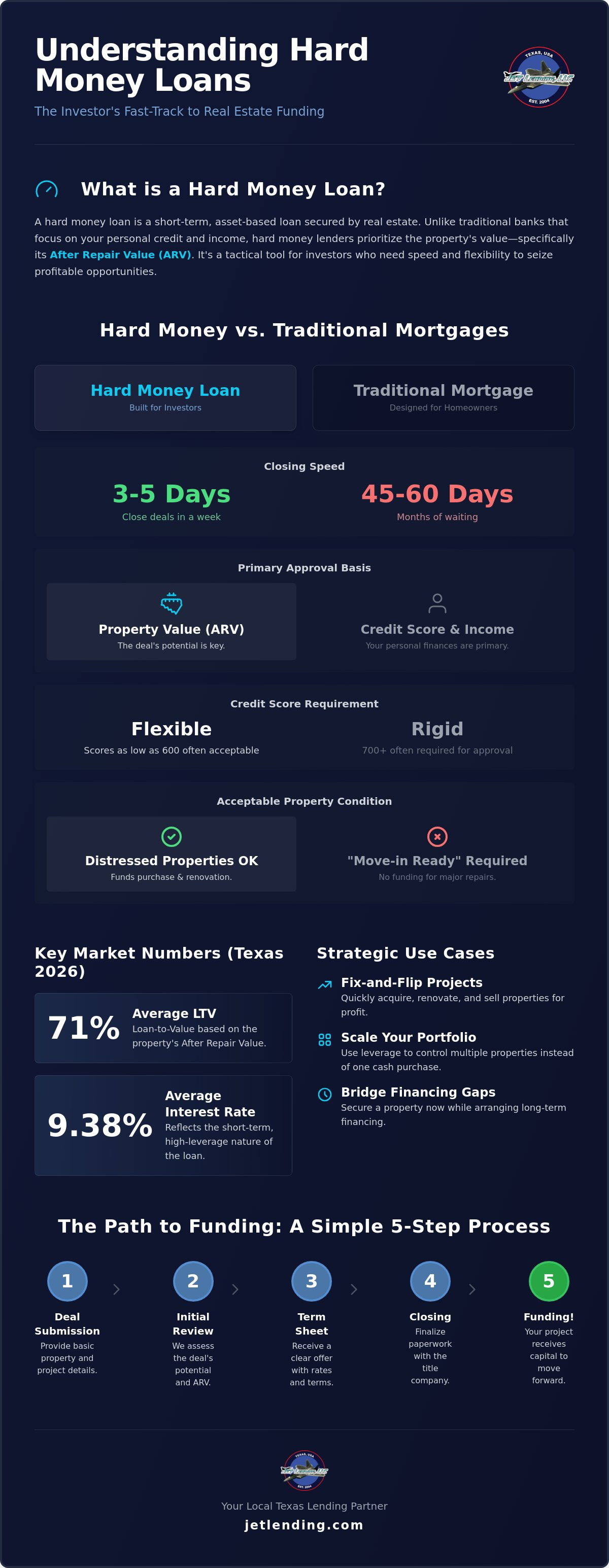
This guide will show you how to master the mechanics of asset-based lending so you can secure fast, reliable funding for your next property. We'll break down how the math actually works in the 2026 market. You'll learn why speed is your greatest asset and how to use leverage without the typical bank headaches. We will explore why the average Texas interest rate hit 9.38% in early 2026, explain the 71% average LTV, and help you find a local partner who values the property's potential more than your tax returns. Let's get your next deal funded.
If you want to scale your real estate business, you've likely asked: what is a hard money loan? At its core, it is a short-term, asset-based loan secured by real estate. Unlike a traditional mortgage that relies on your personal income and credit history, this type of financing focuses on the value of the property itself. It is the fuel for fast-moving deals that traditional banks aren't built to handle. You use it to acquire, renovate, or bridge a property until you can sell it or refinance into long-term debt.
The term "hard" doesn't refer to the difficulty of getting the money. In fact, these loans are often much easier to secure than bank financing. Instead, it refers to the "hard asset" used as collateral. Private lenders and specialized firms like Jet Lending, LLC look at the tangible value of the building and land. While banks act as gatekeepers obsessed with your past financial mistakes, private lenders act as partners focused on the future potential of your project. According to a Hard money loan definition, these are typically issued by private investors or companies rather than banks. This structure allows for a "collateral-first" mindset that prioritizes the deal over the paperwork. It is a tactical choice for investors who value speed and leverage over the slow, rigid processes of institutional lending.
Traditional lenders look at the current appraised value of a property. Hard money lenders look ahead. We focus on the After Repair Value (ARV), which is what the property will be worth after you finish your renovations. This allows you to borrow more of the capital needed for the purchase and the rehab. Speed is the other major differentiator. While a bank might take 45 to 60 days to close, a hard money partner can often fund a deal in just 3 to 5 days. This agility gives you the power to make cash-like offers that win in competitive markets. You get the flexibility to structure terms that fit your specific project rather than trying to fit into a "cookie-cutter" institutional box.
Don't let a less-than-perfect credit score stop your momentum. Banks often have rigid requirements that automatically trigger a "no" for anyone with a score under 700. In the world of asset-based lending, we care more about your experience and the property's potential profitability. A 600 credit score might be a deal-breaker for a traditional mortgage, but it is often perfectly acceptable when you're asking what is a hard money loan. We look at the equity in the deal and your plan for the exit. In hard money lending, the deal is the driver, and the borrower is the pilot.
Understanding the difference between a bank loan and a private loan is critical for your success. Traditional mortgages are designed for homeowners who plan to live in a property for thirty years. They focus heavily on your debt-to-income ratio and years of tax returns. Conversely, when you ask what is a hard money loan, you're looking at a commercial tool built specifically for real estate investors. These loans are strictly for non-owner-occupied properties. You can't use them to buy your personal residence, but you can use them to build a portfolio of rentals or flips that a bank would never touch.
Distressed properties often fall into a "funding gap." If a house lacks a functioning kitchen or has foundation issues, a traditional bank will likely deny the loan immediately. They want "move-in ready" collateral to protect their long-term interest. Hard money lenders see the potential instead of the problems. We provide the capital needed to bridge the gap between a run-down house and a renovated gem. This allows you to secure deals that other buyers have to pass on because they can't get conventional financing.
In the Houston market, speed is your greatest competitive advantage. A traditional bank close typically drags on for 45 to 60 days. In that time, a better offer could easily snatch your deal away. Hard money moves at the speed of business. You can often close in 3 to 5 days. This allows you to make "cash-like" offers that sellers love because they know the money is ready now. You don't have to worry about a loan committee stalling your progress at the last minute.
Leverage is the secret to scaling your business. You might have enough cash to buy one house outright, but using a short-term loan allows you to spread that capital across multiple projects. By putting a smaller percentage down, you can control more real estate and multiply your total returns. You can use our Investment Property Calculator to see exactly how this leverage impacts your bottom line before you sign any paperwork.
You pay for speed and flexibility with a higher interest rate. In the first quarter of 2026, the average interest rate for Texas hard money loans was 9.38%. While this is higher than a 30-year mortgage, the short-term nature of the loan changes the math. You aren't paying this rate for decades; you're paying it for a few months while you finish your project. Most investors find that the cost of capital is a small price to pay for the ability to secure a profitable deal quickly.
You will also encounter "points," which are origination fees paid at closing. In Texas, the average origination fee in early 2026 was 3.0%. These points cover the lender's administrative costs and risk assessment. When you factor these into your deal analysis, you'll see that the access to capital is what drives your ROI, not just the interest rate itself. Focus on the profit at the end of the project rather than the monthly payment.
Many investors view hard money as a backup plan, but seasoned pros at Jet Lending, LLC treat it as a proactive growth tool. It is not about being unable to get a bank loan; it's about choosing the right tool for the job. If you want to scale a real estate business, you need capital that moves as fast as you do. When you look beyond the basic definition of what is a hard money loan, you see a strategic advantage for capturing opportunities that others miss. Whether you are tackling a heavy renovation or need to close a deal in 72 hours, asset-based lending provides the agility you need to win.
Wholesalers also rely on this speed through transactional funding. This allows you to close on a property and sell it to an end-buyer immediately, often on the same day. It keeps your personal capital liquid while you manage back-to-back deals. Additionally, bridge loans serve as a short-term solution to secure a property while you arrange long-term financing. This is perfect for "stabilizing" a commercial asset or a rental property that needs minor repairs before a traditional lender will consider it. You get in, fix the issues, and move on to your next project without the typical institutional delays.
The fix and flip model is the most common use case for these short-term loans. Traditional banks rarely fund the renovation costs of a project, but hard money lenders often cover both the purchase price and 100% of the rehab budget. This is managed through a "draw" process. Instead of giving you all the renovation cash upfront, the lender releases funds in stages as you complete specific milestones. This keeps the project on track and ensures your contractor is actually doing the work. A fast exit strategy is the key here. You want to buy, renovate, and sell as quickly as possible to maximize your ROI and minimize interest carry.
Hard money is the perfect engine for the BRRRR strategy: Buy, Rehab, Rent, Refinance, Repeat. You use a hard money loan for the "Buy" and "Rehab" phases because you need speed and renovation capital. Once the property is renovated and a tenant is in place, the value has increased. This allows you to refinance the property into a long-term DSCR loan based on the new appraised value. You can then pull your initial capital back out to fund your next deal. This hand-off from short-term debt to a long-term rental property loan is how investors build massive portfolios with limited out-of-pocket cash.
To master the math of real estate, you have to treat your financing as a business expense rather than a personal debt. When you're evaluating what is a hard money loan, you should look at it as a tactical line item in your project's budget. The total cost usually consists of three main parts: the interest rate, points, and administrative fees. Most of these loans are interest-only, meaning your monthly payments don't reduce the principal balance. This structure keeps your monthly overhead lower during the renovation phase, allowing you to put more cash toward materials and labor.
You must also prepare for the "balloon payment" at the end of the term. Since you aren't paying down the principal each month, the full loan amount is due when the house sells or when you refinance. It is a structure designed for speed and exit, not for long-term holding. To ensure your deal stays profitable, always use an Investment Property Calculator to stress-test your numbers. Run your scenario with a slightly longer hold time than you expect. This helps you see if the deal still makes sense if the renovation takes two months longer than planned.
Be careful not to fall into the "over-improvement" trap. Beginners often spend too much on high-end finishes that don't actually increase the property's value beyond the local market ceiling. If your renovation costs push you past the projected value, your ROI will vanish regardless of your interest rate. Focus on the repairs that move the needle for your specific neighborhood. If you want to see how these costs fit into your next deal, calculate your potential profit with our professional tools before you make an offer.
Lenders use two primary metrics to limit their risk: Loan-to-Value (LTV) and Loan-to-Cost (LTC). LTV is based on the property's value, while LTC is based on the total cost of the project. Most private lenders cap their exposure at 70% to 75% of the After Repair Value. After Repair Value (ARV) is the projected market value of a property after all planned renovations and improvements are completed. By staying within these limits, you ensure there is enough equity in the deal to protect both you and the lender if the market shifts.
Investors often obsess over interest rates while ignoring the cost of lost opportunity. If a traditional bank takes 60 days to approve a "cheap" loan, a cash buyer will likely swoop in and take the deal while you're still submitting paperwork. If that deal had a $50,000 profit potential, waiting for a bank just cost you $50,000. A hard money loan might be "more expensive" in terms of monthly interest, but if it allows you to close in 7 days and capture that profit, your annual ROI is infinitely higher than a deal you never closed. Focus on your net profit at the finish line, not just the cost of the capital that gets you there.
Securing your first loan shouldn't feel like a high-stakes interrogation. It's a partnership designed to get your project off the ground. When you understand what is a hard money loan, you realize the application process is built for speed rather than bureaucracy. While a bank wants to know your life story, a private lender wants to know about your deal. In the fast-paced Houston market, having a lender who knows the difference between a property in the Heights and one in the Third Ward is your secret weapon. Local expertise ensures your valuation is accurate and your funding is secure.
You don't need a mountain of paperwork to get started. Most successful investors keep a "closing kit" ready to go. To move from a lead to a funded deal, you will generally follow a streamlined five-step process:
Vetting your lender is just as important as vetting your contractor. Look for transparency in their fee structure and a proven track record. A lender like Jet Lending, LLC has been active in the market since 2004, providing a level of stability that "fly-by-night" private individuals can't match. Ask about their draw process and how quickly they can pivot if your project needs change. Speed is vital, but reliability is what keeps your business running.
A professional Scope of Work (SOW) is the heart of your application. It should detail every repair, from foundation work to the final coat of paint, along with estimated costs for each. This document proves you've done your homework and understand the project's requirements. Always have a "Plan B" for your exit strategy. While you might intend to flip the house, show the lender that the property also works as a long-term rental. This dual-exit approach reduces risk and makes your deal much more attractive for approval. Local lenders like Jet Lending, LLC can often move faster because they don't need a national committee to sign off on a Houston neighborhood they already know.
The closing table with a private lender is straightforward. You'll sign the note and deed of trust, and the funds will be wired to the title company. Once you own the property, the relationship shifts to draw management. Clear communication during the rehab phase is essential. When you finish a milestone, request your draw promptly so you can keep your contractors paid and the project moving. If you're ready to take the next step in your investment journey, apply for your short-term investment loan with Jet Lending, LLC today and let's get your deal funded.
You now have the blueprint to navigate the fast-moving 2026 real estate market with confidence. Understanding what is a hard money loan gives you the power to act while other buyers remain trapped in a cycle of bank paperwork and delays. Remember that speed and leverage are your greatest tactical advantages. By focusing on a property's potential and a clear exit strategy, you can scale your portfolio far faster than traditional financing allows. Use professional tools to stress-test your numbers and keep your profit margins secure.
Partnering with a lender who understands the Texas landscape makes all the difference for your bottom line. Jet Lending, LLC was founded in 2004 and brings over two decades of local lending experience to your closing table. We fund deals in as little as 7-10 days, ensuring you stay ahead of the competition. We also provide professional-grade investment property calculators to help all our clients master their deal math. Ready to fund your next deal? Get a quote from Houston’s expert hard money partners at Jet Lending, LLC. Your next successful project is just one quick approval away. Let's build your legacy together.
Yes, it's an excellent tool for beginners. When you're first learning what is a hard money loan, you'll find it acts as a built-in safety net. If a professional lender won't fund your deal, it's a strong signal that the project might not be as profitable as you thought. It allows you to leverage expert analysis and close your first deal with less of your own cash tied up in the property.
You can typically secure funding within 7 to 10 days. Local lenders who understand the Houston market can move much faster than national banks because they don't need weeks to research neighborhood values. This speed is what allows you to win competitive bids and secure distressed properties before other investors even get an appraisal back.
Yes, most lenders require a down payment between 15% and 25% of the purchase price. While some programs may fund a large portion of your renovation costs, having your own "skin in the game" is a standard requirement. This shared risk ensures that both you and the lender are fully committed to seeing the project through to a successful exit.
Yes, you can qualify even with a less than perfect credit score. Because this is an asset-based loan, the value of the property and your exit strategy are far more important than your personal financial history. It's a great way to build your portfolio and improve your financial standing while a bank would simply see a credit score and say no.
You should contact your lender immediately if you foresee a delay in your project. Most lenders prefer to work out a loan extension rather than go through the trouble of foreclosure. If a solution can't be reached, the lender has the right to take the property to recover their investment. Open communication is the best way to protect your reputation and your capital.
Hard money is a specific type of bridge loan used for real estate. Both are short-term solutions designed to get you from acquisition to your final exit, whether that's a sale or a long-term refinance. The main difference is that hard money specifically uses the "hard asset" as the primary criteria for the loan approval rather than just your personal income.
No, these are commercial loans intended for business purposes. They are generally exempt from the consumer protection laws that govern traditional home mortgages for primary residences. In Texas, the Finance Code excludes commercial transactions from many usury caps. This lack of red tape is exactly what allows the lending process to be so fast and flexible for investors.
Closing costs generally include origination points, title company fees, and processing charges. These costs are transparent and should be factored into your deal analysis from the very beginning. While they may be higher than a traditional bank loan, the access to quick capital and the ability to scale your business usually far outweigh the initial fees. To see how these private financing models are structured and compared in other markets, you can explore Srovnání nebankovních půjček for more information on non-bank loan evaluations.
Tags:

Most people think flipping houses is about picking paint colors and swinging hammers, but in 2026, it's actually a game of speed and precise math. Learning how to start flipping houses shouldn't feel...

Imagine you've just found a distressed property in Houston with massive profit potential, but your lender goes silent forty-eight hours before the deadline. In a Texas market where the median home...

What if your ability to scale a portfolio didn't depend on your personal debt-to-income ratio or a stack of tax returns? In the fast-moving 2026 Houston market, waiting 60 days for a traditional bank...