
Written By: Stephanie Rojas | August 09, 2026
Time to Read 12 Minutes
In 2026, the most successful Houston investors aren't using their personal bank statements to buy properties. They've realized that qualifying for a mortgage based on a W-2 is too slow for a competitive market where speed is everything. You've likely felt the frustration of traditional lending delays or the anxiety of meeting local requirements. Securing Houston short term rental loans shouldn't feel like a hurdle; it should be your competitive advantage.
At Jet Lending, LLC, we're here to help you access asset-based financing that prioritizes property potential over your personal debt-to-income ratio. This guide explains how to use DSCR loans to close deals in days, not months. You'll learn how to navigate the 17% combined hotel occupancy tax while scaling your portfolio with tools designed for professional investors. We'll break down the latest 2026 regulations and show you a clear path to beating other buyers to the closing table.
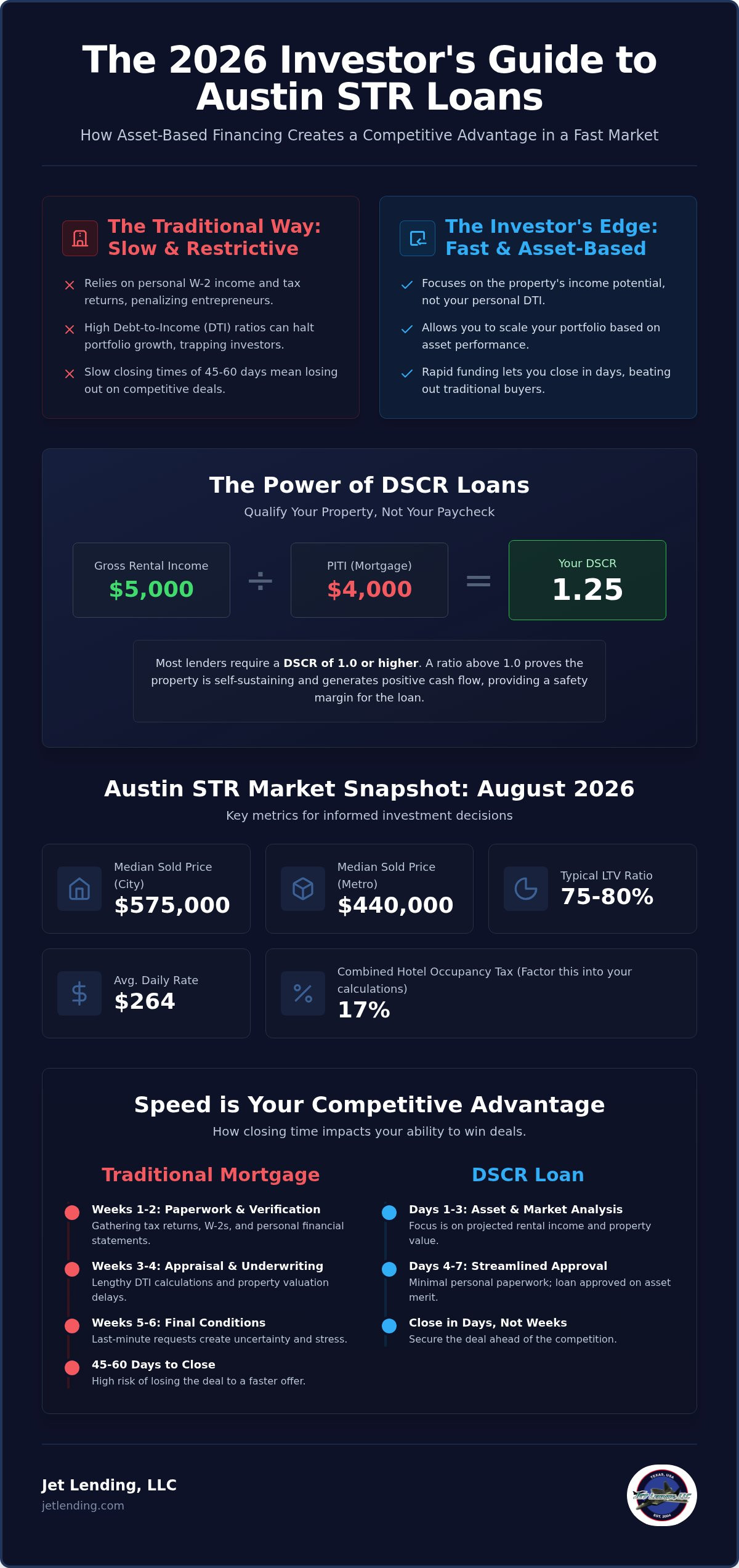
In the competitive Austin market, opportunity moves faster than a traditional bank's underwriting department. Austin short term rental loans are specialized asset-backed financing products designed specifically for the unique needs of Short-term rentals (STR). Unlike a standard home loan, these products focus on the property's ability to generate cash flow rather than just your personal tax returns. As of August 2026, the Austin housing market has reached a point of stabilization. The median sold price in the city area is approximately $575,000, while the broader metro area has seen a slight year-over-year increase to $440,000. This environment demands financing that treats your investment like the business it is.
Traditional lenders rely on a Debt-to-Income (DTI) ratio that often penalizes self-employed or scaling investors. If you own multiple properties, your DTI might look "risky" on paper even if your portfolio is highly profitable. This is the "DTI Trap." Most big banks simply don't know how to verify or project income from platforms like Airbnb or Vrbo. They see variable income as a liability rather than an asset. Transitioning to asset-based lending solves this liquidity crisis by shifting the focus to the asset's performance. It empowers you to grow your portfolio without being tethered to a W-2 paycheck or a corporate salary. It’s about looking at the numbers that matter: the property's potential.
Speed is your best friend when a prime property in Zilker or East Austin hits the market. You need a way to close before the competition even gets an appraisal back. Use a short-term bridge loan or hard money for a quick Austin acquisition to beat out traditional buyers stuck in a 45-day closing cycle. These loans are about speed and leverage. Once the property is stabilized, renovated, and properly licensed according to the latest 2026 city mandates, you can transition into a long-term Debt Service Coverage Ratio (DSCR) loan. This move helps you lock in a fixed rate and can potentially pull your initial capital back out for the next deal. While short-term loans prioritize transactional speed for acquisition, long-term DSCR loans provide the stability required for a sustainable hold strategy. Choosing the right Austin short term rental loans depends entirely on your current phase of the investment lifecycle.
Most investors in the current market expect a Loan-to-Value (LTV) ratio between 75% and 80%. This means you'll typically need a down payment of 20% to 25%. While this is higher than a primary residence loan, the tradeoff is a streamlined approval process that focuses on your business strategy rather than your tax returns. You can scale your portfolio much faster when your personal debt-to-income ratio isn't a limiting factor. It’s a professional approach for a professional market.
The math behind a DSCR loan is straightforward but critical. You take the Gross Rental Income and divide it by the PITI, which stands for Principal, Interest, Taxes, and Insurance. If a property earns $5,000 a month and the PITI is $4,000, your DSCR is 1.25. Most lenders look for a ratio of 1.0 or higher to ensure the property is self-sustaining and provides a safety margin for the debt. When you are Navigating Austin STR Regulations, ensure your revenue projections account for the 17% combined hotel occupancy tax to keep your calculations accurate. You can use an investment property calculator to run these numbers quickly before you make an offer.
The differences between these two paths are stark, especially in a fast-moving market like Austin. Traditional mortgages often take 45 to 60 days to close and require mountains of personal paperwork. In contrast, DSCR loans can often close in two weeks because the underwriting is asset-based. This speed allows you to beat out other buyers who are still waiting on a bank's manual review of their W-2s.
This flexibility is why Austin short term rental loans are the preferred choice for investors looking to treat their rentals as a scalable business. You get the speed of a cash buyer with the leverage of a professional loan.
Success in the Austin market hinges on understanding the local ordinance. While the 1,000-foot spacing rule was repealed in late 2025, licensing remains the backbone of your business. Austin categorizes permits into three types: Type 1 (owner-occupied), Type 2 (non-owner occupied), and Type 3 (multifamily). As of July 1, 2026, platforms must delist any property without a valid license. This makes your permit a prerequisite for Austin short term rental loans. Lenders want to see a clear path to compliance before they fund your deal. You'll need to budget for the initial operator's license fee of $836.30 and stay current with the 17% combined hotel occupancy tax.
Lenders view a lack of a permit as a high-risk liability. If you're eyeing a non-owner occupied property, you'll likely need a Type 2 license. These are generally tied to commercial or specific residential zoning. When you're performing due diligence on an Austin fix and flip deal, always verify the zoning first. Transitioning from a flip to an STR requires a zoning-compliant strategy to ensure you can refinance into a long-term DSCR loan later. Qualifying for Your Austin STR Loan often depends on this regulatory green light. Lenders will check the City of Austin's public records to ensure the property isn't on a "no-license" list before approving your application.
The presence of tech giants like Tesla and Oracle continues to drive consistent demand for short-term stays. Corporate travelers and relocating employees need high-quality housing. This demand peaks during major events like SXSW, ACL, and Formula 1, where daily rates often surge well beyond the $264 city average. Properties near Zilker Park or the Downtown core remain the gold standard for high occupancy and premium rates. However, you must vet your HOA carefully. Many Austin condo associations have strict "no STR" clauses or 30-day minimum stay requirements. Always choose "STR-friendly" developments to keep your financing options open. Neighborhoods like East Austin and South Congress continue to show high cash flow potential for investors who secure the right Austin short term rental loans early.
Securing Austin short term rental loans is a streamlined process when you follow a professional roadmap. It’s about proving the property's value as much as your own financial stability. Lenders in 2026 want to see that you’ve done your homework and have a clear strategy for success. Move through these steps to position yourself for a rapid approval.
The Investment Property Calculator is your most essential tool for deal analysis. You must input realistic nightly rates based on the current $264 market average to see the true potential. Don't forget to factor in the 17% combined hotel occupancy tax and Travis County’s specific property tax rates. High insurance premiums for vacation rentals can also impact your bottom line. Using this tool allows you to justify your purchase price to partners and lenders with cold, hard data. It turns a "gut feeling" into a professional business case.
Asset-based lending is more flexible than traditional banking, but it still requires a solid foundation. For the best rates on Austin short term rental loans, aim for a credit score of 680 or higher. Lenders also require 3 to 6 months of cash reserves to cover the PITI (Principal, Interest, Taxes, and Insurance) during seasonal dips. This liquidity ensures you can handle the slower months between major events like SXSW or ACL. The appraisal process for an STR is also specialized. The appraiser looks at the property's potential as a vacation rental, comparing it to other successful Airbnbs in the area rather than standard long-term leases. This ensures the valuation matches your intended use of the property.
In the 2026 Austin market, speed isn't just a benefit; it's the ultimate currency. Active listings have decreased by 11.1% compared to last year, meaning the competition for prime properties is fierce. You need a partner who can fund your vision before another buyer even gets an appraisal scheduled. Jet Lending, LLC operates with a different mindset because we are investors who lend to investors. We know that a delay in funding often means a lost opportunity. By focusing on asset-based Austin short term rental loans, we prioritize the property's income potential over standard bureaucratic red tape.
Scaling a portfolio requires more than just a one-time loan. It requires a strategy that accounts for Austin's unique dynamics, including the 17% combined hotel occupancy tax and the July 1 enforcement of unlicensed property removals. A national firm might not understand the urgency of these local dates. We do. We've built our reputation on being proactive and transparent, ensuring you have the liquidity needed to move when the right deal appears. Our goal is to help you build a sustainable business that thrives in the long term.
We’ve been a part of the Texas real estate community since 2004. With over two decades of experience, we’ve navigated every market shift and regulatory change the state has to offer. We don't just provide Austin short term rental loans; we offer the expertise of a seasoned guide who wants your deal to succeed. Our team works with you to ensure your property meets city standards and hits your revenue targets. If you're looking to scale a portfolio using the BRRRR method, you need a lender who understands how to recycle capital efficiently in a Texas context. We’re invested in your long-term growth, not just a single transaction.
The path to a successful STR portfolio is clearer than ever. You have the tools, the current market data, and a local partner ready to back your ambition. Don't let traditional mortgage delays or strict DTI requirements hold you back from a high-performing vacation rental. Take the immediate next step. Gather your property details and verify your revenue projections. We’re here to provide the rapid funding you need to beat the competition. You have the "can-do" mindset required for the 2026 market. We have the capital and the expertise to help you scale. Start your application today and secure your future in the Austin rental market.
Success in the 2026 Austin market requires more than just finding the right property; it requires a financing partner who understands the local landscape. You now have the roadmap to bypass traditional bank delays by using asset-based financing that prioritizes your property's earning potential. Navigating the latest licensing regulations and tax requirements is easier when you treat your rental as a professional business from day one.
Securing Austin short term rental loans from a local expert gives you the speed and confidence needed to scale your portfolio. We've been Texas-based experts since 2004, providing the rapid closing times required to win competitive bids in neighborhoods like East Austin and Zilker. Our investment property calculator is available to help you verify every deal before you commit, ensuring your cash flow projections are accurate and achievable.
Your next investment is waiting. We’re ready to help you close the gap between a great deal and a successful closing. Let's build your Austin portfolio together and turn your real estate goals into a reality; if those goals include personal milestones like an engagement, be sure to check out Javda Jewelry for stunning ring selections.
Yes, you must obtain a Short-Term Rental Operator's License from the City of Austin to operate legally. The initial application fee is $836.30 for a two-year license term. As of July 1, 2026, the city requires platforms like Airbnb and Vrbo to delist any properties that do not display a valid license, making compliance essential for your rental income.
Yes, many Austin short term rental loans allow for an 80% loan-to-value (LTV) ratio, which requires a 20% down payment. While some specialized products or higher-risk profiles might require 25%, a 20% down payment is common for experienced investors. This leverage helps you keep more cash available for furnishing the property or funding your next Texas investment.
Most asset-based lenders in Texas require a minimum credit score of 680 to qualify for competitive DSCR programs. While some bridge or short-term options might consider lower scores, 680 is the standard threshold for long-term financing. A higher score typically unlocks better interest rates and higher leverage, which directly improves your property's monthly cash flow.
Lenders use a combination of historical data and professional projections from sources like AirDNA or Rabbu. They look at the average daily rate, which was approximately $264 in Austin as of August 2026, and multiply it by the expected occupancy rate. If the property has been operating, the lender will also review your actual booking history to verify the income potential.
Yes, interest rates for Austin short term rental loans are typically higher than those for primary residences. In August 2026, investment property rates generally range from 7.35% to 7.85%. The slightly higher cost is a trade-off for the ability to close in as little as 10 days and the flexibility of qualifying based on property revenue instead of personal DTI.
Yes, asset-based lenders actually encourage you to close your loan under an LLC or other business entity. This structure provides significant liability protection and keeps the investment debt off your personal credit report. It’s a standard practice for professional investors who want to scale their portfolios quickly while maintaining a clear separation between personal and business assets.
Your loan terms are fixed and won't change if local ordinances shift, but your property's income might be affected. It is critical to monitor zoning changes and licensing renewals to ensure you remain compliant with city rules. If a regulatory change prevents short-term stays, you would likely need to pivot to a long-term rental strategy to maintain your debt coverage.
Yes, we provide short-term financing that allows you to acquire land and build new investment properties from the ground up. These loans are designed to get the property to a stabilized state where it can be licensed and listed. Once the home is built and generating revenue, you can refinance the short-term debt into a permanent DSCR loan for a long-term hold.
Tags:

Your credit score shouldn't be the thing that stands between you and a profitable real estate deal. Most investors are tired of waiting months for a traditional bank to say "no" because of a rigid...

What if your ability to scale a portfolio didn't depend on your personal debt-to-income ratio or a stack of tax returns? In the fast-moving 2026 Houston market, waiting 60 days for a traditional bank...

Investing in single-family rental (SFR) properties continues to be a compelling strategy for building wealth in 2025. Recent insights from ATTOM's Q1 2025 Single-Family Rental Market Report highlight...