
Written By: Stephanie Rojas | October 21, 2026
Time to Read 12 Minutes
A Houston portfolio should match your goals, combine suitable property types and neighborhoods, and rest on careful deal analysis. Building a real estate investment portfolio in Houston means weighing rental demand, property condition, insurance needs, flood exposure, and projected returns before you buy. The city had 2,397,315 residents on July 1, 2025, according to the U.S. Census Bureau, but population alone doesn’t tell you which investment fits.
Choosing a property is only one part of building a real estate investment portfolio in Houston. You also need a strategy and a team to help assess the numbers, financing, tax considerations, and day-to-day demands of ownership. Houston’s neighborhoods and property types can support different goals. Use the practical steps below to evaluate opportunities and build a network of knowledgeable professionals, then shape your portfolio around the outcomes you want.
Houston’s scale creates varied rental opportunities, but location and deal quality still matter. The U.S. Census Bureau estimated Houston’s population at 2,397,315 people on July 1, 2025 (V2025). That population can support housing demand, while affordability challenges in the single-family market have also supported interest in multifamily rentals.
Look beyond population when assessing potential appreciation. Houston middle-tier home values rose from $122,000 to $196,902 over the last decade discussed in market data. Those historical figures offer context, not a forecast for a specific property today.
Start rental property analysis with achievable rent, vacancy assumptions, recurring expenses, and financing. Investment property mortgage borrowers usually need a 20% down payment, while interest rates and loan terms affect monthly debt payments. Compare financing offers by examining the rate, repayment schedule, fees, and prepayment terms. Model the full payment before deciding whether projected rent supports the purchase.
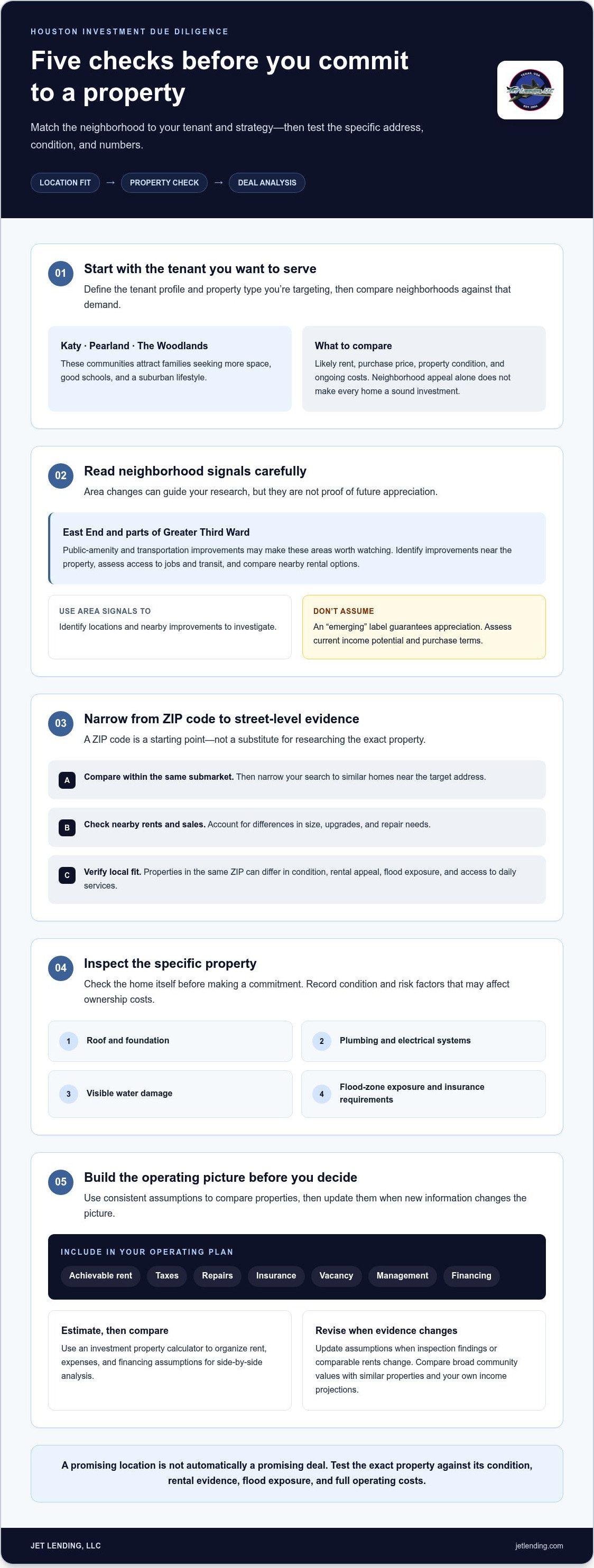
Inspect the property before making an offer. Review the roof, foundation, plumbing, electrical systems, and any signs of water damage. Check the property’s flood-zone status and insurance requirements, since these can affect risk and operating costs. Compare nearby rental rates and recent comparable sales. A Houston rental that looks attractive at first may be less compelling once you account for repairs, insurance, taxes, and achievable rent.
Use a written lease that clearly covers rent, term, deposits, maintenance, and notice procedures. Follow applicable Texas landlord-tenant requirements and the required legal process before pursuing an eviction. Include lease administration and possible vacancy in your operating plan rather than treating rent as guaranteed income.
Property taxes are a recurring ownership expense that reduces cash flow. Use the property’s assessed value and applicable tax bills to estimate annual costs. Add taxes to insurance, repairs, management, and debt payments to see how much rental income may remain. Revisit the estimate when the assessed value or operating costs change.
Calculate cash flow by subtracting operating expenses and debt service from collected rent. To calculate cap rate, divide net operating income by the purchase price. Estimate ROI by comparing annual net income and any realized gain with your invested cash. An investment property calculator can organize these inputs and help you compare scenarios before making an offer.
Listings illustrate how property types and asking prices vary across Houston. Treat each listing as a starting point, then compare condition, neighborhood rents, repair needs, taxes, and insurance before assessing its investment potential.
Start with the tenant profile you want to serve, then compare neighborhoods against that demand. Katy, Pearland, and The Woodlands attract families seeking more space, good schools, and a suburban lifestyle. That may support interest in residential properties, but it does not make every home a sound investment. Compare likely rent, purchase price, condition, and ongoing costs for each property.
Houston’s East End and parts of Greater Third Ward are seeing public-amenity and transportation improvements. These changes may make an area worth watching, but property-level due diligence still matters. Identify improvements near the property, assess access to jobs and transit, and compare nearby rental options. Do not treat an “emerging” label as proof of future appreciation. Evaluate current income potential and purchase terms instead.
Use ZIP codes as a starting point, not a substitute for street-level research. Properties in the same ZIP code can differ in condition, rental appeal, flood exposure, and access to daily services. Compare properties within the same submarket, then narrow your search to similar homes near the target address. Review comparable rents and sales, accounting for differences in size, upgrades, and repair needs.
Home values across Houston-area communities show why submarket analysis matters. These figures describe broad differences between locations, not the value or investment performance of an individual home. Compare each asking price with similar properties and your own income projections.
Use a consistent due-diligence process before committing:
Compare the results across neighborhoods. An investment property calculator can organize rent, expenses, and financing assumptions for side-by-side analysis. Use consistent assumptions for each property, then revise them when inspection findings or comparable rents change. This disciplined approach helps distinguish a promising location from a promising deal and focus your search on properties that fit your portfolio goals.
Houston offers several ways to invest in real estate, each with different responsibilities. A single-family rental gives you direct control, but you handle upkeep and tenant needs. Multifamily properties can spread rental income across units, while adding operational complexity. Compare expected rent, operating costs, financing, and the time you can devote to management before choosing.
Commercial property can broaden a portfolio beyond housing. Houston’s economy is diversifying beyond oil and gas, and technology parks and medical campuses, including the Texas Medical Center, are potential areas to study. Hybrid work also creates demand for flexible office solutions. Evaluate location, tenant mix, lease terms, and vacancy risk instead of assuming nearby development guarantees demand.
Real estate investment trusts, or REITs, provide real estate exposure without requiring you to manage a Houston property directly. A REIT holds or finances income-producing real estate, and investors buy shares rather than manage tenants. This can make diversification easier, though you have less control over individual assets. Compare a REIT’s property focus, fees, and performance information with your goals.
Short-term rentals may suit locations with visitor demand, but frequent turnover changes the workload. Bookings can mean more cleaning, communication, furnishing, and maintenance than a long-term lease. Houston investors considering this model should review local regulations before purchasing. Confirm which rules and permits apply to the property’s location and intended use, then include compliance tasks in your operating plan.
Screen tenants consistently, using relevant criteria such as income, rental history, references, and credit information. A general screening benchmark is income of at least three times the monthly rent. Apply the same standards to every applicant. The Fair Housing Act of 1968 bars housing decisions based on race, color, religion, sex, disability, familial status, or national origin.
Houston’s rental options include single-family homes, multifamily units, commercial spaces, and short-term stays. To diversify, first decide what role each investment should play, such as providing rental income or exposure to commercial real estate. Compare property-level costs and management demands, then add an asset only when its risks and workload fit your existing portfolio.
For a long-term rental, estimate income after operating expenses and debt payments. For commercial property, examine lease structure and tenant concentration. For a REIT, review its holdings and share-based exposure. For short-term rentals, account for operating requirements and local rules. These checks help you compare opportunities on more than headline rent or projected appreciation.
Choose a strategy that fits your capital, timeline, and preferred workload. Buy-and-hold focuses on rental income and long-term ownership, while fix-and-flip involves purchasing, improving, and reselling a property. House hacking combines living in a property with renting part of it. BRRRR links buying, renovating, renting, refinancing, and repeating. Each approach requires a different kind of deal analysis.
For buy-and-hold, assess rent against recurring expenses and debt payments before purchasing. In Houston, compare similar rental properties in the same submarket, then account for taxes, insurance, repairs, and vacancy. Check the roof, foundation, and major systems during inspection. A property with steady tenant appeal may suit a long-term plan, but cash flow still depends on purchase terms and operating costs.
A fix-and-flip starts with a clear scope of work. Before buying, list required repairs, estimate construction costs, and identify improvements that support resale appeal. Separate essential work, such as correcting a system defect, from optional upgrades. Compare expected resale value with purchase, renovation, holding, and selling costs. Delays or unexpected repairs can reduce the margin, so include a practical timeline and contingency in your decision.
House hacking can reduce personal housing costs by renting part of a property you occupy. A Houston investor might live in one unit of a multifamily property and rent the others, or rent spare rooms in a suitable home. Assess privacy, maintenance, tenant communication, and layout before committing. Keep personal and rental expenses organized, and confirm the financing terms allow your intended use.
BRRRR requires a connected plan for acquisition, renovation, leasing, and refinancing. First, find a property whose condition and purchase terms support the renovation plan. Document construction needs and track spending. Then assess whether achievable rent can cover operating costs and debt. Before relying on refinancing, understand how the lender will evaluate the improved property and your repayment capacity. The strategy can recycle capital, but depends on execution at each stage.
Match the approach to your skills and available time. A hands-on investor may prefer a fix-and-flip or house hack, while a buy-and-hold investor may prioritize stable operations. BRRRR requires coordination among renovation work, leasing, and financing. For each Houston opportunity, compare the required cash, likely workload, exit plan, and downside exposure. Choose the model you can manage, not just the one with the most appealing projected return.
A strong Houston investment team helps turn property research into clear decisions. Start with the roles your strategy requires: a real estate agent for local market context, an inspector to assess property condition, and a property manager for rental operations. Add a lender who understands investment-property financing and a licensed tax professional for tax advice tailored to your circumstances. Your team can grow as your portfolio and workload expand.
Choose professionals who explain their reasoning using property-level details. Ask an agent to compare similar Houston sales by condition, upgrades, and location. Ask an inspector to distinguish urgent repairs from routine maintenance. A property manager can explain how tenant turnover, leasing, and upkeep affect a rental’s operating plan. Clear explanations make it easier to compare advice and identify assumptions to revisit.
Coordinate communication around each deal’s decision points. Share the property address, intended strategy, expected rent, and inspection findings with the relevant team members. Have the lender review financing terms before you commit, and give the tax professional the property’s income and expense assumptions. This sequence can surface mismatches early, such as renovation plans that do not fit the financing timeline or projected income that overlooks operating costs.
Keep the team connected without adding unnecessary complexity. Use a shared checklist for each property to track open questions, responsible people, and next steps. For a Houston fix-and-flip, the agent can inform resale assumptions, the inspector can identify repair priorities, and the lender can explain financing requirements. Bring those perspectives together before finalizing the offer and renovation plan.
Local relationships can also help you stay informed. Attend Houston real estate events, join investment groups, and network with professionals who understand the neighborhoods and property types you are considering. Use these conversations to learn how people evaluate deals, not as a substitute for property-specific analysis. A useful contact might suggest a market question to investigate or a professional resource to add as your portfolio expands into new strategies.
Review your team as your portfolio changes. A first rental may need support with acquisition, inspection, and tenant operations. A growing portfolio may require more consistent bookkeeping, property oversight, and tax planning. Record who handles each task, which decisions need your approval, and what information each person needs. A clear process helps you manage several properties without losing track of deal assumptions.
Use an investment property calculator to organize deal assumptions before discussing a property with your team.
Jet Lending, LLC offers short-term loans for real estate investors assessing an acquisition or renovation. Consider short-term financing when it fits your project and investment plan. Review repayment terms alongside expected rental income, renovation costs, timeline, and exit strategy before moving forward.
Use the Investment Property Calculator to organize deal assumptions and assess a property’s potential. Compare projected income with expenses and financing obligations before deciding whether the numbers support your goals. A clear analysis can help you discuss the opportunity and its financing needs with greater confidence.
Contact Jet Lending, LLC to discuss short-term financing for your Houston real estate investment.
Set a decision framework for your next Houston investment before you begin searching. Write down the property features you want, the costs you are prepared to manage, and the conditions that would make you walk away. Keep brief notes on each opportunity you review. Over time, these records can show whether your choices still support your goals or your approach needs adjusting.
Building a real estate investment portfolio in Houston means making informed decisions one property at a time. You do not need to pursue every opportunity. Focus on investments that fit your plan, understand the numbers, and move forward with a team that helps you act with clarity.
Set a thoughtful pace, stay grounded in your goals, and keep building toward the portfolio you want.
Houston can suit investors seeking rental income, appreciation potential, and varied property types. Multifamily demand has been supported by population growth and affordability pressures in single-family housing, while economic diversification creates commercial-property opportunities. One market illustration compares monthly rent of $1,940 with a $940 monthly mortgage payment, producing $12,000 in annual gross profit before taxes and property expenses. Treat that as a screening example, not net profit. Careful analysis supports building a real estate investment portfolio in Houston.
Houston home prices and rents vary by submarket, property type, and condition, so compare similar properties instead of relying on a citywide figure. These are home values, not rent estimates or guaranteed current asking prices. For rental projections, compare similar homes by bedroom count, location, and condition, then account for vacancy and operating expenses.
No neighborhood fits every strategy. Compare tenant demand with acquisition and operating costs. A family-focused rental may warrant studying Katy, Pearland, or The Woodlands, while investors interested in areas with public-amenity and transportation improvements might examine Houston’s East End or parts of Greater Third Ward. Compare achievable rent, nearby employment and services, property condition, and purchase terms. Favor the specific deal whose numbers match your goals, not a neighborhood label.
Flood exposure and storm damage can add insurance costs, repair needs, and potential rental interruptions. Before purchasing, review the property’s flood-zone status and water history, inspect drainage and visible moisture, and understand the insurance terms for that address. Include premiums, deductibles, repairs, and possible vacancy in your operating model. Nearby Houston properties can have different exposures, so assess each parcel rather than assuming risk is uniform across a neighborhood.
Down payment requirements depend on the loan structure, property, and underwriting. Down payment requirements for investment-property mortgages can vary depending on the loan and borrower. Investors can compare mortgage financing with asset-backed short-term loans for investment purchases or rehabilitation. Review repayment terms, collateral, timeline, and your exit plan together. An Investment Property Calculator can help organize projected income, expenses, and financing assumptions before you select an approach.
Evaluate the deal in sequence: compare similar properties, inspect the home, estimate needed work, then update your projections. Ask the inspector to distinguish urgent defects from planned improvements, and obtain estimates for major repairs before finalizing your offer. For a renovation, connect each construction task to a timeline and a resale or rental plan. Recalculate income after inspection findings, since repairs can change both cash requirements and the property’s intended use.
Choose based on your operating capacity and preferred income model. Long-term rentals generally involve longer tenant relationships; short-term stays require more frequent turnover and coordination. Multifamily properties can spread rental income across units, but bring property-wide management responsibilities. For example, an eight-bedroom Houston multifamily listing can prompt analysis of unit layout, achievable rents, and maintenance needs. Short-term rental investors should also review applicable local rules before buying.
Plan for vacancy, repairs, insurance, property taxes, management, financing payments, and unexpected construction needs. Houston investors should also consider flood exposure and how repair work could affect rental availability. Keep operating reserves separate from funds set aside for acquisition or renovation, and update projections when expenses or rents change. Mortgage interest, depreciation, insurance, repairs, and operating expenses may be deductible, subject to applicable tax rules. A licensed tax professional can advise on your situation.
Tags:

What if you could make a strong Houston offer without waiting for a bank’s full approval process? For investors competing with cash buyers, bridge loans for real estate investors Houston can provide...

What if the financing that helps you secure a Houston investment also puts pressure on your exit plan? A short-term loan can support an acquisition or rehabilitation project, but the fit depends on...

A long-term rental loan may be the wrong first move for a Cypress property that needs work. The right investment property financing Cypress TX investors pursue depends on the deal’s timeline and...