
Written By: Stephanie Rojas | September 28, 2026
Time to Read 12 Minutes
The framing crew is ready to start, but the next funding request depends on showing what’s complete and how the project budget is being used. A construction loan draw schedule template can help connect that work to planned funding requests before missing information disrupts cash flow.
If you’re unsure how to divide project costs into lender-ready draws, start by matching each request to approved budget items, completed work, and the records your lender asks for. Missing invoices, progress photos, or inspection details can slow a review and leave contractors waiting.
This guide shows you how to build a practical schedule that connects milestones, costs, documentation, and lender review. You’ll learn how to organize a schedule of values, plan draw timing around project progress and payment needs, and prepare evidence for each request. Use the template as a starting point, then confirm lender-specific requirements before work begins. A clear schedule also gives you a more useful way to discuss project readiness, funding timing, and deal analysis, whatever financing structure you use.
A construction draw schedule lays out planned funding requests in sequence. It connects each request to project progress and costs approved for the loan. Rather than treating funding as one general pool, it helps you identify when money may be needed, which work or costs support a request, and what the lender may need to review.
Think of it as a coordination tool. Contractors can compare upcoming work and payment needs with planned draws. You can prepare supporting records and track cash flow, while the lender can compare each request with the approved budget, completed work, and its review process. For projects organized around completed stages, this approach is related to milestone-based funding.
A draw schedule is different from a construction timeline, contractor invoice, or project budget. The timeline shows when work is expected. An invoice requests payment for specific goods or services. The budget organizes estimated project costs. The schedule connects these pieces by showing which costs and project progress relate to each planned funding request.
A schedule can help organize ground-up construction, major rehabilitation, or an investment project completed in phases. For example, you might list foundation work, framing, and interior completion as separate planned requests, then note the evidence needed for each stage. This makes upcoming cash needs easier to anticipate and discuss with contractors.
Milestones aren’t automatically the right fit. The project scope, approved budget, and lender’s requirements determine whether funding should follow completed phases, eligible costs, or another structure. Before relying on the schedule, check that planned timing fits contractor payment obligations and material needs.
A construction loan draw schedule template organizes planned requests. It doesn’t approve funding or replace the loan agreement. Treat dates, amounts, milestones, and evidence fields as planning assumptions until the lender confirms what applies. The loan documents and lender’s process determine how requests are reviewed and which supporting records are required.
Keep proposed details separate from approved terms. If your draft assumes a request follows framing, confirm that the lender accepts that milestone and the evidence you plan to provide. A well-prepared schedule helps you ask clearer questions before work starts, but it can’t guarantee approval or funding on a particular date.
A useful schedule connects each funding request to a specific budget line, completed or upcoming work, and the records that support it. Keep dates and amounts specific to your project. The blank fields below are placeholders, not standard figures, required draw counts, or lender-approved terms.
Copy the table into a spreadsheet or document, then adjust the columns to match your approved budget and the lender’s forms. Add or remove rows to fit your project.
| Draw # | Phase | Planned date | Budget category | Milestone | Evidence | Scheduled amount | Prior funding | Remaining budget | Request date | Status | Notes |
|---|---|---|---|---|---|---|---|---|---|---|---|
| [Project-specific] | [Phase] | [Planned date] | [Approved budget line] | [Work or cost milestone] | [Records to confirm] | [Project-specific amount] | [Project-specific amount] | [Project-specific amount] | [Request date] | [Status] | [Notes] |
| [Project-specific] | [Phase] | [Planned date] | [Approved budget line] | [Work or cost milestone] | [Records to confirm] | [Project-specific amount] | [Project-specific amount] | [Project-specific amount] | [Request date] | [Status] | [Notes] |
For the evidence field, list relevant items such as invoices, inspection records, progress photos, or lien waivers, as applicable. Use consistent status labels, such as “planned,” “submitted,” “under review,” or “approved.” Record follow-up questions and missing documents in the notes so they’re easy to track.
Make each row traceable. A work-based request should identify the related budget category and milestone. An invoice-based request should point to the contractor or supplier invoice. Also record who prepares and submits the request, who reviews the supporting materials, and who confirms project status. Those responsibilities may differ by project and lender.
Ask the lender which records it requires and how it wants them organized. Confirm whether inspections or lien waivers apply, and check local documentation questions with the lender and qualified local professionals. Don’t assume a checklist from another project applies to yours.
Before using the construction loan draw schedule template, compare its categories with the approved budget and the lender’s required forms. For broader investment deal analysis, explore Jet Lending’s real estate investment resources.
A construction loan draw schedule template can organize funding around completed phases, eligible costs, or a combination of both. The right fit depends on how your project is budgeted and documented, but the lender may require a specific format. Confirm the required structure before you build your schedule around it.
| Consideration | Milestone-based tracking | Cost-based tracking |
|---|---|---|
| Organized by | Defined stages of project progress | Approved budget categories or invoices |
| Progress visibility | Shows whether a described phase is complete | Shows which costs have been incurred or invoiced |
| Documentation focus | Evidence that supports milestone completion | Invoices and records tied to budget line items |
| Potential challenge | A delayed or changed phase can disrupt planned timing | Tracking numerous small costs can add administrative work |
Milestone tracking can work well when a project has clear phases and progress is easy to describe. “Framing complete” is more useful than a vague label such as “construction progress.” Define what completion means and what evidence will demonstrate it, then confirm that the lender accepts the milestone. If work is delayed or the scope changes, update the schedule and coordinate the revision with the lender.
Cost-based tracking links requests to approved categories or specific invoices. It can help you compare spending with the budget, especially when work spans project phases. The trade-off is additional paperwork: a project with many smaller purchases or invoices may take more effort to organize. Ask the lender how to document mixed costs, changed line items, and partially completed work.
Neither approach is automatically simpler or more reliable. Milestones can make progress easier to scan, while cost categories provide a closer view of spending. Some projects may benefit from combining the two, such as recording the project phase alongside its associated budget items. Use a hybrid format only if the lender’s process allows it.
Before choosing, compare the project scope, contractor billing practices, and the records you can consistently provide. Ask the lender:
For a Houston project, don’t assume local documentation or inspection practices determine the lender’s draw format. Confirm project-specific expectations with the lender and qualified local professionals. The loan agreement and lender’s process remain the guide.
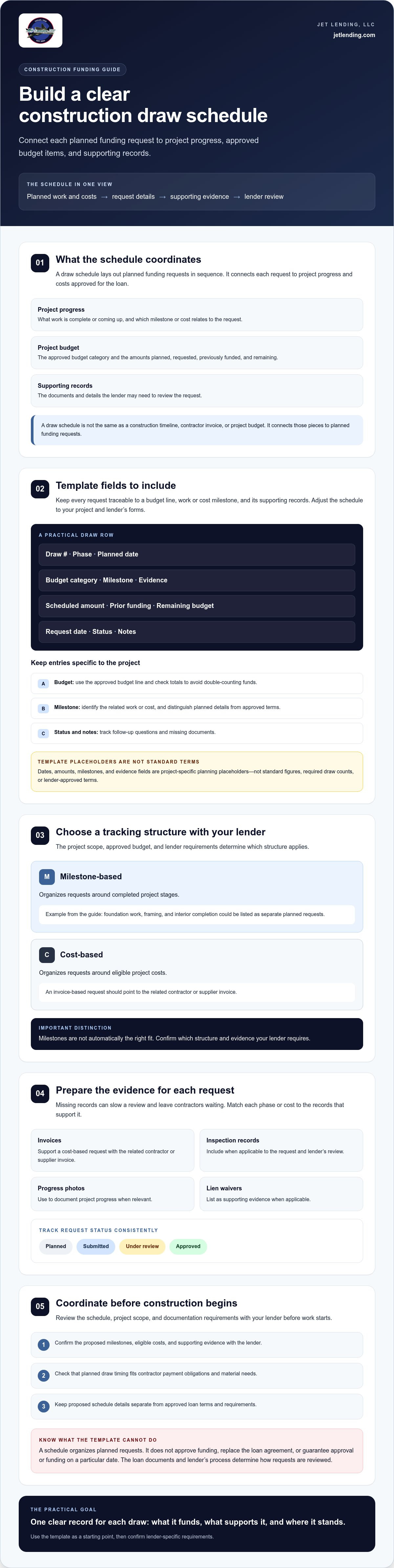
Turn the blank schedule into a working control sheet before construction begins. Build it from the approved project budget and scope, then check the lender’s forms and process. A construction loan draw schedule template should reflect your actual funding terms, not a generic percentage split.
Before the first request, confirm which lender forms to use, how inspections are handled, where to submit documents, and how much review time to plan for. Ask how changes to scope, costs, or timing are handled. For a Houston-area project, check which permits and inspections apply with the relevant local authorities. Requirements may vary by property and type of work.
Compare each request with the work completed and the budget allocation. Match the amount to invoices and progress evidence, and include inspection documentation if required. Keep records together by draw or budget item so the reviewer can see which document supports each cost.
Reconcile the schedule with each request. Update prior funding with amounts already disbursed, record the current request separately, and recalculate what remains in each approved category. Don’t count an earlier payment again as part of the new request, and don’t treat a submitted request as funded until its status is confirmed. If a cost shifts between categories, document the change and ask the lender how to handle it before updating the totals.
For broader project feasibility context, review this fix and flip deal analysis guide alongside your budget and projected cash needs.
For information about Jet Lending’s short-term, asset-backed financing for real estate investment projects, visit Jet Lending.
A construction loan draw schedule template is a planning aid, not a substitute for confirming the lender’s process. Before work starts, review the schedule alongside the approved budget, project scope, and evidence requirements. Funding availability, inspections, required documents, and review timing depend on the terms and procedures for your specific loan.
Clarify the draw process before contractor payments depend on it. Ask your lender:
Keep the answers with your project records and update your schedule if the lender confirms a change. For Houston-area work, check applicable permits and inspections with the relevant local authorities. Requirements can depend on the property and scope, so confirm what applies to your project rather than relying on a general template.
The draw plan is one part of the investment picture. Review acquisition assumptions, rehabilitation costs, carrying costs, and the projected exit together. If the timing or amount of funding changes, consider how that could affect cash needs and project feasibility. For local financing context, see the Houston hard money lending guide.
Jet Lending provides short-term, asset-backed financing for real estate investment projects in Texas, including for investors in Houston. That doesn’t mean every project or construction plan fits its financing options, so confirm construction-specific eligibility and terms directly. Jet Lending’s investment property calculator can support deal analysis, but it doesn’t approve financing or set loan terms.
Bring your project scope, budget, and draw plan to any lender conversation. An organized plan helps you discuss funding needs and project readiness without treating a template as approval.
A well-built construction loan draw schedule template gives you a practical way to connect project milestones, approved budget items, funding requests, and supporting records. Customize the fields to your project, then confirm the schedule, documentation, and review process with your lender before work begins. The lender’s terms and requirements take priority over any sample template.
Keep the schedule connected to the wider investment plan. Review project costs and timing alongside your expected exit assumptions so you can discuss funding needs with a clearer view of feasibility. Jet Lending is a Texas-based, privately held provider of asset-backed financing for real estate investment projects. Its investment property calculator can help investors analyze a deal, but it doesn’t approve loan terms or determine whether construction-specific financing is available. Confirm fit directly.
With a clear plan and open lender communication, you’ll be better prepared to manage project funding and move your investment forward.
A construction loan draw schedule is a planning document that organizes expected funding requests around project phases, approved budget items, or documented costs. Each request should connect to completed work or another condition the lender has approved. The schedule can help you anticipate cash needs and organize records, but it doesn’t set the approval rules. Your signed loan documents and lender instructions determine the actual process.
A construction loan draw schedule template should include the draw number, project phase, milestone, budget category, planned and actual dates, requested amount, prior funding, remaining allocation, supporting evidence, and status. You can also add notes and identify who is responsible for submitting or reviewing each request. Match the fields to your approved budget and lender forms. Document requirements, draw order, and the number of requests vary by lender.
There’s no single draw count that fits every construction project. The number and timing depend on the lender’s process, approved budget, project scope, construction phases, and documentation requirements. Ask your lender how it wants work grouped and whether inspections or other evidence are needed. For a Houston project, build your schedule around confirmed instructions rather than copying a draw plan from a different property or financing arrangement.
Yes, a generic template can be a useful starting point if you adapt it to your project budget and lender’s requirements. It can’t replace required lender forms or the loan agreement. Before relying on it, confirm approved budget items, supporting evidence, inspection steps, submission procedures, and how changes are handled. Keep dated copies of revisions so contractors and project partners can identify the current schedule.
Required documents vary by lender and project. A draw request may call for invoices, evidence of completed work, progress photos, inspection records, or lien-related documents, but don’t assume every item applies. Ask your lender for its current checklist, and consult qualified local professionals about project-specific documentation. For easier review and follow-up, organize files by draw number and budget category, and label each item clearly.
Calculate a draw using the lender-approved budget and the costs or milestones eligible for that request. Before submitting, reconcile prior funding, current documented costs, and the remaining allocation. Don’t substitute a generic percentage for the loan terms or lender’s calculation method. If the amount depends on an inspection, approval, or another condition, confirm the steps with your lender before planning around those funds.
Draw requirements are generally set by the lender and loan documents, while permits and inspections depend on the project and applicable local rules. For a Houston-area property, confirm current permit and inspection requirements with the relevant local authority and qualified project professionals. Ask the lender which local approvals or inspection records it needs for a request. A generic template can help organize the plan, but it can’t confirm local requirements.
Jet Lending provides short-term, asset-backed financing for real estate investment purposes in Texas, including for investors in Houston. Whether a specific construction project fits its current financing options depends on the project and lender review, so confirm directly rather than assuming a construction draw product is available. Jet Lending doesn’t provide owner-occupied residential mortgages or unsecured personal loans. Its investment property calculator can help investors evaluate a deal, but it doesn’t approve loan terms.
Tags:

The biggest bottleneck on a spec build isn't sourcing materials; it's waiting months for a bank committee to approve your deal. Securing reliable new construction financing for investors Houston...

Why are some Houston developers breaking ground on their third project this year while you're still waiting for a bank callback on your first? You've likely felt the sting of a lost deal because a...

You found a prime lot in a surging Houston neighborhood, but while you're digging through old tax returns for a bank, your competitor is already pouring concrete. It's a common frustration in the...