
Written By: Stephanie Rojas | August 10, 2026
Time to Read 12 Minutes
You found a prime lot in a surging Houston neighborhood, but while you're digging through old tax returns for a bank, your competitor is already pouring concrete. It's a common frustration in the 2026 market where traditional red tape often moves slower than the pace of local growth. You know that securing a ground up construction loan shouldn't feel like a second job, especially when your project's value speaks for itself. Managing cash flow during the early phases of a build is hard enough without waiting months for a committee to review your personal income history.
This guide shows you how to leverage asset-based financing to skip the restrictive documentation hurdles and fund your next build with speed. You'll learn how these loans compare to traditional debt and how to use them to scale your pipeline across the city. We'll break down the specific requirements for 2026, from NMLS compliance to Houston's tiered permit fees, so you can get funded and get to work. It's time to stop acting like a bookkeeper and start acting like the developer you are.
A ground up construction loan is a short-term, asset-backed vehicle designed to fund every phase of a new build from the dirt up. It's the financial engine for investors who want to transform a vacant lot into a high-value asset. Unlike a rehab loan that focuses on fixing an existing structure, ground-up financing covers the entire journey. You get capital for site clearing, foundation work, framing, and every other milestone until you receive the final certificate of occupancy. It's a comprehensive tool for builders who need to move faster than a traditional bank allows.
Asset-based lenders prioritize the project's potential over your personal debt-to-income ratio. This approach is rooted in understanding project finance; the loan is primarily secured by the project itself and its projected future value. This allows you to skip the mountain of paperwork required by institutional lenders. You won't need to provide years of tax returns or W-2s to prove you can handle the debt. Instead, the lender acts as a partner, evaluating the After-Repair Value (ARV) and the feasibility of your build plan to ensure the deal makes sense for everyone involved.
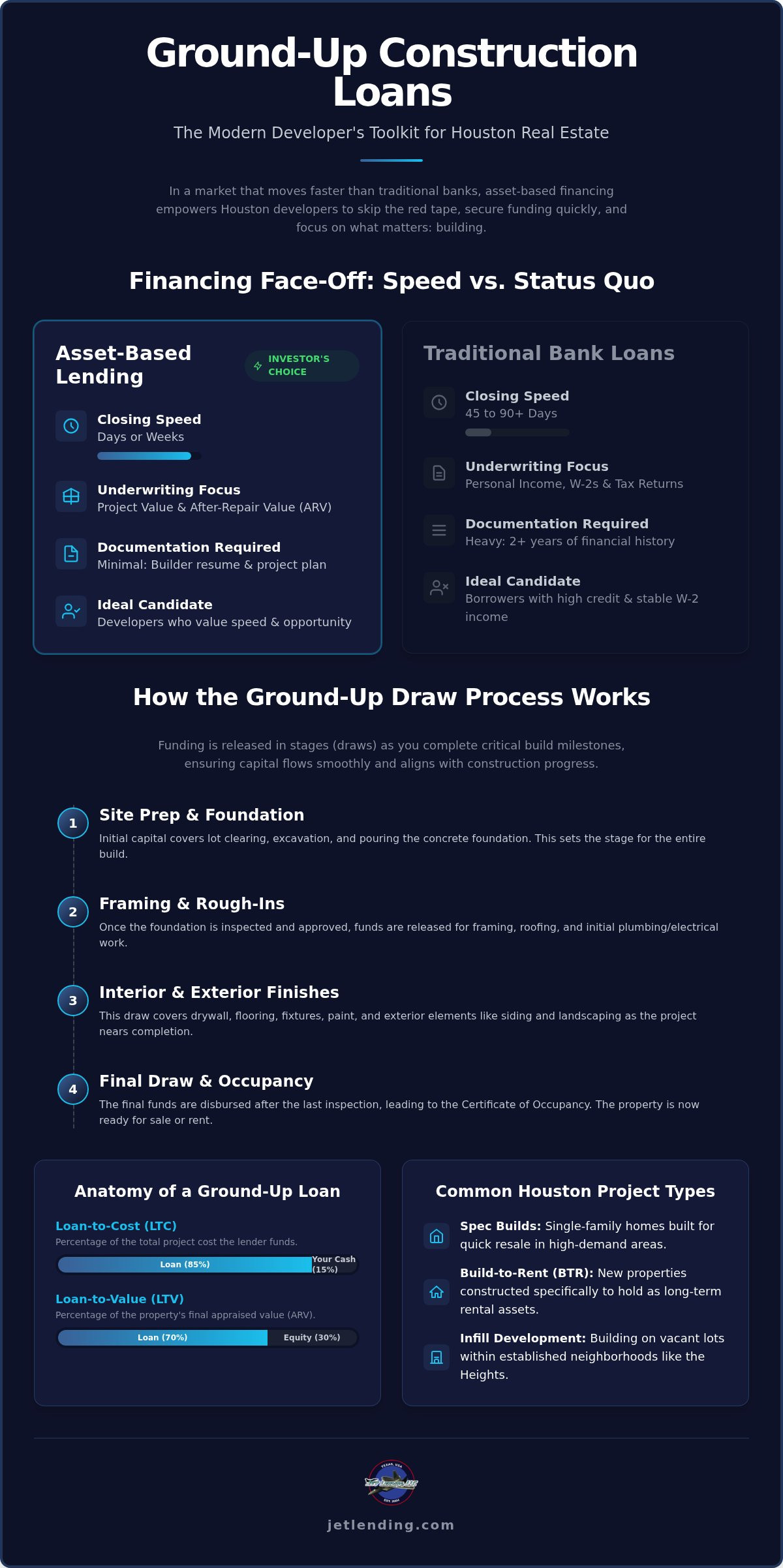
Success in development starts with knowing your numbers. The Loan-to-Cost (LTC) tells you exactly how much of the total build budget the lender will provide, which helps you calculate your required "skin in the game." Meanwhile, the Loan-to-Value (LTV) is based on the final appraised value of the home once it's finished. Most professional investors prefer interest-only payments during the construction phase. This keeps your monthly overhead low and protects your cash flow while you're focused on hitting your build milestones. You only pay interest on the funds you've actually drawn, making it an efficient way to manage a project's capital throughout the year.
Choosing your capital source is the most critical decision you'll make before breaking ground. While traditional banks offer lower interest rates, they often come with a hidden "time tax" that can kill your deal flow. Understanding how construction loans work through an institutional lender involves a 45 to 90-day underwriting process. In a fast-moving market like Houston, that's an eternity. Asset-based lenders focus on speed, often closing a ground up construction loan in just days or weeks. Specialized firms like JGL Capital LLC prioritize the project's profitability, using Broker Price Opinions (BPOs) instead of your last two years of personal tax returns.
Experience matters more than a perfect credit score in the private lending world. Banks are rigid; they want a W-2 and a near-perfect score. Private lenders want to see your builder resume or the track record of your general contractor. This shift in focus allows you to scale your build pipeline without hitting a debt-to-income ceiling. It's about looking at the asset's potential rather than just your personal history. If you're looking for a team that values your vision, explore hard money loans Houston to see how private capital can accelerate your timeline.
Institutional lenders view vacant land and spec builds as high-risk assets. Their underwriting is built for stability, not the agility required for modern development. This often leads to heavy personal recourse, meaning your personal assets are on the line if the market shifts. The opportunity cost is the real killer here. While you're waiting for a bank committee to approve your application, a competitor with faster financing has already secured the lot. Banks act as gatekeepers, but in 2026, you need a partner who can keep up with the NMLS-regulated speed of the Texas market.
Private capital offers a partnership mentality that banks simply can't match. When you utilize hard money loans Houston, you're working with experts who know local neighborhoods and current material costs. The draw process is streamlined. You won't be left hanging when a sub-contractor needs payment to keep the job moving. This efficiency allows you to fund multiple builds simultaneously, turning your capital over faster and increasing your annual ROI. It's about moving with the speed of the Houston market, not the speed of a bank's back office.
The draw process is the heartbeat of your construction project. It's the mechanism that moves capital from the lender into your build as you hit specific goals. When you secure a ground up construction loan, you aren't handed a lump sum of cash on day one. Instead, you follow a pre-negotiated draw schedule. This schedule acts as a roadmap, identifying critical milestones like foundation completion, framing, and the "dried-in" stage. This structure keeps the project moving forward while ensuring the funds are used exactly where they add the most value.
Most asset-based lenders in the Houston market operate on a reimbursement basis. You complete a phase of work, pay your contractors, and then request a draw to replenish your capital. This cycle protects your liquidity and keeps your trades happy. To simplify your monthly overhead, you can often utilize an interest reserve. This is a dedicated portion of the loan set aside to cover monthly interest payments during the construction phase. It ensures you don't have to manage out-of-pocket debt service while your property is still under construction and not yet generating revenue.
Your funding journey starts with initial site prep. This first draw often reimburses the lot purchase or covers the costs of clearing and grading the land. As the structure rises, mid-build draws handle the complex "mechanical" phases, including plumbing, electrical, and HVAC installations. These are often the most capital-intensive parts of the build. The final release occurs once the city issues the certificate of occupancy. This signifies the project is complete and ready for its next phase, whether you plan to sell the asset or transition into a long-term rental loan.
Delays in funding can stall a job site and frustrate your crew. To keep the cash flowing, stay disciplined with your documentation. Collect paid invoices and lien waivers from every subcontractor as soon as their work is done. If your paperwork is ready, your lender can process your request without a hitch. Coordination is also vital. Your contractor must be in sync with the lender's inspection schedule so work is verified immediately upon completion. A draw request is the formal trigger for fund release following a successful site inspection. By staying proactive and organized, you ensure your project stays on track and your capital remains as active as your job site.
Qualifying for a ground up construction loan in the 2026 Houston market is less about your personal debt-to-income ratio and more about the strength of your project. Asset-based lenders want to see a profitable spread between your total build cost and the projected market value. While a bank might obsess over your W-2, a private lender looks at your liquidity and your ability to execute the plan. You'll need enough skin in the game to cover the initial phases, typically represented by your down payment on the land or your initial equity in the project. This ensures your interests are aligned with the lender's from day one.
The Houston Factor is a major part of the qualification process. Local lenders look for developers who understand the city's unique permitting and drainage requirements. As of 2026, Houston building permit fees are based on square footage tiers. A plan review for a new construction project now costs 65% of the building permit fee. Proving you have accounted for these specific costs in your budget shows a level of professionalism that makes you a preferred borrower. It's about demonstrating that you aren't just a dreamer; you're a builder who knows the local terrain.
Experience is your primary currency in development. Most lenders prefer to see a builder resume that includes at least 2 to 3 completed builds or major renovations with budgets exceeding $200,000. If you're new to the industry, your general contractor's track record can bridge this gap. You must also provide a detailed budget. In the 2026 market, ballpark figures are a red flag. Lenders expect precise line items for materials, labor, and municipal fees. Finally, you need a clear exit strategy. Whether you plan to sell for a profit or transition into a long-term rental using the brrr method, your lender needs to know how they'll be repaid.
To speed up your approval, come to the table with a complete package. Having your architectural plans approved and permits in process shows the lender you're ready to break ground immediately. Formalize your relationship with your builder through a signed contractor agreement that outlines timelines and responsibilities. The loan amount will ultimately be driven by an as-completed appraisal. This valuation predicts what the property will be worth once the final certificate of occupancy is issued. Providing strong comparable sales from the immediate neighborhood helps the appraiser justify the value you need to fund your build.
Analyze your build's profitability now
Scaling a portfolio in a competitive market requires a lender that moves as fast as you do. Jet Lending, LLC has operated in Houston since 2004, offering the local expertise needed to navigate high-demand areas. When you're looking for a ground up construction loan, you need more than just a source of funds. You need a mentor who understands that time is money. We help you close quickly to beat out institutional buyers who are bogged down by committee-style decision-making. By focusing on project profitability over personal tax returns, we empower you to fund multiple builds simultaneously without hitting traditional debt-to-income caps.
Mentorship is a core part of the partnership we build with our clients. We don't just act as a gatekeeper; we act as a guide to help you refine your strategy. If your goal is to transition from a spec build to a long-term rental, we provide the flexibility to help you hold that asset and grow your equity. This build-to-rent strategy is a powerful way to scale in 2026. Having a lender like Jet Lending, LLC that understands the full lifecycle of the asset gives you a massive competitive advantage when bidding on prime Houston lots.
Success in development is won or lost during the analysis phase. You need to know your numbers before you commit to a lot. Our Investment Property Calculator is designed to help you stress-test your margins before you even make an offer. You can input your specific build costs, municipal fees, and projected exit price to see the real potential of a deal. This tool helps you identify the exact break-even point in your development timeline. The Jet Lending, LLC calculator helps investors avoid thin deals by accounting for all financing fees in one place.
Ready to move from planning to pouring concrete? Your next step is to consult with a mentor who can review your project's feasibility. We'll look at the spread between your construction costs and the market value to ensure the deal is solid. Getting a pre-approval letter is also essential. It makes your lot offers more competitive and tells sellers you have the backing of a reliable Houston lender. Don't wait for a bank to catch up with the pace of the city. Take control of your development future and start building today.
Success in the 2026 Houston market belongs to the developers who act with speed and precision. You now have the roadmap to skip the traditional bank hurdles and fund your vision using project-based value. Whether you're targeting infill lots in the Heights or scaling a build-to-rent portfolio, the right ground up construction loan acts as an accelerator for your business. It's about moving from the spreadsheet to the job site without the friction of personal income documentation.
Jet Lending, LLC has been a staple of the Houston investment community since 2004. We provide the asset-backed financing and expert tools, like our investment property calculator, that allow you to bid with confidence. Our team is here to act as your mentor, ensuring your next build is as profitable as it is professional. Don't let opportunity pass you by while waiting on a gatekeeper.
Your next project is ready for its foundation. Let's build something lasting together.
Most lenders look for at least 2 to 3 completed projects or major renovations with budgets over $200,000. If you don't have that personal resume yet, you can often qualify by partnering with an experienced general contractor. We focus on the entire team's ability to execute the project successfully. It's about ensuring the build moves from dirt to delivery without avoidable delays.
In 2026, residential construction loan interest rates in Texas generally range between 9% and 12%. Commercial projects typically see rates between 10% and 13%. These rates reflect the speed and flexibility of private capital compared to traditional institutional debt. Your specific rate will depend on your experience and the project's overall profitability.
Yes, owning the land is a major advantage that provides immediate equity for your project. We can often use that equity to satisfy your "skin in the game" requirements. This might even reduce the amount of cash you need to bring to the closing table. It's an efficient way to leverage your existing assets to fund a new build.
Yes, you'll typically need to cover 15% to 25% of the total project cost. This down payment ensures that both the lender and the developer are committed to the project's success. If you already own the lot, the value of that land often counts toward this requirement. We work with you to structure the deal so your capital is used as effectively as possible.
Approval for a ground up construction loan through an asset-based lender can happen in just a few days. While traditional banks often take 45 to 90 days, our local expertise allows us to move much faster. Once we review your budget and the property's potential value, we can issue a pre-approval letter to help you secure your lot quickly.
We recommend building a 10% to 15% contingency fund into your initial budget to handle unexpected costs. If you exceed that amount, you'll generally need to cover the difference out of pocket to keep the project moving. Staying in close communication with your lender helps you manage these shifts before they stall your job site or impact your timeline.
Absolutely, build-to-rent is a highly effective strategy for scaling a Houston portfolio in 2026. You use the construction loan to fund the build and then refinance into a long-term rental loan once you have a tenant. This allows you to create a brand-new asset with low maintenance costs and high equity from day one.
Most lenders reimburse the borrower after a successful site inspection verifies the work is complete. This ensures you maintain control over your job site and your subcontractor relationships. You pay the trades, and we replenish your capital so you can move to the next phase. Some lenders may offer direct payments to contractors only with specific written authorization.
Tags:

Why are you letting a traditional bank's 12-month pre-sale requirement kill your next Houston spec build before the first shovel hits the dirt? It's frustrating to watch prime lots in Cypress or Katy...

In the fast-moving 2026 Houston market, your property is your strongest financial credential, not your tax returns. You've likely felt the sting of watching a prime investment or a lucrative...

You found the perfect Houston fixer-upper, but your bank just sent a four-page list of documents they need before they even consider your application. In the time it takes a traditional lender to say...