
Written By: Stephanie Rojas | November 22, 2026
Time to Read 13 Minutes
The fastest sale isn’t always the best finish. Exit strategies for fix and flip investors usually mean selling the renovated property, refinancing and keeping it as a rental, or preparing a backup if the first choice is delayed. An exit strategy is your plan to repay the project loan and decide what happens to the property next.
It’s easy to focus on the expected sale price, but your timeline, carrying costs, rental potential, and investment goals matter too. A sale can free up cash for another project; refinancing may suit a property you want to hold if the numbers and financing align. Weigh both options before the project is complete so you have a plan for delays. This guide explains how to estimate sale proceeds, compare resale and refinance paths, and choose a primary exit with a practical fallback.
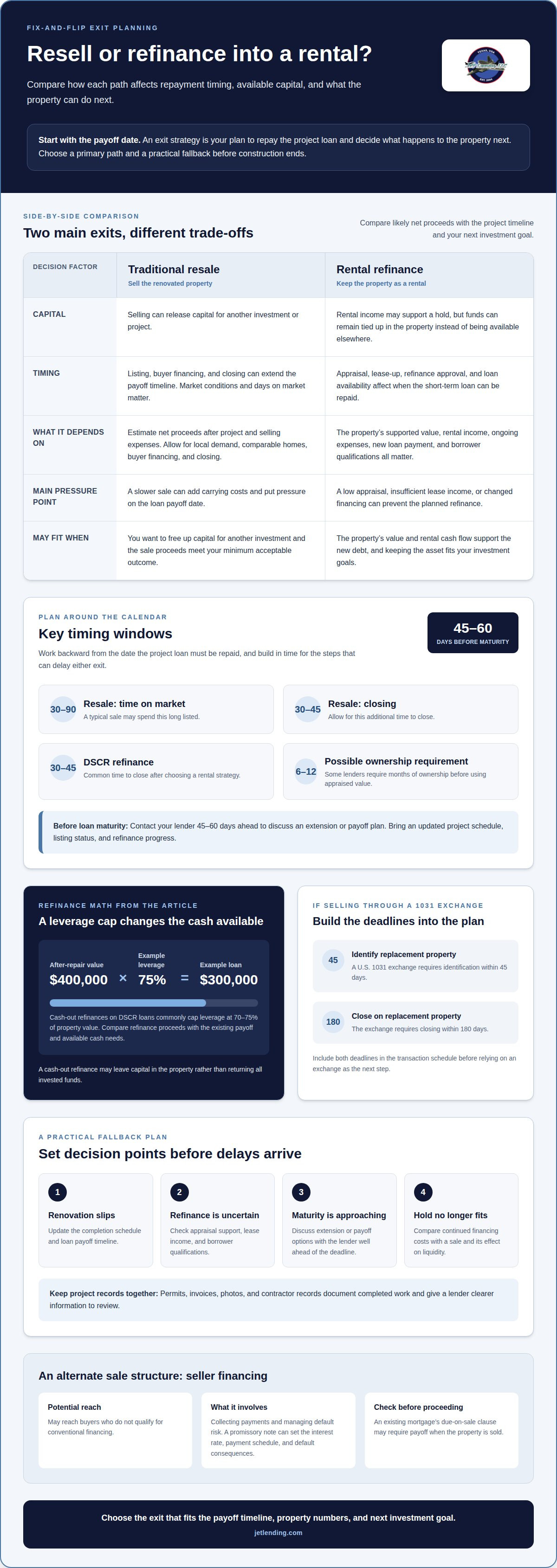
Start with the date your project loan must be repaid, then work backward. Selling, refinancing, or renting can each provide an exit, but they affect liquidity differently. Selling can release capital for another investment. Keeping the property may generate rental income, while tying up funds you could use elsewhere. Compare likely net proceeds with your project timeline and investment goals.
Local market conditions and days on market shape how long a resale may take. Listing, appraisal, buyer financing, and closing can all add time; a typical sale may spend 30-90 days on the market, followed by 30-45 days to close. If nearby demand softens or comparable homes take longer to sell, allow more time and carrying costs in your plan.
Bridge financing can fund a short-term project before a longer-term rental plan takes effect. Use it only with a defined repayment source, such as a completed sale or planned refinance. A refinance depends on appraisal support and loan availability. Some lenders require 6-12 months of ownership before using appraised value, so confirm that timing fits your loan maturity.
For a rental exit, compare expected monthly rental income with ongoing property expenses and the new loan payment. A finished property with reliable cash flow may support refinancing into longer-term financing, replacing a short-term rehab loan. But refinancing depends on the property’s value, lease income, and your qualifications. Keep a sale as a fallback if those factors don’t support the planned loan.
Build an extension decision into your timeline instead of waiting until maturity. Contact your lender 45-60 days before the loan matures to discuss an extension or payoff plan. Bring an updated project schedule, listing status, and refinance progress. These details help frame the request and reveal whether you need another repayment path before the deadline.
A 1031 exchange may suit an investor selling one investment property to acquire another. According to the Internal Revenue Service, a U.S. 1031 exchange requires investors to identify replacement property within 45 days and close on replacement property within 180 days. Include these deadlines in your transaction schedule before relying on an exchange as the next step.
With a traditional resale, the buyer arranges financing, but approval and closing still affect your payoff date. Seller financing may reach buyers who don’t qualify for conventional financing, but it also means collecting payments and managing default risk. A promissory note can set the interest rate, payment schedule, and default consequences. An existing mortgage’s due-on-sale clause may require payoff when the property is sold.
Before accepting seller financing, weigh the payment stream against the risk of buyer default, which may lead to foreclosure and eviction. For any bridge exit, identify the next repayment source first. The best fit depends on how quickly you need capital, whether rental income supports a hold, and how much timeline uncertainty your project can absorb.
Common exit strategies for fix-and-flip investors include selling, refinancing into a rental, or holding for rental income. Choose a primary route and a fallback before construction ends. If buyers hesitate, compare a revised listing plan with the income and financing requirements of a rental. If refinancing stalls, estimate how long you can keep the property financed while pursuing a sale or extension.
Build a delay plan around project milestones: renovation completion, appraisal, lease-up, refinance application, and loan maturity. A missed contractor deadline can delay the appraisal, while incomplete work may affect the property’s supported value. Keep permits, invoices, photos, and contractor records together. This file documents completed work and gives a lender clearer information to review the project.
For a rental refinance, check whether projected cash flow supports the new debt and ongoing property expenses. The appraisal, lease income, and borrower qualifications affect the outcome. A cash-out refinance may also leave capital in the property rather than returning all your invested funds. Compare expected proceeds with the debt to be repaid, then decide whether keeping the asset still fits your return goals.
Timing matters. A DSCR refinance commonly takes 30-45 days to close after choosing a rental strategy. Cash-out refinances on DSCR loans commonly cap leverage at 70-75% of property value. For example, a refinance at 75% leverage on a property with a $400,000 after-repair value produces a $300,000 loan. Compare that amount with the existing payoff and available cash needs.
BRRRR, or buy, rehab, rent, refinance, repeat, uses a cash-out refinance to pay off the original loan and potentially fund another property’s down payment. The plan works only if the finished property supports refinancing and rental income covers the new obligations. If the appraisal falls short or financing changes, keep selling as a genuine alternative, not just a last-minute reaction.
Set decision points before delays arrive. If renovation slips, update the completion and payoff timeline. If the refinance cannot meet the maturity date, discuss an extension or payoff plan with the lender well before then. If rent supports holding but refinancing does not, compare continued financing costs against a sale. An investment property calculator can help organize project assumptions for that comparison.
Refinancing makes financial sense when the property’s supported value and rental income can sustain the new loan, and keeping it advances your investment goals. Compare expected cash flow and refinance proceeds with the payoff, ongoing expenses, and capital you’ll leave invested. If those figures don’t support a hold, selling may protect liquidity and provide a clearer path to your next project.
Revisit your original numbers before setting a listing price. Compare the expected sale price with purchase costs, renovation spending, loan payments, carrying expenses, and selling costs. The sale price reflects what the market will pay, not your total investment. If comparable sales point below your original estimate, update the plan instead of treating the earlier projection as a target.
Estimate net proceeds by subtracting the loan payoff and sale expenses from the expected sale price. Then subtract your total project investment to estimate profit. A higher sale price can still produce weaker returns if extra months add interest, utilities, insurance, or taxes. Keep a separate record of each cost so a delayed finish doesn’t obscure the project’s actual margin.
For a U.S. sale, agent commissions and concessions commonly total 5-6%, while seller closing costs and transfer taxes typically total 1-2%. Add these selling expenses to your budget alongside loan payments and property carrying costs. The combined effect matters: a price that looks profitable before expenses may leave less equity available for the next purchase.
A typical fix-and-flip sale may take 30-90 days on the market, followed by 30-45 days to close. The timeline can stretch if listing activity, appraisal, buyer financing, or closing takes longer. Sale costs vary with the transaction, while holding expenses continue during the delay. Include both the expected selling expenses and the cost of additional time in your updated estimate.
Tax planning also belongs in the initial business plan. Account for potential capital gains tax when estimating what you can reinvest, and distinguish taxable profit from cash available after the lender’s payoff. According to the Internal Revenue Service, a 1031 exchange is a tax-deferred exchange of one investment property for another. It may fit an investor replacing one investment property with another, rather than taking sale proceeds for personal use.
Decide where sale proceeds will go before closing funds arrive. Reinvesting may support another project, while retaining some proceeds can preserve liquidity for unexpected costs. Compare the next property’s purchase price, repair plan, and projected resale value with the cash actually available. A faster purchase isn’t automatically a stronger move if it leaves too little capital for the work.
Before approving the final asking price, update comparable sales, calculate net proceeds, include the lender payoff, and test a longer holding period. If the revised figures no longer meet your minimum profit goal, consider whether a price adjustment or a different exit better protects your equity. This review keeps the original business plan useful without treating its first estimate as fixed.
A real estate exit strategy is the plan for ending a property investment and deciding how to recover your capital. With a traditional resale, you renovate the property and sell it, often with an agent’s help. The aim is to repay project debt, cover expenses, and realize any remaining profit. This route may suit a property that needs targeted improvements rather than a complete rehabilitation.
Start with current market value, not the amount you invested. Ask real estate agents to assess the finished property and suggest listing prices. Compare their assessments with recent sales of similar homes in the neighborhood. A dated kitchen may call for focused improvements, but overbuilding can reduce profit and slow your exit. Set a target price that reflects buyer demand and the property’s condition.
Before listing, prepare the home for buyers. Address visible defects, complete minor improvements, and consider staging to help buyers picture the space. Use clear photos and an accurate, compelling description across online listings, agent marketing, and social media. A polished living room and a clear feature list, for example, can make the property easier to evaluate during a showing.
Set a minimum acceptable offer before negotiations begin. Compare each offer’s price, financing terms, and proposed closing timeline with your payoff needs. In a traditional sale, the buyer obtains their own financing, so the offer price alone doesn’t determine how quickly the transaction closes. Even with a cash offer, confirm the buyer has funds before accepting.
Watch market response after the listing goes live. If there’s no serious offer after 21-30 days, consider reducing the asking price by 3-5%. That adjustment can help attract buyers, but weigh it against the expected net proceeds and your carrying costs. A seller’s market may support stronger pricing when demand is high; neighborhood-level conditions can differ from broader metro trends.
Use a simple sequence: review comparable sales, confirm the home’s condition, set the asking price, then track showings and offers. If buyers consistently raise the same concern, assess whether a practical improvement or price change would address it. A price that’s too high can deter buyers, while one set too low may leave value unrealized.
Traditional resale gives you a clear route to paying off the project loan and moving capital into another investment. Include the expected payoff, selling expenses, and tax considerations in your net-proceeds estimate. Capital gains can affect what remains available after closing, so include tax planning in your decision. The right listing strategy balances market value, buyer response, and the return you need from the project.
Choose the exit that advances your next financial goal, not simply the one that closes fastest. Selling can release capital for another project; holding can build recurring income and extend your portfolio. Compare the cash you need now with the work, expenses, and risk you’re prepared to carry forward.
If your goal is to recycle capital, resale may suit a renovated single-family home with active buyer demand. Estimate net proceeds, then consider whether the funds support your next investment property without draining reserves. If ongoing income is the priority, compare a rental’s expected cash flow with operating expenses and financing payments before choosing to hold.
Property type can guide your decision. A distressed single-family home may suit a quick resale, while a small multifamily property may fit a refinance-and-rental plan better. For a long-term hold, assess each unit’s rental potential and the property’s ability to cover expenses. A property that generates income only under optimistic assumptions may not support your broader portfolio plan.
Set a clear hold test before changing course. One approach is to evaluate whether projected rent covers the new loan payment and property expenses, while leaving room for vacancies and repairs. For a DSCR-based hold, a 1.1x or better coverage ratio at 70-75% leverage provides a useful test. Also consider whether the lender’s terms and your available reserves fit the planned holding period.
Time horizon matters. Multifamily investors commonly hold buy-and-hold properties for five to 10 years or longer. That period can suit investors seeking income and long-term ownership, but it also keeps capital tied to the asset. If your goal is retirement income, compare the sale proceeds with a low-risk, income-generating asset and consider how each option fits your retirement plan.
Consider portfolio concentration, too. Keeping a rental can strengthen recurring income, while reinvesting sale proceeds across different assets can spread exposure. Account for the full transaction: expected proceeds, remaining debt, future expenses, and the time you’ll devote to the property. Match the exit to your available capital and capacity to manage ongoing ownership.
Use a simple sequence: define your goal, identify the property’s strongest use, compare projected income or sale proceeds, then test the result against your reserves and next investment. If a rental supports your cash-flow target and holding period, refinancing may fit. If liquidity and a faster next purchase matter more, selling may better serve your plan.
Use an investment property calculator to organize deal assumptions as you compare possible goals.
Jet Lending offers Short-Term Loans for real estate investors and an Investment Property Calculator to support deal analysis. If your exit plan depends on completing renovations before a sale or rental refinance, a short-term loan may fit the project’s financing needs. Use the calculator to organize property assumptions and compare how expected sale proceeds or rental income may affect your plan. These tools can help you assess a transaction alongside its timeline, costs, and intended payoff strategy. Bring your project details and preferred exit to Jet Lending so the financing conversation stays connected to your investment goals.
Your next move starts before the next property closes. Decide what outcome matters most, then carry that goal into your deal analysis, financing plan, and timeline. A clear primary exit and workable backup can help you respond deliberately when buyer demand, project timing, or refinance terms shift.
Apply the same discipline to each opportunity. Compare the property’s likely use with your available capital and the time you can commit. The right exit strategies for fix and flip investors vary by project, so choose a plan that reflects the property and your investment goals.
Jet Lending’s Investment Property Calculator can help organize deal assumptions, and its Short-Term Loans support real estate investment projects. If you’re weighing financing alongside your exit plan, bring a clear picture of your project and goals to the conversation with Jet Lending.
Plan with purpose, stay flexible, and move into your next investment with greater clarity.
An exit strategy is the planned way to end or reposition a real estate investment. For a renovated house, that may mean selling, refinancing it as a rental, or keeping it for income. The choice affects when you recover capital, what debt remains, and how much time you’ll spend managing the property. Define your intended outcome before purchase, then revisit it as the project and market change.
Sell when likely net proceeds support your profit and liquidity goals better than holding. Consider refinancing when rental income can cover the new loan and property expenses, and you want to keep the asset. Compare both paths using updated figures, including payoff, expected sale proceeds, appraisal support, and lease income. In Houston, neighborhood-level sales and rental conditions can make the comparison more useful than broad metro trends.
For U.S. tax purposes, holding an investment property for more than 12 months can qualify a gain for long-term capital gains treatment. The holding period alone doesn’t determine your final tax outcome; the property’s use, transaction details, and your tax situation also matter. Include the possible tax effect when comparing a sale now with a longer hold. A tax professional can apply the rules to your specific transaction.
A sale can release capital and end day-to-day ownership, but final proceeds depend on buyer demand and transaction expenses. Refinancing can preserve ownership and create rental income, though it depends on appraisal support, loan terms, and cash flow. Renting without refinancing may extend income potential but leave existing debt in place. Compare each option’s control, liquidity, ongoing work, and exposure to changes in the property market.
Act before maturity, not after missing a payoff date. Give the lender a clear update on renovation status, listing activity, buyer progress, or refinance milestones, then discuss an extension or payoff arrangement. Prepare a backup repayment source, such as sale proceeds or another financing plan. Don’t assume a pending sale or refinance will close on time; base your plan on actual progress and the loan’s maturity terms.
Choose the exit that best fits your next financial goal and the property’s realistic performance. If you need capital for another acquisition, compare a sale’s net proceeds with the cost of holding. If you want recurring income, test the rental’s cash flow against debt and operating expenses. A practical choice also accounts for your available reserves and management capacity, not just the projected return.
Compare the three paths by modeling cash needs and the property’s likely use. Estimate sale proceeds after payoff and selling expenses; for a refinance, assess appraisal support and achievable loan proceeds; for a rental, compare income with debt service and operating costs. Then test each result against your investment horizon. A strong resale market may favor selling, while a viable rental can support holding.
Selling costs and loan payoff reduce the cash left from a transaction, while taxes can affect how much profit is available to reinvest. Calculate proceeds after commissions, concessions, closing expenses, and debt repayment, then consider potential capital gains tax. Keep project profit separate from cash received at closing. A profitable sale, for example, may leave less available for another purchase once these obligations are accounted for.
Tags:

A bank isn’t the only route to financing an investment property. Real estate investor funding without banks can include hard-money loans, private lenders, crowdfunding, and seller financing, with...

A long-term rental loan may be the wrong first move for a Cypress property that needs work. The right investment property financing Cypress TX investors pursue depends on the deal’s timeline and...

The goal isn’t to win your spouse over. It’s to find out whether real estate investing fits both of you. If you’re wondering how to convince a spouse to invest in real estate, start with an open...