
Written By: Steve Skillern | July 16, 2026
Time to Read 13 Minutes
In a market where cash is king, your biggest threat isn't a higher offer; it's a slow approval process. It's incredibly frustrating to watch a perfect investment property slip away because a traditional bank is stuck in a weeks-long underwriting loop. You know the deal is solid, but your capital is often tied up in another project, leaving you with a temporary liquidity gap that kills your momentum. We understand that in the 2026 real estate landscape, speed is your most valuable currency.
This guide shows you how to use hard money bridge loans to secure properties in as little as seven days, bridge your funding gaps, and scale your portfolio with total confidence. You'll learn how to navigate the latest Texas regulatory changes and understand the true cost of capital in today's market. We'll preview the essential steps to move from a fast close to a profitable exit, ensuring you have a clear path to permanent financing or a successful flip. Let's look at how you can stop losing deals and start closing them on your own terms.
Imagine you've found a distressed property in a high-demand Houston neighborhood. You know the deal is a winner, but your capital is currently tied up in another project. A traditional bank will take weeks to review your personal financial history; by then, a cash buyer will have already snatched the property. This is where hard money bridge loans become your most effective tool. These are short-term, asset-backed loans designed to bridge the gap between the immediate need for acquisition capital and a long-term exit strategy, such as a sale or permanent refinancing.
You might wonder why the industry uses the term "hard money." It isn't because the process is difficult; in fact, it's often much simpler than dealing with a big-box bank. The name comes from the fact that the loan is secured by a "hard asset," which is the real estate itself. To understand the foundational mechanics of this lending style, it helps to look at the broader definition of What is a Hard Money Loan? and how it prioritizes property value over borrower credit. In the competitive 2026 Texas market, this focus on the asset allows for much faster decision-making and funding cycles.
A hard money bridge loan is a tactical tool for liquidity, not a long-term debt solution.
The primary difference between these two options is speed. While a traditional mortgage might take 45 to 60 days to close, a bridge loan can often be funded in as little as 7 to 14 days. Banks focus heavily on your personal income and debt-to-income ratios. In contrast, bridge lenders look at the property's value and your exit strategy. You'll also find more flexibility in the payment structure; most bridge loans involve interest-only payments. This keeps your monthly carry costs low while you work on stabilizing the asset.
Investors use bridge capital to solve specific timing and condition problems that traditional lenders won't touch. Common scenarios include:
In 2026, where Texas investors are seeing average loan-to-value ratios around 71%, having a reliable partner who understands the local Houston landscape is vital. At Jet Lending, LLC, we don't just act as gatekeepers; we act as facilitators for your growth. By focusing on the strength of the deal, we help you move faster and scale your portfolio with much less friction than institutional lenders.
Understanding the internal gears of hard money bridge loans is the first step to using them effectively. Unlike traditional loans that rely on your personal tax returns, these loans prioritize the collateral. To get a deeper look at the underlying logic, you can explore The Mechanics of Hard Money Lending. In early 2026, the average loan-to-value (LTV) for investment projects in Texas sat around 71%, though bridge scenarios specifically often range between 60% and 75%. This buffer protects the lender while giving you the liquidity needed to move fast on a high-value opportunity.
Speed and risk dictate the cost. You'll typically see interest rates and origination points that are higher than a standard 30-year mortgage. This higher cost of capital is a direct trade-off for the ability to close in days rather than months. Most bridge terms span 6 to 24 months. This timeline gives you enough room to execute your strategy without the weight of long-term debt. Before you sign, use our investment property calculator to run your numbers. At Jet Lending, LLC, we believe this is the most reliable way to ensure the cost of the bridge fits within your projected ROI. Running these numbers early prevents expensive surprises later in the project.
Lenders focus on the property's "as-is" value or the After Repair Value (ARV). They want to know the location, property type, and how quickly the asset could be liquidated if necessary. This "no-doc" approach is a massive advantage for active investors. You won't spend weeks digging up old bank statements or explaining minor credit fluctuations to a faceless committee. We care about the deal's merit and your plan to exit it. The 2026 regulatory environment in Texas has also modernized, with new reporting requirements ensuring that your lender is transparent and compliant, providing an extra layer of security for your investment.
Efficiency is baked into the process. Here is what a typical 2026 funding cycle looks like for a bridge loan:
This timeline is roughly five times faster than the standard 2026 bank process. If you're ready to see how these numbers look for your next Houston deal, calculate your potential returns with Jet Lending, LLC and see if a bridge is the right fit for your portfolio growth.
Choosing the right financing is like picking the right tool for a job site. You wouldn't use a sledgehammer for finish trim; similarly, you shouldn't use a construction loan for a turnkey acquisition. While both options fall under the asset-based lending umbrella, they serve distinct roles in your portfolio. If you're comparing Bridge Loans vs. Fix-and-Flip Loans, the primary difference is how the capital is deployed and what the lender is monitoring.
Hard money bridge loans are built for speed and acquisition. They typically provide a single lump sum at the closing table. You use this money to secure the deed and "bridge" the time until your next move. You won't have to deal with the administrative hurdles of rehab draws, contractor bids, or progress inspections. This makes the process incredibly lean. If you need a deeper dive into how these mechanics work compared to other debt types, our guide on What Is a Hard Money Loan? provides the 2026 context you need to stay competitive.
Fix-and-flip loans are different because they're designed to fund the transformation of a property. These loans include a rehab budget that the lender holds in escrow. As you complete specific phases of the renovation, the lender releases funds through "draws." While this provides more leverage for heavy repairs, it also requires more oversight and documentation than a standard bridge.
Speed is your main priority here. You should utilize hard money bridge loans when your project doesn't require a complex construction schedule. Common scenarios include:
Reach for a flip loan when the property's value is locked behind a significant renovation. This is the right choice when:
We see many Houston investors use bridge capital as a strategic "first strike" to win a deal, then pivot their strategy once the asset is secured. It's all about matching the loan's structure to your specific exit plan.
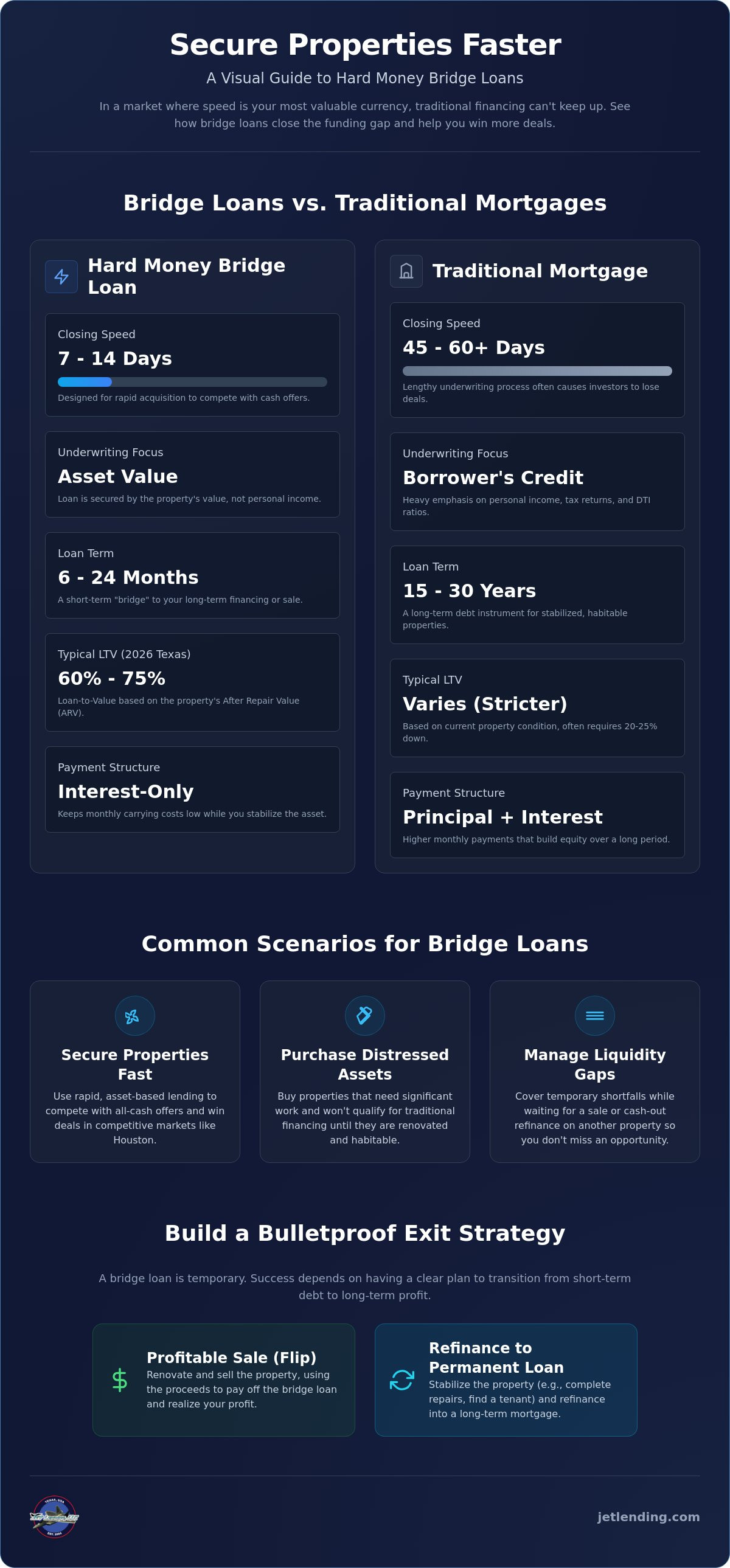
The golden rule of bridge lending is simple: never cross a bridge without knowing exactly where it ends. Hard money bridge loans are high-octane tools designed for speed and agility, but they are not meant for long-term storage. If you enter a deal without a clear exit, you risk watching your profits disappear into monthly interest payments. Smart investors treat the bridge as a strategic "temporary structure" that only works if the exit ramp is built before they ever cross.
Your first exit option is the classic sale. This is the primary path for flippers and wholesalers who need to move an asset quickly to realize a profit. Your second option involves refinancing into long-term debt, such as a Debt Service Coverage Ratio (DSCR) loan or a conventional mortgage. This is common for buy-and-hold investors who use the bridge to stabilize the property first. However, you must also account for risk. If the market shifts or your refinance is delayed, having a backup plan, like a pre-negotiated loan extension, is vital for protecting your equity.
Transitioning from a bridge loan to a permanent mortgage requires foresight. You should start preparing for your DSCR loan the moment your bridge funds. In 2026, lending guidelines often emphasize seasoning periods, which is the amount of time you must hold a property before a bank will recognize its new, higher value. Working with a partner like Jet Lending, LLC who understands both short-term and long-term financing ensures a seamless handoff. We help you map out these timelines so you aren't left scrambling when the bridge term nears its end.
When your exit strategy is a sale, timing is everything. You must calculate your holding costs meticulously; every extra month you hold the property is another month of interest eating your bottom line. Houston’s local market moves fast, and your exit timeline should reflect that reality. A bridge loan is a tool for speed, not a place to park debt indefinitely. If you're ready to secure your next deal with a clear path to profit, apply for your short-term loan with Jet Lending, LLC today and let's build your exit strategy together.
Choosing a lender is more than a financial transaction; it's a strategic partnership. While national firms often treat Houston like any other dot on a map, we understand the specific pulse of Harris County. National lenders frequently struggle with the nuances of Texas real estate, from localized neighborhood shifts to the complexities of our state's property tax structure. When you use hard money bridge loans to grow your portfolio, you need a partner who knows the difference between a deal in the Heights and one in Sunnyside without needing a week of research to figure it out.
Our process is built for speed and transparency because we know that in 2026, a delay of forty-eight hours can cost you a property. We encourage all our partners to "pre-flight" their deals using our proprietary investment property calculator. This tool allows you to run your numbers against current market data before you ever submit an application. It ensures your hard money bridge loans are structured for maximum ROI from the start. For a deeper look at how we support local investors across the state, explore our guide on Hard Money Loans Texas.
Working with a Houston-based lender provides a distinct home-field advantage. We facilitate faster site visits and appraisals because our team is already on the ground. We also help you navigate the 2026 Texas regulatory environment, including the latest NMLS reporting requirements and OCCC rules, with ease. Perhaps most importantly, we understand the impact of Texas property taxes on your cash flow. We factor in local appraisal district trends to ensure your LTV remains realistic and your exit strategy stays profitable. You also gain access to our trusted network of local title companies and contractors who understand the Houston market as well as we do.
Ready to secure your next asset? The path to funding is straightforward and designed to respect your time. To get started, you simply need to provide the property address, your purchase price, and a clear description of your intended exit strategy. Whether you are bridging the gap to a long-term rental or preparing for a high-end flip, we provide the capital and the mentorship to help you cross the finish line. Don't let a slow bank kill a great opportunity. Contact Jet Lending today to fund your next Houston bridge loan.
Success in the 2026 real estate market requires more than just finding a good deal; it requires the agility to fund it before someone else does. You've learned how hard money bridge loans serve as the ultimate tactical tool to close liquidity gaps and secure properties with the speed of a cash buyer. By prioritizing asset value and maintaining a clear exit strategy, you can navigate even the most competitive Houston neighborhoods with total certainty. Whether you're planning a classic flip or transitioning into a long-term rental, the right capital structure makes all the difference.
Jet Lending has been a trusted partner for Texas investors since 2004. Our Houston-based team provides the deep local knowledge and specialized investment property calculators you need to "pre-flight" every opportunity. We don't just act as a lender; we act as a mentor dedicated to your growth. Ready to secure your next deal? Apply for a Bridge Loan with Jet Lending today! We're excited to see what you'll build next and look forward to helping you reach your long-term investment goals.
Yes, you can. Unlike traditional banks, we prioritize the value of the "hard asset" rather than your personal credit history. This asset-based approach means the deal's potential is the primary factor for approval. While we may review your credit, a low score won't necessarily kill a deal if the property has enough equity and a clear exit strategy. We focus on the strength of the investment itself.
You can close in as little as 7 to 10 days. Because we are based in Houston, we move much faster than national firms or traditional banks. Our local team understands Harris County property values and can expedite site visits or appraisals. This speed allows you to compete with cash buyers and secure time-sensitive opportunities before they disappear from the market.
In 2026, interest rates for hard money bridge loans generally range from 9.5% to 12.5%. These rates are slightly higher than traditional mortgages because they account for the increased lender risk and the rapid closing speed. Your specific rate will depend on the loan-to-value ratio, the property type, and your level of experience with similar investment projects in the Texas market.
Yes, most bridge loans require a down payment or existing equity in the asset. Lenders typically follow the "70% ARV rule," meaning the total loan doesn't exceed 70% of the property's after-repair value. Having some "skin in the game" aligns your interests with the lender and ensures the project remains financially viable. In early 2026, the average LTV for Texas projects was approximately 71%.
You should contact your lender immediately if your exit strategy is delayed. While the risk of foreclosure exists, many lenders offer extension options for a fee if the project is still on track. This is why having a clear backup plan is vital. We work as your partner to help you navigate these shifts and protect your equity through transparent communication and proactive planning.
The terms are often used interchangeably, but there is a slight tactical difference. A "hard money loan" is the broad category of asset-based lending. A "bridge loan" specifically describes the function of the capital, which is to bridge a temporary funding gap until a permanent refinance or sale occurs. Most hard money bridge loans are used for acquisition rather than heavy construction or renovation draws.
No, these loans are strictly for non-owner-occupied investment properties. We do not provide owner-occupied residential mortgages or unsecured personal loans. Our capital is designed specifically to help you acquire, flip, or bridge investment assets. If you plan to live in the home, you'll need to seek a traditional residential mortgage from a consumer lender that handles primary residences.
We typically look for a maximum LTV around 70% to 75% of the property value. This ensures you have enough equity to protect your investment while providing the capital needed to close the deal quickly. During the first quarter of 2026, the average LTV for hard money projects in Texas was 71%. We use our local expertise to evaluate each property's value accurately and fairly.
Tags:

You find the perfect fix-and-flip in Dignowity Hill, but by the time your bank processes the initial paperwork, a cash buyer has already closed the deal. It's an all-too-common story in the Alamo...

In the 2026 Houston real estate market, waiting for a traditional bank approval isn't just a delay; it's a guaranteed way to lose your deal to a faster cash buyer. While many investors begin their...

Why are you still waiting 45 days for a bank approval while your competitors close deals in less than a week? You know that in the fast-paced 2026 Texas market, speed is often the only difference...