
Written By: Stephanie Rojas | October 31, 2026
Time to Read 13 Minutes
Land can account for half of an apartment building’s hard construction costs. That’s why hard money for small apartment buildings in Houston depends on more than the purchase price: the parcel, building plan, neighborhood, permit status, and repayment strategy all shape the financing picture.
A promising property can still come with costly surprises. Location affects its potential, while the proposed building and permit path influence what must happen before construction or renovation can proceed. Understanding these details early helps you assess the deal as a whole.
This article explains how financing considerations connect to land and construction costs, what Houston location factors can mean for a small apartment project, and why permits matter to timing and feasibility. You’ll also see how building height can affect requirements and costs, and how to use an investment property calculator to bring the numbers together. The goal is to understand the deal more clearly before deciding whether short-term financing fits your plan.
For a Houston apartment deal, assess the building, land, work plan, and repayment route together. Construction costs, site value, and the property’s intended use all affect the financing picture.
An exit path explains how you’ll repay short-term debt after renovation. It matters because the expected project outcome should match how you plan to recover your investment.
Common routes include selling the renovated building or refinancing into longer-term financing while keeping it as a rental. A refinance replaces the short-term loan with new debt. The renovated property’s value, rental performance, and remaining work can shape that next step. Base your exit plan on realistic project costs and income, not just an anticipated sale price.
Property size and unit count show the scale and operating complexity of an apartment project. They matter because lenders assess the asset and its business case, not just the number of units.
Present the building’s usable space, unit mix, current condition, and planned improvements as one clear picture. A small property needing major structural work may call for a different financing analysis than a similar-sized building needing cosmetic updates. Account for the land separately from the building work: it can amount to half of hard construction costs for apartment buildings.
Building height can also affect the budget. These factors can change both the funding needed and the project’s exit calculations.
Closing speed is the time needed to review and fund a loan. It matters when a purchase contract or renovation schedule depends on funds being ready.
The property’s condition, valuation, title work, project scope, and application completeness can all affect the path to closing. For a Houston building, organize the purchase details and renovation plan early so questions about the site or proposed work don’t stall the review. A clear deal file also helps show how the requested financing fits the project budget.
An application package contains information used to assess the property, borrower, and financing plan. Clear, consistent details help explain how the loan supports the deal.
Gather the purchase contract, property address and details, renovation scope, cost estimates, and intended repayment plan. Add available information about rents, occupancy, and the building’s current condition. Then compare total project costs with the planned funding and exit. For example, keep land, construction, permits, and design expenses distinct; apartment construction hard costs usually make up 70% to 80% of the project budget, while soft costs such as design fees and permits are usually around 20% to 30%.
The label “small apartment building” does not establish a universal square-footage or unit-count limit for hard money. A loan assessment considers the property’s physical scale along with its condition, purchase terms, renovation needs, and repayment plan. Treat unit count and building size as separate details, then explain how each affects project income and costs.
For a practical reference, one-to-three-story apartment buildings in the market cost table span 6,800 to 41,400 square feet. Four-to-seven-story buildings span 34,000 to 115,000 square feet. These ranges describe building categories, not loan eligibility limits. A three-story building near the top of its size range may have a different financing profile from a smaller building with extensive repairs.
Unit count helps show how the building operates. It can shape the rent roll, vacancy exposure, maintenance needs, and renovation scope. Square footage offers another measure: it can show whether the units, hallways, and shared spaces use the structure efficiently. Compare the unit mix and usable area with the floor plan instead of relying on the door count alone.
Prepare a concise property profile before evaluating financing. Include:
These details connect the building’s scale to the deal’s financial logic. A vacant property, for example, has no current rent roll, so the proposed operating plan and renovation scope become important context. An occupied building may generate income, but its leases and unit condition still matter. Present current facts separately from projections.
Location in Houston also matters to a building’s potential use. Parcel dimensions, surrounding development, access, and existing site improvements can affect what the property can support. Keep the land description separate from building measurements. That distinction helps explain whether financing is for acquiring the asset, improving existing units, or repositioning the property.
Use figures as comparison points, not promises of approval. Apartment buildings vary widely in scale, and a lender’s loan parameters depend on its program and review of the specific deal. Accurate details about units, size, condition, and income give the financing discussion a stronger foundation.
Closing timelines vary from one Houston apartment loan to another. Timing depends on how quickly the property, borrower, transaction, and funding plan can be reviewed. A clean purchase file may move differently from a deal involving vacant units, extensive repairs, or unclear ownership records. Focus on the steps that control progress instead of relying on an unsupported number of days.
The process often involves several connected reviews. The lender needs to understand the property and requested financing, while valuation and title work help clarify the asset and transaction. The purchase contract, renovation plan, and exit strategy provide context. If an item changes, such as the project scope or contract terms, other parts of the review may need updating.
For example, a Houston building with occupied units calls for a clear picture of current leases and rents. A vacant building needs a proposed operating plan and a description of the work required before leasing. These differences affect the information that supports the property’s value and repayment plan. Describe current conditions plainly and separate existing facts from future projections.
Several moving parts can influence when closing is ready:
Keep every item consistent. If the contract shows one purchase price but the financing request uses another, the mismatch raises questions. If renovation estimates cover different work from the written scope, clarify the project. Send updated documents together when terms or plans change so reviewers are working from the same file.
Start coordinating as soon as the purchase terms take shape. Confirm who is handling valuation and title tasks, and respond promptly when a document or property detail needs attention. The seller’s deadline, appraisal access, and time needed to prepare closing documents all affect the schedule. Allow for these dependencies in your transaction plan.
To estimate a realistic closing path, map the deal’s dependencies in order: contract details, property review, title preparation, final documentation, then signing and funding. Mark what is complete and what still needs input from another party. This simple timeline helps identify bottlenecks early and keeps a Houston apartment acquisition moving toward its planned closing.
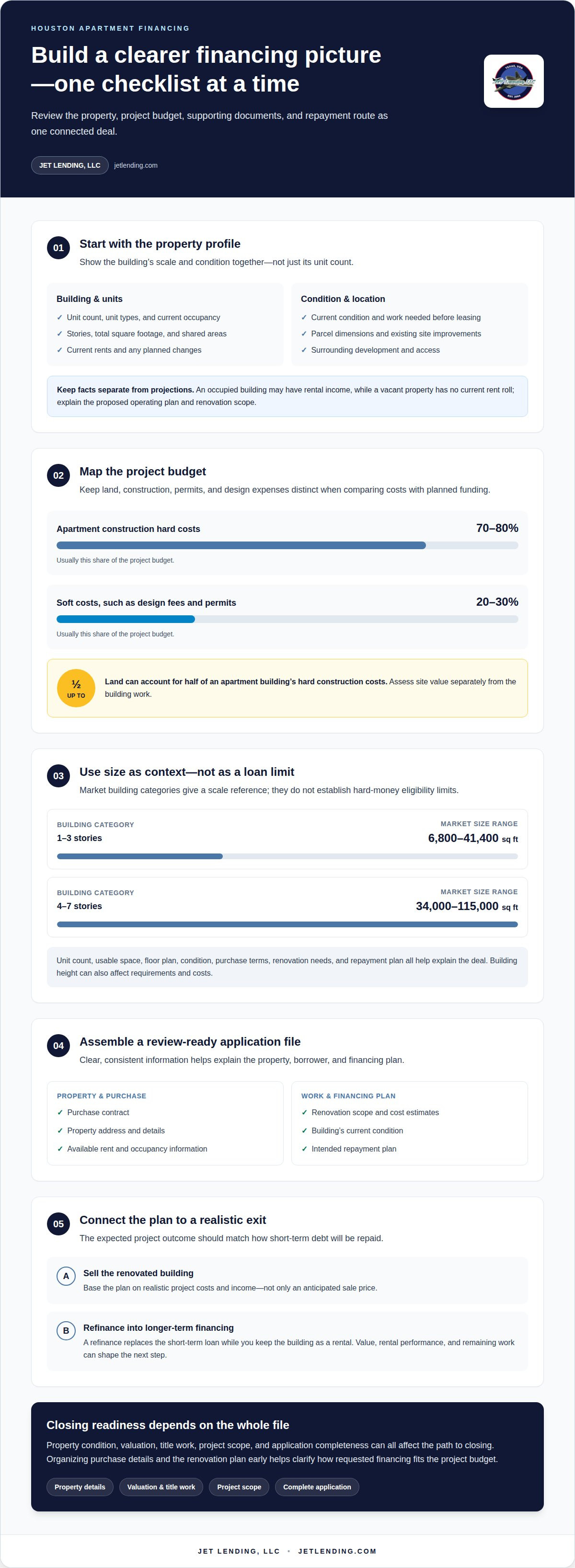
A useful application file connects the borrower, property, purchase, and repayment plan. For a Houston apartment building, organize records by topic and make sure each document describes the same deal. A clear file helps reviewers understand what you’re buying, what work you plan, and how financing fits.
Start with property and purchase records. Include the signed purchase contract, property address, available title information, and a current description of the building. Add photographs or inspection findings showing visible conditions, such as damaged roofing, vacant units, or outdated interiors. Label photos by building area so they correspond to the renovation scope.
Next, assemble the operating and financial details. For an occupied property, provide a rent roll and copies or summaries of existing leases. Include recent income and expense records when available. For a vacant building, prepare a proposed rent and operating plan, clearly separating estimates from current income. This distinction prevents projections from being mistaken for actual performance.
Prepare a project file with the renovation scope and supporting estimates. Break the work into categories such as structural repairs, unit improvements, and shared-area upgrades. For example, specify whether a contractor’s estimate covers kitchens only or also includes plumbing and electrical work. Match each estimate to the written scope, and note which work is essential before leasing.
Borrower and entity records help show who will own and manage the property. Gather the purchasing entity’s formation and ownership details, the authorized signer’s information, and relevant experience with similar investment projects. If the entity name differs between the contract and ownership documents, explain the connection briefly and keep names consistent wherever possible.
Use this sequence to build a review-ready package:
Before submitting, compare the contract, budget, and repayment plan side by side. If the contract describes an occupied property but the plan assumes vacant units, explain the timing and transition. If the budget includes work missing from the scope, revise a document so both tell the same story. Clear filenames, dated estimates, and one current version of each record help keep a Houston application organized.
Hard money is asset-backed financing, so a Houston apartment’s condition and renovation plan matter in the loan assessment. Renovations, distress, or vacancy do not automatically determine eligibility. What matters is how the property, planned work, and repayment strategy fit together. For investors considering hard money for small apartment buildings in Houston, a vacant building needs a clear plan for completing repairs and preparing units for use.
For a renovation, describe the work in practical terms. Separate essential repairs from upgrades, and connect each item to the building’s current condition. A scope that says “improve units” provides little detail. One identifying damaged flooring, outdated kitchens, or system repairs makes the project easier to understand. Attach estimates that match the written work plan, and distinguish planned improvements from existing conditions.
Distressed properties need a clear account of their challenges. Explain visible damage, deferred maintenance, occupancy issues, or operating problems with property-specific examples. Photographs can document conditions, while inspection findings and repair estimates can explain their impact. Separate urgent work from improvements planned after stabilization. This shows how the project will progress without treating every repair as equally important.
Vacancy changes the income picture. An empty building has no current rent collection to demonstrate, so explain the intended use of each unit and what must happen before leasing. For example, identify apartments needing repairs, shared areas requiring attention, and how the proposed work supports future operations. Clearly label projected rents as estimates, not current income.
Build the financing request around four connected pieces:
Review the deal as a whole before presenting it. If a Houston property needs substantial work but the repayment plan assumes immediate rental income, explain the steps between acquisition and leasing. If the building is vacant, connect renovation timing to the operating plan. An investment property calculator can help organize purchase, work, and projected operating figures, making gaps easier to spot.
When evaluating hard money for small apartment buildings in Houston, separate current facts from expected results. Make sure the property description, renovation estimates, and exit plan agree. This gives the financing review a coherent picture of the asset and its intended path forward.
Jet Lending offers short-term loans for real estate investors assessing Houston apartment acquisitions, renovations, or repositioning plans. These loans may suit an investment strategy with a defined project and repayment route, such as selling after improvements or refinancing to hold the building. Financing is not a substitute for planning: align the property’s condition, work scope, budget, and exit strategy before evaluating the deal.
Use the Investment Property Calculator to organize deal figures and assess how costs and projected income fit your investment plan. It can help you compare assumptions before making a financing decision.
Explore Jet Lending’s options at jetlending.com.
Before committing to an apartment deal, define what success looks like for your investment. Decide which outcomes matter most, what might change your plans, and how you’ll measure progress. A clear decision framework helps you stay focused as new details emerge.
Planning for hard money for small apartment buildings in Houston starts with matching financing to your investment goals. Consider how long you plan to hold the property, what must happen before it can operate as intended, and which future event would trigger your exit. Write down those priorities. They can guide your next move without letting a tight deadline dictate the decision.
Jet Lending can help you consider the next steps for your project.
Every investment brings a different set of decisions. Approach yours with a defined plan, room to evaluate new information, and confidence in the path you choose.
Jet Lending is a Houston-focused option for real estate investors seeking short-term, asset-backed financing. For a small apartment building, frame your request around the investment property, its intended use, and the project’s repayment plan. Loan terms and review focus can differ from deal to deal. Keep the property’s investment purpose clear: these loans fund investments, not owner-occupied residential mortgages.
Ratios vary by lender and deal structure. For Jet Lending’s Texas short-term loans, the maximum loan amount is 70% of the property’s after-repaired value, with repair costs deducted at closing. That figure is tied to after-repaired value, not a universal loan-to-cost limit. Compare how each proposal defines value, calculates eligible costs, and handles repair funding before judging the amount available for your Houston property.
Loan pricing depends on the specific case, and Jet Lending does not publish rates or fees. The property’s value and condition, renovation scope, requested financing, and repayment plan can shape proposed terms. Compare the interest rate, origination points, and other closing charges as separate items. Also review payment due dates and how total repayment changes over the loan term instead of comparing a single figure.
Requirements vary among lenders and loan programs. For Jet Lending’s short-term loans, credit score isn’t an exclusion factor because underwriting is asset-based. That does not make every property or deal the same: the collateral and proposed investment still matter. Prepare a clear account of your experience, available funds, property income, and renovation plan. For vacant Houston buildings, distinguish existing rental income from projections.
Hard money generally emphasizes the investment property and project, while DSCR financing focuses on whether rental income supports the debt payment. Bank and agency multifamily loans have their own underwriting criteria and may suit a different holding plan. For example, an investor renovating before stabilization may prioritize short-term asset-backed financing, while a stabilized rental may call for evaluating income-based options. Compare timelines, repayment terms, and qualification criteria.
These risks depend on the signed loan agreement. A balloon payment can leave a large balance due at maturity; an extension may involve conditions or added costs. Prepayment terms determine whether early payoff carries a charge or restriction. Default provisions describe what happens after a missed obligation. Before signing, compare the maturity date with your renovation and exit schedule, and understand payoff amounts under different scenarios.
Houston zoning and land-use constraints, flood exposure, inspection findings, and major repair needs can influence a property’s value and project plan. Jet Lending requires hazard insurance for all properties. Flood insurance is required if a property is in a flood zone or has a flood history. For example, water damage or an unresolved building issue can affect renovation scope, leasing plans, and the financing review.
Tags:

More flips do not automatically mean more profit. The practical answer to how to scale a house flipping business in Houston is to grow only as fast as your deal analysis, financing, contractor...

A Houston flip can spend no more than $700,000 in total under the 70% rule when its after-repair value is $1 million. If repairs are budgeted at $50,000, that puts the purchase price at no more than...

What if the financing that gets you the keys leaves too little cash to finish the renovation? Learning how to finance a house flip in Houston means looking beyond the purchase price. Rehab costs,...