
Written By: Stephanie Rojas | October 16, 2026
Time to Read 13 Minutes
What if the financing that gets you the keys leaves too little cash to finish the renovation? Learning how to finance a house flip in Houston means looking beyond the purchase price. Rehab costs, loan payments, holding expenses, contingency funds, and the resale timeline all affect how much capital a project needs. A shortfall at any stage can put the deal under pressure.
It’s natural to focus first on finding the right loan. A stronger plan matches financing to the property, renovation scope, and exit strategy from the start. Short-term, asset-backed financing can support investment acquisitions and rehabilitation, while careful deal analysis helps test whether the numbers work together.
This guide explains how to compare financing options, estimate the full cash requirement, and prepare a lender-ready deal file. You’ll also learn how to account for delays and renovation overruns, assess acquisition and resale assumptions with an investment property calculator, and plan practical next steps for funding your Houston flip.
How to finance a house flip in Houston starts with one question: how much capital will the deal need from purchase through resale? A loan that covers the acquisition alone may leave renovation work, holding expenses, or transaction costs unfunded. Map the complete project first, then compare financing options against that need.
A flip financing plan is a project-wide funding map that connects the property purchase, renovation, carrying costs, and resale timeline. That’s different from planning only for the amount needed to close. House flipping involves buying, improving, and reselling a property, as outlined in this overview of House flipping. The capital plan should account for each stage and the risks between them.
Financing for an investment property differs from an owner-occupied residential mortgage. A flip is acquired for investment, and short-term, asset-backed financing can support investment acquisitions and rehabilitation. The property, borrower, and transaction all matter when evaluating a financing plan.
Start with estimates for the specific property, not generic cost assumptions. Record each expense separately so you can see what needs funding and when it is likely to arise. Build the preliminary budget around:
Estimate the renovation period and resale timeline, then include holding costs for the full span. If the sale takes longer than planned, the project may need more cash even if construction stays on budget. A purchase-only budget can hide that exposure and create a funding gap once work is underway.
Estimate after-repair value (ARV) using comparable properties that resemble the finished home in location, size, condition, and features. State your assumptions clearly, including which improvements support the expected resale price. Treat the sale estimate as a projection, not a guarantee. Your financing plan should work with a defensible resale scenario, not only the best-case number.
Connect the renovation scope to its schedule and resale plan. A larger project may require more capital for work and a longer period of carrying costs. A delayed listing or sale can extend that period further. Check that the funding plan supports each phase, and note where timing or scope changes could increase the cash required. For a deeper framework, use this guide on how to analyze a fix and flip deal.
Bring the budget, ARV assumptions, scope, schedule, and resale plan together before selecting financing. This gives you a clearer view of the project’s total capital needs and a practical basis for comparing options.
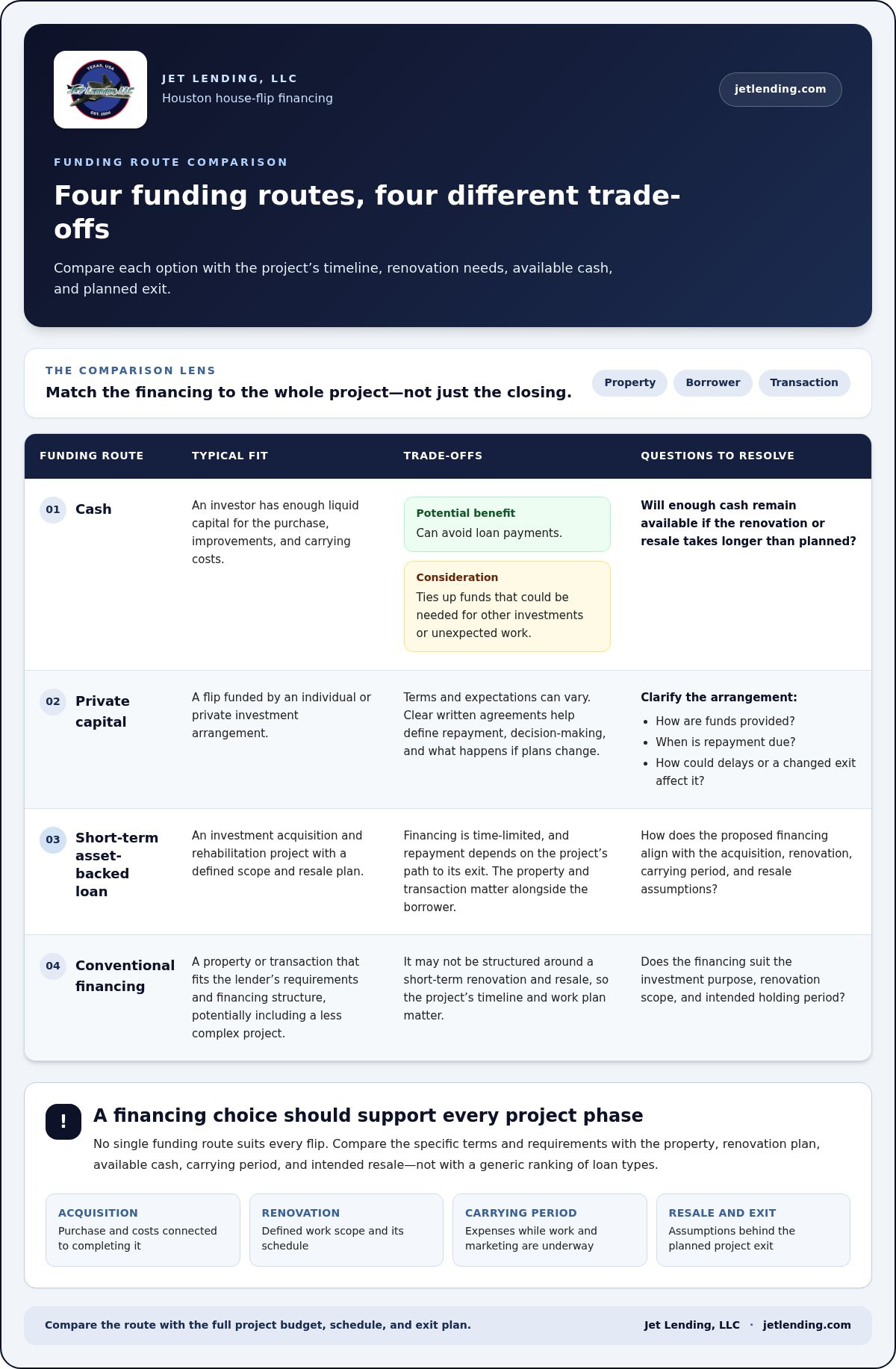
No single funding route suits every flip. Compare options against your project’s timeline, renovation needs, available cash, and planned exit, rather than relying on a generic ranking of loan types. The right fit depends on the borrower, property, and transaction, as well as how the financing aligns with the project.
| Funding route | Typical fit | Trade-offs | Questions to resolve |
|---|---|---|---|
| Cash | A project where the investor has enough liquid capital for purchase, improvements, and carrying costs. | Can avoid loan payments, but ties up funds that may be needed for other investments or unexpected work. | Will enough cash remain available if the renovation or resale takes longer than planned? |
| Private capital | A flip funded by an individual or private investment arrangement. | Terms and expectations can vary. Clear written agreements help define repayment, decision-making, and what happens if plans change. | How are funds provided, when is repayment due, and how will delays or a changed exit affect the arrangement? |
| Short-term asset-backed loan | An investment acquisition and rehabilitation project with a defined scope and resale plan. | Financing is time-limited, and repayment depends on the project’s path to its exit. The property and transaction matter, alongside the borrower. | How does the proposed financing align with acquisition, renovation, carrying period, and resale assumptions? |
| Conventional financing | A property or transaction that fits the lender’s requirements and financing structure, potentially including a less complex project. | It may not be structured around a short-term renovation and resale, so the project’s timeline and work plan matter. | Does the financing suit the investment purpose, renovation scope, and intended holding period? |
Short-term, asset-backed financing is designed for investment purposes, including property acquisition and rehabilitation. The property is central to the financing, along with details of the borrower, project, and planned exit. This can make the approach relevant to a flip. Evaluate the specific property and renovation plan against the project’s funding needs.
Keep the purpose clear. Financing for a short-term investment project differs from a mortgage designed for long-term owner occupancy. Compare the proposed loan structure with the work schedule and likely resale period. Houston investors looking for broader context can review this Houston hard money lender guide.
To decide how to finance a house flip in Houston, test each option against the same project assumptions. A long renovation, limited cash reserves, or uncertainty about resale timing can change which trade-offs are manageable. Jet Lending provides short-term investment financing for real estate acquisition and rehabilitation projects.
A deal can look profitable based on the purchase price and resale estimate alone, then lose its margin to financing costs, delays, or work missing from the original scope. Model the full transaction in one place: acquisition, renovation, carrying expenses, transaction costs, financing, and projected resale proceeds. This shows how each assumption affects the amount you may need and the funds available at exit.
A flip’s projected margin must account for both financing costs and time, because every extra day can add expense and reduce the cushion for resale changes. Projected profit is not guaranteed. It depends on estimates, the work completed, the time required, and the eventual sale.
After-repair value (ARV) is an estimate of what a property could sell for after planned improvements. Support it with relevant comparable sales, and explain how differences in location, size, condition, and features affect your estimate. For more detail on the valuation concept, see this after-repair value guide.
Keep the renovation estimate distinct from your contingency reserve. Record the work included, material and finish assumptions, and items still needing inspection or pricing. If the scope changes, revise the budget and schedule instead of treating the original estimate as fixed. That makes the effect on financing and projected margin easier to track.
Build a base case, then test less favorable outcomes. Extend the renovation or resale timeline, add a plausible scope change, and model a lower sale price. The goal isn’t to predict exactly what will happen. It’s to see whether the deal can absorb setbacks or whether a small change could exhaust available funds.
Compare each scenario with your available capital and planned exit. If the project only works under the most optimistic forecast, revisit the assumptions, scope, or purchase decision. An investment property calculator can help organize deal inputs, but results remain estimates based on the information entered.
Before finalizing assumptions, review property-specific details that could affect work, costs, or timing. Use FEMA resources to check flood-risk information for the specific address. Review property tax and assessment details in Harris Central Appraisal District records. For planned work, check current permit requirements with the City of Houston or the relevant jurisdiction, since requirements can vary by location and project.
Bring those findings back into the deal analysis. A property-specific risk or permit-related step may change the work plan or timeline, which can affect carrying expenses and the financing needed. This helps you assess how to finance a house flip in Houston with a realistic view of both the project’s potential and its uncertainties.
A clear financing file helps turn a flip from an idea into a project that can be evaluated. Organize the details around the property, the work, the people executing it, and the planned exit. Include accurate information about the property, renovation scope, borrower experience, and exit plan. Keep estimates clearly labeled as preliminary when they are not final.
Build your file in stages, starting with the property and moving toward the financing plan. Make sure the numbers match across your budget, scope, and timeline.
Understand how the proposed financing is structured for the deal. Document how acquisition funds and renovation funding fit into the project timeline, what information is needed at each stage, and how a renovation draw process affects cash availability. Add the expected funding sequence to your schedule and consider how delayed work could affect the funds on hand.
Keep Houston due diligence specific to the property and current requirements. Check FEMA flood-risk resources for the address, review assessment and tax information with Harris Central Appraisal District, and verify permits with the City of Houston or the relevant jurisdiction for the planned work. Save the records or notes that support your assumptions. These checks can flag items that may affect scope, timing, or costs.
Before submitting the file, do one final consistency check. The purchase details, renovation budget, schedule, financing need, and exit plan should tell the same story. If an estimate changes or new property information affects the work, update the file instead of relying on outdated figures.
Once your property, renovation plan, and resale assumptions are organized, match the financing structure to the deal. Jet Lending is a Texas-based asset-based lender serving Houston investors with short-term financing for real estate investment acquisitions and rehabilitation. Its financing is for investment projects, not owner-occupied residential mortgages. Since 2004, Jet Lending has focused on short-term, asset-backed real estate investment financing.
Connect the funding need to the project itself. Lay out what you expect to need for acquisition and rehabilitation, when different expenses may arise, and how the planned resale supports the exit. This creates a clearer basis for evaluating financing than the purchase figure alone.
Keep the project assumptions consistent. If the renovation scope changes, update the budget and timeline before relying on earlier figures. If the expected sale takes longer, account for how the revised exit could affect the project. Evaluate the property, scope, and resale plan as one investment.
Jet Lending’s investment property calculator can help organize your deal assumptions. Use it as a planning aid, not a promise of profitability or financing approval. Results depend on the information entered and the assumptions behind projected costs, renovation work, timeline, and resale.
Before discussing a Houston flip with Jet Lending, have the property details and current deal analysis ready. Include the purchase information, renovation scope, budget, expected schedule, resale strategy, and important assumptions or open questions. This makes it easier to explain what the project needs and how you expect it to reach its exit.
If you’re still weighing how to finance a house flip in Houston, tie the decision to the project’s actual requirements. Consider how the funding aligns with acquisition and rehabilitation, how the schedule affects the investment, and whether your resale assumptions leave room for changes. A financing conversation is a practical next step once you can clearly describe those moving parts.
Use the calculator to review your investment assumptions, then explore Jet Lending’s short-term investment financing for your Houston flip.
Before committing to a property, set decision points for the deal. Decide which assumptions would make you pause, what changes you can absorb, and when a revised budget means it’s time to reconsider. This discipline helps keep a promising opportunity from becoming a rushed decision. It also gives you a practical starting point for deciding how to finance a house flip in Houston based on the project in front of you, not just the financing you hope to secure.
Use your property analysis to guide the next step. Bring clear purchase details, renovation plans, and resale assumptions to Jet Lending, then explore how its short-term investment financing can align with the project. A thoughtful funding plan won’t remove uncertainty, but it can help you move forward with greater clarity.
Keep refining your numbers and updating the plan as new property details emerge. When you’re ready to finance a Houston investment acquisition or rehabilitation, explore short-term investment financing with Jet Lending.
Yes, limited experience doesn’t automatically rule out financing, but it is only one part of the project assessment. For a first flip, explain who will oversee construction and how that person has handled similar work. Include written renovation estimates, a clear work sequence, and a realistic resale plan. Strong documentation helps show how you’ll manage the project. Treat projected resale proceeds as an estimate, not guaranteed profit.
Possibly. Investors may acquire or borrow through an LLC, but the structure depends on the transaction and financing requirements. Don’t assume an LLC and individual borrower will be treated the same way. Before signing, confirm which party is borrowing, which entity will own the property, and who is responsible for repayment under the documents. Consider legal and tax implications when structuring the investment, not as an afterthought once the property is under contract.
An overrun can shrink your projected margin and leave you needing additional capital. First, identify the cause: unexpected property conditions, a revised work order, or a schedule issue. Separate essential repairs from upgrades you can defer, document the revised scope, and update the remaining budget and completion estimate. Discuss material changes with Jet Lending before relying on additional funding. Recalculate the expected sale proceeds using the updated costs and timeline.
Coverage depends on the financing structure and transaction. Don’t infer coverage from the purchase amount or assume all project expenses are included. Review the financing documents to understand how acquisition expenses, renovation funds, and ongoing property costs are treated. Identify which costs you’ll need to pay directly and when they fall due. Timing matters because expenses due before a later funding stage may require cash on hand.
Assess flood exposure for the specific property instead of assuming risk from its Houston location. Review current flood information for the address and consider how the home’s condition, planned repairs, insurance options, and resale appeal may affect your budget. A map alone won’t show every property-specific issue. Review the information alongside inspections and current insurance estimates, then update your project assumptions if the findings could change costs or timing.
Possibly, but a resale-focused flip plan and a long-term rental strategy have different exits. Decide which outcome you’re pursuing before financing, and make sure the proposed loan’s repayment structure fits that plan. If you switch to renting during the renovation, recalculate how long you’ll hold the property, how rental income compares with operating expenses, and how you’ll meet the loan obligations. Don’t assume the original financing automatically fits a changed strategy.
Tags:

A strong fix-and-flip loan supports the full project, not just the property purchase. When comparing fix and flip loans Houston TX, look at how financing relates to both acquisition and renovation,...

Your first flip doesn’t start with a loan application. It starts with a Houston deal whose numbers make sense. If you’re figuring out how to get funding for your first flip Houston, start by building...

What if the financing that helps you secure a Houston investment also puts pressure on your exit plan? A short-term loan can support an acquisition or rehabilitation project, but the fit depends on...