
Written By: Stephanie Rojas | November 16, 2026
Time to Read 12 Minutes
Is EaDo safe enough for a real estate investment? Safety deserves a close look, but it is only one part of the decision. Houston real estate investment trends in EaDo reflect ongoing development, transit access, and a changing property market, not a guaranteed return.
It makes sense to weigh neighborhood conditions alongside the numbers. A property’s potential depends on its location, condition, likely rental demand, operating costs, and how long you can hold it. Houston’s growth adds context, while the planned 700,000-square-foot George R. Brown Convention Center expansion and East Blocks development bring new activity to watch.
This article covers EaDo’s transformation, practical property-evaluation factors, Houston’s growth, and what planned projects could mean for the area. Use these considerations to assess both opportunity and risk. Construction and major development plans can inform your outlook, but they cannot replace property-level analysis.
EaDo’s transformation reflects years of public investment, new housing, and growing neighborhood activity. The East Downtown Redevelopment Authority was established in 1999 and invests in Tax Reinvestment Zone No. 15. The area is also included in Houston’s East End Revitalized area, known for rapid gentrification and a growing arts scene.
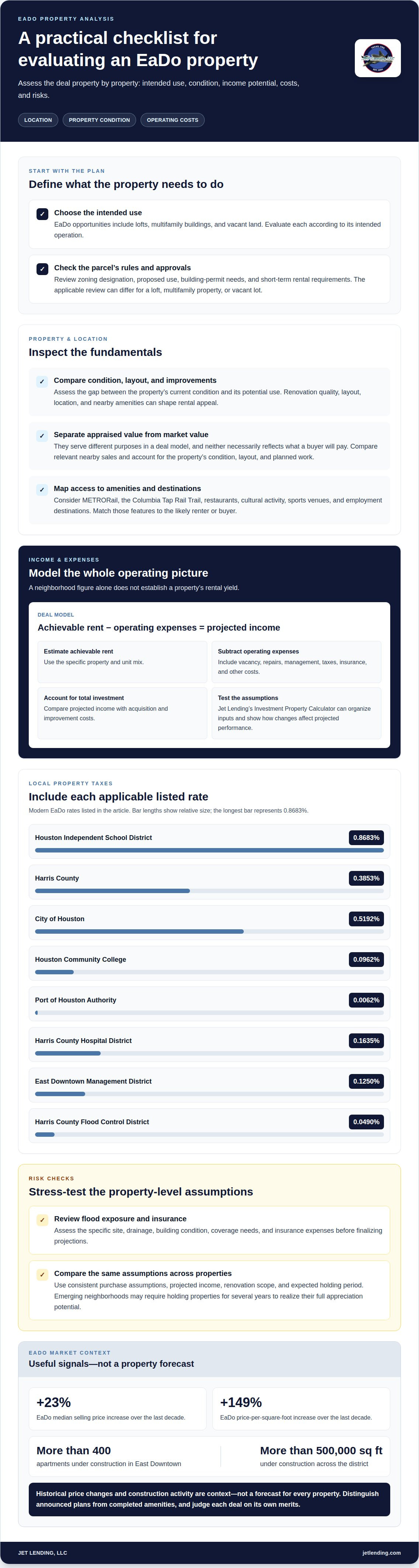
Residential values show how that transformation has reached the property market. Over the last decade, EaDo’s median selling price increased by 23%, while its price per square foot increased by 149%. Those figures describe historical change, not a forecast for every property. For investors considering value-add opportunities, focus on the gap between a property’s current condition and its potential use. Renovation quality, layout, location, and nearby amenities shape whether improvements can support stronger rental demand.
The stadium helped establish a year-round activity anchor. Houston announced the stadium now known as Shell Energy Stadium in 2011, and it opened in 2012. Its presence adds to EaDo’s sports and event identity, alongside nearby destinations such as Toyota Center. For an investor, nearby venues matter because they can contribute to neighborhood visibility and activity. They do not replace property-level analysis of tenant demand, maintenance needs, and operating costs.
Transit and everyday amenities also influence residential appeal. EaDo residents can access METRORail light rail routes to destinations across Houston. The Columbia Tap Rail Trail offers another local mobility option. Restaurants and cultural activity add to the neighborhood’s appeal. When evaluating a property, map its access to transit, dining, and employment destinations, then consider how those features match the likely renter or buyer.
How does EaDo compare with nearby Houston neighborhoods for investment returns? Historical price growth is one useful signal, but it does not establish that EaDo outperformed nearby areas. Compare properties using the same measures, including purchase assumptions, projected income, renovation scope, and expected holding period. In Houston’s emerging neighborhoods, investors may need to hold properties for several years to realize their full appreciation potential.
Current real estate investment trends in EaDo include ongoing residential construction and larger district projects. More than 400 apartments are under construction in East Downtown, and more than 500,000 square feet is under construction across the district. East Blocks is another project to watch as the area develops. These projects may add housing and activity, but investors should distinguish announced plans from completed amenities when judging a property’s present-day demand.
Start with the property’s intended use, then compare its condition, income potential, and ongoing costs. EaDo offers different investment profiles, from lofts and multifamily buildings to vacant land. A loft near downtown may appeal to renters seeking urban living and proximity to sports venues. For a multifamily property, analyze income and maintenance unit by unit. For land, assess permitted use and development potential.
Separate appraised value from market value. These measures serve different purposes in a deal model, and neither necessarily reflects the price a buyer will pay. Compare the property with relevant nearby sales, then account for its condition, layout, and planned improvements.
That figure alone does not establish a property’s rental yield. Estimate achievable rent for the specific unit mix, then subtract vacancy, repairs, management, taxes, insurance, and other operating expenses. Compare the resulting income with the total acquisition and improvement cost. Jet Lending’s Investment Property Calculator can help organize those inputs and show how changes affect projected performance.
Local property taxes also belong in the operating-cost model. Modern Eado’s listed rates include Houston Independent School District at 0.8683%, Harris County at 0.3853%, and the City of Houston at 0.5192%. Other listed rates are Houston Community College at 0.0962%, Port of Houston Authority at 0.0062%, Harris County Hospital District at 0.1635%, East Downtown Management District at 0.1250%, and Harris County Flood Control District at 0.0490%. Include each applicable charge when estimating expenses.
What zoning, permitting, and short-term rental rules apply in EaDo? Before underwriting, evaluate the parcel’s zoning designation, proposed use, building-permit needs, and short-term rental requirements. The applicable review depends on the property and its intended operation, so do not assume a loft, multifamily building, and vacant lot follow the same path.
What are current rents and rental yields in EaDo? Model the full operating picture rather than relying on a neighborhood average.
Flood exposure and insurance costs also affect returns. Assess the specific site, drainage, building condition, coverage needs, and insurance expenses before finalizing projections. For a focused deal model, use the Investment Property Calculator to organize property costs and income assumptions.
Houston’s population growth gives EaDo investors a wider demand backdrop. Houston’s current population is stated as 6.8 million, and the city is projected to reach 10 million people by 2040. Houston is also identified as the fourth-largest city in the United States. These figures describe citywide scale, not guaranteed demand for any individual EaDo property.
Recent growth adds another point of context. Houston added just under 127,000 residents in the 12 months ending July 1, 2025. For investors, population gains matter when they translate into households seeking housing near jobs, services, and transportation. Track the connection between citywide growth and the specific tenant profile a property can serve.
EaDo’s resident profile offers a more local lens. The neighborhood is listed with a population of 3,745, a median age of 35 years, and an average individual income of $83,635. It has 2,339 households, with an average household size of 2 people. Those details can help frame demand for housing types and amenities, but they don’t determine the right rent or unit mix by themselves.
The East Downtown Management District reports more than 5,000 residents and a median household income of $105,000. These figures differ from the neighborhood-level profile, so keep their stated geographic scopes in view rather than combining them into one estimate. For property analysis, use the resident profile that best matches the parcel’s location and likely renter base.
EaDo’s position near downtown Houston connects residents with a major employment center. Houston’s energy sector is another part of the city’s economic identity, while hospitality, restaurants, and sports venues contribute to activity across the urban core. Proximity to these destinations may appeal to renters seeking shorter commutes or access to dining and events. Assess actual routes and travel options, not just distance on a map.
Historic attractions and sports venues add to the district’s visitor appeal. Minute Maid Park is a recognizable downtown Houston destination, while EaDo has its own growing restaurant and arts scene. Visitor activity can raise neighborhood visibility, but a rental strategy should still rest on resident demand and realistic operating assumptions.
Use Houston’s growth as context, then narrow the analysis to EaDo. Compare a property’s layout, access, and target renter with the neighborhood’s household size and income profile. A unit suited to a two-person household may serve a different demand segment than a larger home. This connects broad population trends with a practical property decision.
EaDo’s location gives investors several ways to assess access and property appeal. The neighborhood is east of downtown Houston and north of Interstate 45. That position places properties between the central business district and major road connections. For a specific address, map its routes to employment, services, and entertainment before estimating how location could support tenant demand or future appreciation.
Walkability scores offer useful context, but they are not interchangeable measures. EaDo has a Walk Score of 68, categorized as somewhat walkable, and a Transit Score of 59, categorized as good transit. A separate walkability score for the neighborhood is 71. Treat each score as an indicator, not a substitute for understanding the property’s immediate surroundings.
For an investment review, examine access at the block level. Note the routes residents can use to reach nearby destinations, then consider whether they suit the likely renter or buyer. A property near useful services may appeal to people who prioritize urban living, while a location that relies more on driving may suit a different tenant profile. These differences can affect leasing assumptions and projected income.
East of downtown Houston, proximity to central employment and entertainment can be part of a property’s appeal. EaDo’s location also means Interstate 45 is an important reference point when assessing access. Don’t assume that being near a highway guarantees convenience: the property’s actual route, traffic conditions, and noise exposure can influence its appeal. Include these address-specific factors in your comparison.
EaDo’s bike score is 70, giving another perspective on local transportation options. Compare that score with the street-level setting around each property, including routes residents may use for daily errands. Walkability, transit, and cycling access can support different living preferences. Their value depends on how well they match the property’s layout and target market.
Houston’s varied land uses also make property type important. A residential investment, multifamily building, and industrial property can respond differently to the same location. Consider how access supports the property’s intended use rather than assuming nearby downtown activity benefits every asset equally. This keeps the investment case tied to practical demand, not just a neighborhood label.
Treat location as one part of a broader return analysis. Compare access, property condition, operating expenses, and expected income for each candidate. EaDo’s scores and position can help frame the comparison, but they do not establish a guaranteed return. A clear property-level model shows whether access advantages justify the purchase and holding assumptions.
Planned projects can influence an EaDo investment outlook by changing nearby activity, housing supply, and commercial demand. The George R. Brown Convention Center expansion is planned at 700,000 square feet in the March 2025 master plan. That scale makes the project relevant to East Downtown property analysis, but it does not guarantee higher rents or appreciation for nearby properties.
East Downtown also has more than 500,000 square feet under construction and more than 400 apartments under construction. Together, these figures point to substantial building activity across the district. New apartments could add competition for existing rentals, while construction and new destinations may attract residents and businesses. Evaluate both effects rather than treating development as an automatic benefit.
East Blocks is another named project to consider in a neighborhood outlook. Review its location relative to the property, nearby streets, existing services, and planned uses. These details help frame how a project could affect access and local activity. Keep the analysis tied to the specific address instead of assuming every EaDo block will experience the same impact.
The convention center expansion may support visitor-related activity around downtown Houston. For residential investors, the practical question is whether that activity connects to sustained tenant demand, not just event traffic. Compare the likely renter profile with access to employment, transportation, restaurants, and schools. These factors help distinguish a vibrant district from a property with dependable rental fundamentals.
Review development before building future growth into a deal. First, separate completed amenities from projects underway or planned. Next, map the property’s proximity to the convention center, East Blocks, and current construction. Then consider whether new apartments could compete with the property’s unit type and rent range. This keeps projections grounded in the street-level setting.
Construction can bring disruption before it brings new activity. Nearby work may affect access, noise, parking, or the timing of neighborhood improvements. Consider how those conditions could influence leasing during your investment period. For example, a property beside an active building site may have a different near-term experience from one several blocks away.
Development creates opportunity and uncertainty at the same time. Model the property using current conditions first, then assess how the 700,000-square-foot convention center plan and EaDo’s construction pipeline might change demand. Keep projected income separate from hoped-for appreciation. That approach helps investors judge whether the deal works before future projects become part of the neighborhood.
Jet Lending’s Investment Property Calculator helps you organize the numbers behind an EaDo deal. Use it to assess property income and expenses alongside purchase and improvement assumptions. It brings key inputs together as you compare a property’s potential with your investment goals.
Consider Jet Lending Short-Term Loans when short-term financing fits your investment plan. Use the calculator to analyze the deal, then evaluate financing separately based on the property and your strategy. Keep projected income, operating costs, and planned improvements clear as you weigh the next step.
For a practical conversation about your investment property analysis, contact Jet Lending.
Use your view of Houston real estate investment trends in EaDo to build a decision framework, not a promise of future performance. Set the conditions a property must meet before moving forward. Define your income goals, renovation limits, financing approach, and acceptable holding period. Then test whether the investment still fits when assumptions change.
Keep the next step practical. Choose a property type and investment strategy that match your resources and appetite for risk. Separate what you can control, such as purchase terms and the improvement plan, from broader market forces. A disciplined process makes it easier to act when an opportunity fits and step back when it does not.
Build your plan one decision at a time. A thoughtful approach can help you move toward your next investment with greater clarity.
Safety in EaDo can vary by block, time, and surrounding activity, so assess the specific property rather than relying on a neighborhood-wide label. Visit the area at different times, note lighting and street activity, and consider how residents access parking and building entrances. For an investment, these details can affect tenant comfort and leasing appeal. Pair local observations with property condition and operating-cost analysis before deciding.
Houston offers investors a large urban market with varied property types and employment centers. For an EaDo property, the investment case depends on location, intended use, rental demand, expenses, and purchase terms. Compare projected income with full operating costs, then test how different rent or vacancy assumptions change the result. Houston real estate investment trends in EaDo provide context, but each deal needs its own analysis.
EaDo can suit investors whose strategy matches the property and its neighborhood setting. A rental-focused buyer might prioritize tenant appeal, operating expenses, and the unit’s condition; a value-add buyer might focus on renovation scope and the time needed to complete it. Treat planned development as context, not guaranteed appreciation. The decision is strongest when the property’s current numbers meet your goals without depending entirely on future neighborhood change.
These figures describe different properties and do not establish a separate condo median. For a specific home or condo, compare its size, condition, location, and property type with relevant nearby sales before estimating an offer or resale value.
The available figures show longer-term price movement, not a complete five-year series. EaDo’s median selling price increased by 23% and its price per square foot by 149% over the last decade. Compare rent histories for similar units and account for condition, lease terms, and included expenses.
Property taxes depend on the taxing entities and the property’s applicable assessed value. Listed Modern Eado rates include Houston Independent School District at 0.8683%, Harris County at 0.3853%, and City of Houston at 0.5192%, alongside other district rates. HOA fees vary by property and association, and no typical EaDo amount is established here. Include the property’s actual tax obligations and HOA charges in its operating-cost model.
The figures presented do not provide a specific EaDo vacancy rate, so estimate vacancy using comparable rentals and the property’s likely tenant pool. Demand drivers can include access to downtown employment, METRORail, restaurants, and sports or entertainment destinations. Unit layout, condition, rent level, and lease terms also shape leasing prospects. Test your projections with realistic downtime between tenants rather than assuming continuous occupancy.
Start by confirming the property’s intended use, physical condition, projected income, and expenses. Review applicable parcel-use requirements and permits relevant to planned work or rental operations. Examine the building for repair needs, assess site-specific flood exposure and insurance costs, and include taxes, HOA charges, and vacancy assumptions in the financial model. Finally, compare the asking terms with similar properties and stress-test the deal if renovation costs rise or rent falls.
Tags:

What if the right loan for a Spring Branch investment depends less on a standard mortgage checklist and more on the property, project, and exit plan? Comparing real estate investment loans Spring...

A promising Houston deal can still carry risk if it doesn’t fit your investment plan. Houston real estate investment risk management starts with matching each property to your goals, testing the...

Your LLC may be ready to own a Houston property while the deal still needs to prove its numbers. That distinction matters when you’re exploring hard money loans for LLC in Houston and working against...