
Written By: Stephanie Rojas | October 08, 2026
Time to Read 13 Minutes
What if the right loan for a Spring Branch investment depends less on a standard mortgage checklist and more on the property, project, and exit plan? Comparing real estate investment loans Spring Branch Houston investors may consider can feel uncertain when acquisition costs, repairs, and resale or rental plans all affect the numbers. The financing should fit the deal, not the other way around.
This guide walks through how to choose a financing direction, assess a property’s condition and renovation scope, and prepare a clear loan request. It also covers local due diligence, from verifying property details to testing whether your projected exit still works if costs or plans change. Jet Lending provides short-term, asset-backed financing for investment acquisitions and rehabilitation projects, along with an investment property calculator to help organize deal analysis. Start with the property, build a realistic budget, and connect each financing decision to a practical next step.
An investment property loan finances a property acquired to generate income or serve another investment purpose. That might mean buying a rental, purchasing a property that needs rehabilitation, or acquiring a property to resell. Start with what you intend to do with the property, not just its listing price or neighborhood name. For a broader overview of real estate investing, consider how income, resale potential, and financial risk connect to your plan.
Investment-purpose financing differs from a mortgage for a home the borrower intends to occupy. Be clear about whether the property will be held as a rental, improved, or resold, because the intended use shapes the financing conversation. Jet Lending provides short-term, asset-backed financing for investment acquisitions and rehabilitation projects. Its financing is for investment purposes, not an owner-occupied residential mortgage.
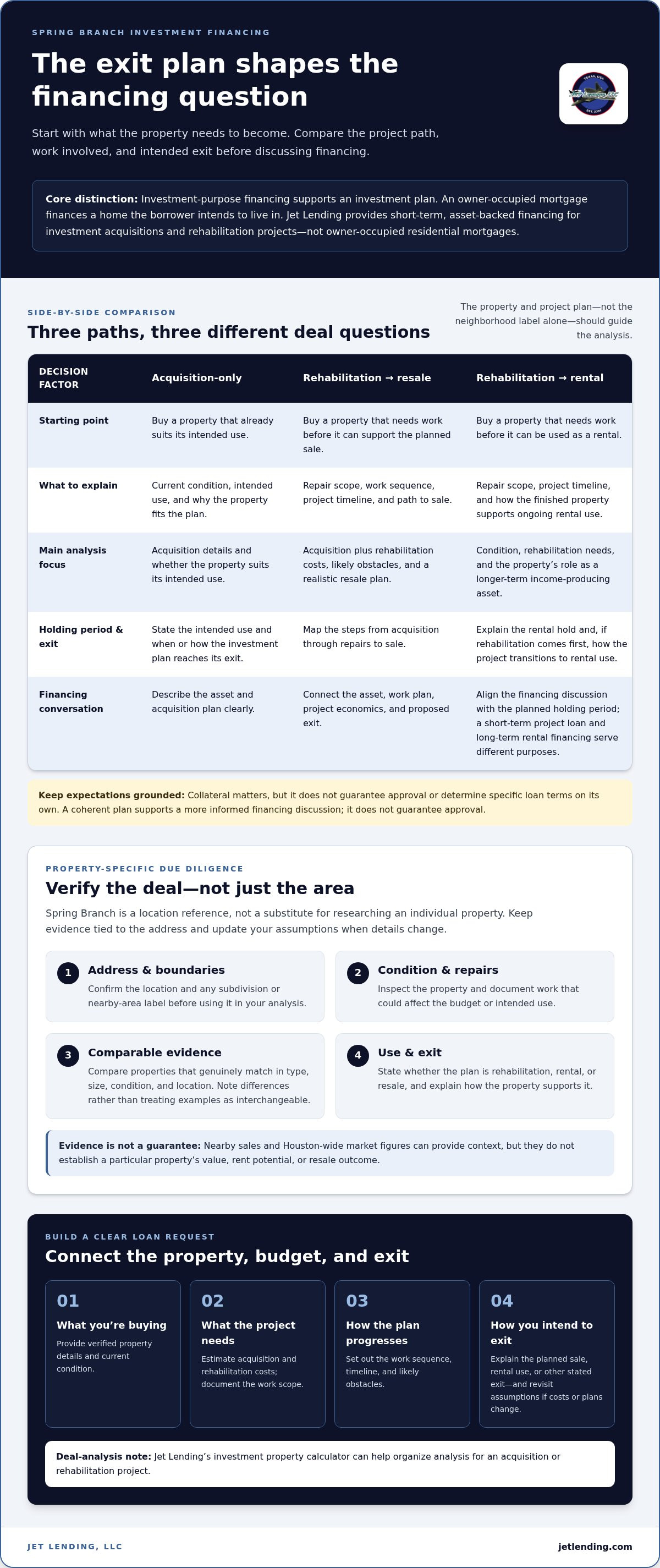
Define your strategy before comparing financing. An acquisition-only plan may involve buying a property that already suits its intended use. A rehabilitation plan adds repair scope, costs, and a project timeline to the analysis. A rental hold focuses on the property’s role as a longer-term income-producing asset, while a resale plan depends on the work required and a realistic path to sale.
Your holding period and exit strategy determine what the project needs to accomplish and when. For a short-term resale plan, map the steps from acquisition through repairs to sale. For a rental plan, assess the property’s condition and intended ongoing use. In either case, consider the property as collateral alongside the project’s viability. Estimate acquisition and rehabilitation costs, identify likely obstacles, and explain how the plan reaches its exit. A coherent analysis supports a more informed financing discussion, but it doesn’t guarantee approval.
Spring Branch is a useful location reference, not a substitute for researching the individual property. Start with the address and verify its location, features, intended use, and condition. Then review comparable properties that genuinely match its type, size, condition, and location. A nearby sale can provide context, but it doesn’t prove your property will perform the same way.
Keep your evidence tied to the specific deal:
Houston-wide market figures can provide broad context, but they can’t establish a particular Spring Branch property’s value, rent potential, or resale outcome. Build the financing conversation around verified details for the address and a realistic project plan.
Short-term, asset-backed financing is designed around an investment project, with the property serving as a central part of the deal evaluation. The lender considers the asset alongside the project’s purpose and economics. Explain what you’re buying, what work you plan to complete, and how you intend to exit. Collateral matters, but it doesn’t guarantee approval or determine specific loan terms on its own.
Investment financing supports a property’s investment plan; an owner-occupied mortgage finances a home the borrower intends to live in. Keep that distinction clear from the start. Jet Lending provides short-term financing for real estate investment acquisitions and rehabilitation projects, not mortgages for owner-occupied homes.
An acquisition-only plan differs from a purchase that includes substantial repairs. For an acquisition-only deal, explain the property’s current condition and intended use. For a rehabilitation project, define the work, its sequence, and how the finished property supports a resale or refinance exit. A short-term project loan and financing intended for a long-term rental hold serve different purposes, so align the financing discussion with your planned holding period.
Consider a hypothetical Spring Branch property that needs updates before it can be rented or sold. Connect the purchase to a documented work scope, a realistic completion plan, and a clear exit. If you plan to keep the property as a rental after rehabilitation, explain that transition rather than presenting resale as the only possible outcome. Explore different strategies for real estate investment to clarify which approach fits your goals, then show how the project steps support that choice.
Collateral-based lending puts the property at the center of the evaluation, but the lender also needs a coherent picture of the deal. Property condition, planned work, acquisition details, and the proposed exit help explain whether the project makes sense. Present evidence and assumptions separately, and flag details that still need verification. A well-organized plan makes the request easier to understand without guaranteeing a particular decision or financing structure.
If inspection findings change the rehabilitation scope, update the budget and timeline before relying on the original resale or refinance plan. Linking property facts to project economics is especially useful when a deal has several steps. Jet Lending’s hard money loan guide offers more background on asset-based lending. To organize your assumptions before discussing an acquisition or rehabilitation project, use Jet Lending’s investment property calculator.
Choose a financing direction after defining the property’s role in your plan. A rental hold, rehabilitation project, and resale strategy place different demands on your budget, timeline, and exit. Use this comparison as a starting point for evaluating real estate investment loans Spring Branch Houston investors may consider. No single approach fits every property.
| Strategy | Purpose and property condition | Holding period and exit | Financing direction to consider |
|---|---|---|---|
| Rental hold | Acquire a property ready to rent or make improvements that support long-term use. | Longer-term ownership; rental income and ongoing operations are central to the plan. | Long-term or conventional investment financing may suit some rental plans. |
| Acquisition and rehab | Buy an investment property that needs defined work before its intended use. | Short-term project; complete improvements, then sell, refinance, or hold if the plan supports it. | Short-term, asset-backed financing may fit an acquisition and rehabilitation project. |
| Resale | Purchase a property with a clear path to sale, with or without targeted improvements. | Hold through preparation or rehabilitation, then exit through resale. | Consider financing that aligns with the project schedule and a credible sale plan. |
A rental strategy needs more than a purchase plan. Estimate rent, vacancy, repairs, taxes, insurance, and routine operating costs, then test whether the property’s expected income supports your ownership goals. These are deal-analysis inputs, not guaranteed results. Long-term or conventional investment financing may be worth considering if you plan to own and operate the property over time. That differs from short-term financing designed around an acquisition or rehabilitation project. If a rental property needs substantial work, plan how to complete it before long-term operation begins.
Short-term financing may fit an investment property acquisition or rehabilitation project with a planned exit. Map the project from purchase through each major work phase, then check that the exit follows logically. If you expect to sell, base your analysis on the property’s condition, planned improvements, and resale assumptions. If you intend to refinance or hold after the work, explain that transition and assess its feasibility rather than treating it as automatic.
Before committing to a fix-and-flip strategy, analyze the deal by connecting acquisition costs, rehabilitation scope, timeline, and expected exit. Jet Lending offers short-term investment loans for acquisitions and rehabilitation, which investors can consider when assessing whether that financing direction fits the project. Explore Jet Lending’s investment financing as you compare your options.
A lender can assess only the deal you present, so build your request around evidence from the property itself. A neighborhood label or broad Houston market figure can’t show whether a specific house needs drainage work, has a costly repair, or supports your intended exit. For an investment property, address-level due diligence matters more than neighborhood averages.
Work through this checklist in order. Keep records and note when each figure was gathered so your assumptions are easy to review and update.
Check flood exposure and drainage at the address, not just across the neighborhood. FEMA flood maps can serve as an initial screening tool, but they aren’t a substitute for property-specific investigation. Review relevant Harris County records and current local permitting information for the property and proposed work. Verify tax figures, comparable sales, and rental assumptions using reliable sources, then note each source and date. Don’t treat a map result or nearby example as a complete assessment.
Bring the key materials together in one organized file: purchase details, property records, inspection findings, project scope, available contractor documentation, and cost and timeline assumptions. Add your intended exit and the evidence behind it. Mark estimates that still need validation rather than presenting them as confirmed facts. This makes gaps visible early and keeps the financing discussion grounded in the actual project.
Use Jet Lending’s investment property calculator to support your deal analysis. Enter your assumptions carefully, then compare the results with property documents and new findings. If inspection or record research changes the scope, revise your analysis before relying on it in a loan request. A clear, well-supported file explains how the property, proposed work, and exit plan fit together.
For real estate investment loans Spring Branch Houston investors are evaluating, property-specific facts can make the financing conversation more focused than broad neighborhood claims. Validate the address, costs, and exit assumptions before submitting your request.
Jet Lending is a Texas-based lender serving real estate investors with short-term, asset-backed financing for investment property acquisitions and rehabilitation projects. The property and project plan are central to the financing conversation. Be ready to explain what you’re buying, what work it needs, and how you intend to exit. This financing is for investment purposes, not for a home you plan to occupy.
A well-prepared request won’t guarantee a particular outcome, but it can make your deal easier to understand. Connect the property’s current condition to your proposed work, then show how your timeline and exit strategy fit the investment thesis. Keep the details specific to the address instead of relying on general neighborhood assumptions.
Build a concise project file before discussing real estate investment loans Spring Branch Houston investors may pursue. Include the property address, purchase information, known condition issues, and proposed scope of work. Add a realistic timeline and explain whether your planned exit is resale, refinance, or a longer-term hold.
Jet Lending’s investment property calculator can help organize deal assumptions as you prepare. Treat its results as a tool for analysis, then compare them with your property records and project documentation. If new information changes the scope or timeline, update your figures before presenting the deal.
Jet Lending has served real estate investors since 2004. Its Texas focus and short-term, asset-backed financing serve investors evaluating acquisitions and rehabilitation projects. A property file that separates verified facts from open questions gives the financing discussion a useful starting point. For added context on the local lending landscape, explore the Houston hard money lender guide.
Bring your address, purchase details, work scope, timeline, and intended exit into the conversation. That way, the project can be discussed in terms of the actual property and investment plan, not a generic checklist. Keep assumptions clear, especially where inspections, records, or market evidence still need review.
A promising investment isn’t defined by a neighborhood name or an optimistic projection. It depends on how well the property, project plan, and intended exit hold together when you test the assumptions. Before moving forward, identify what information could change your plan and how you’ll respond if repairs, timing, or market evidence differ from expectations. That clarity supports a more deliberate financing decision.
If you’re weighing real estate investment loans Spring Branch Houston for a specific acquisition or rehabilitation, bring your deal details into a focused conversation. You don’t need every uncertainty resolved, but you should be able to distinguish confirmed facts from open questions and explain how the investment is meant to work.
Use Jet Lending’s investment property calculator to organize your assumptions, then discuss your Spring Branch acquisition or rehabilitation project with Jet Lending.
No. Investment-purpose financing is intended for a property used as an investment, not as your owner-occupied residence. Be upfront about how you plan to use the property when discussing financing. Buying a house to renovate and resell is different from buying a home to live in, even if both properties need repairs. Jet Lending focuses on short-term, asset-backed loans for real estate investors, including acquisition and rehabilitation projects.
Test the specific property’s numbers and assumptions rather than relying on a neighborhood-wide claim. Compare its condition and purchase assumptions with relevant local evidence, then account for repairs, carrying costs, and your planned exit. For real estate investment loans Spring Branch Houston investors are considering, check the address, relevant records, and flood exposure as part of due diligence. Stress-test the analysis by adjusting key assumptions, such as repair costs or expected resale proceeds. A calculator organizes estimates, but can’t predict performance.
Prepare a concise deal summary with the property address, acquisition details, known condition issues, and proposed work. Include your investment strategy, estimated project timeline, and intended exit, such as resale or a longer-term hold. Keep source documents together and label estimates clearly. For example, distinguish a contractor’s written scope from a preliminary repair allowance. This makes it easier to spot missing information and explain how the project plan relates to the property.
Jet Lending provides short-term, asset-backed financing for investment acquisitions and rehabilitation projects. Describe the property’s current condition, list the proposed improvements, and identify which scope details are estimates when discussing your project. Don’t assume every repair item or payment arrangement is included in a loan. Align the project plan with the financing details.
Check flood exposure and drainage at the individual address rather than assuming nearby properties share the same conditions. FEMA flood maps can help with initial screening, but they don’t replace review of property-specific records or observed drainage concerns. Keep a record of the sources and dates you use. If questions remain about the site, include them in your analysis instead of treating an initial map result as a complete risk assessment.
A short-term loan may fit an investment acquisition or rehabilitation plan, while a rental hold calls for careful consideration of long-term operating assumptions and the eventual financing plan. If you’ll renovate before renting, explain how the work and timeline connect to the intended hold. Short-term project financing doesn’t automatically suit an extended rental strategy or guarantee a later refinance.
The intended use is the key distinction: an investment property loan supports a property acquired for investment, while an owner-occupied mortgage is for a home the borrower plans to live in. Make the property’s purpose clear in your financing request and keep it consistent with your plan. Jet Lending provides short-term, asset-backed financing for real estate investors, not owner-occupied residential mortgages. Don’t treat these financing purposes as interchangeable.
Tags:

What if your Houston BRRRR deal looks profitable on paper but the refinance can’t return the capital you expected? Finding the right BRRRR method lenders Houston investors can work with starts with...

The best hard money lenders Houston TX investors consider aren’t automatically the ones with the fastest pitch or broadest claims. The right fit depends on whether the loan structure matches your...

What if the financing that gets you into a Houston investment property becomes the biggest risk to getting out? A bridge loan can connect an acquisition or rehabilitation project to its next...