
Written By: Stephanie Rojas | October 03, 2026
Time to Read 12 Minutes
Houston’s latest home-price data don’t tell one simple story. In August 2026, the Houston Association of Realtors (HAR) reported a median single-family home price of $330,000, down 1.5% year over year, while the average price rose 1.2% to $426,760. That mixed picture is why Houston real estate market predictions 2026 need local context, not a single citywide headline.
If you’re weighing an investment, prices are only one part of the decision. Mortgage rates, insurance costs, property taxes, rehabilitation needs, and neighborhood-level demand can all affect a project’s numbers. A national forecast may miss those differences.
This guide reviews the local indicators worth watching, compares plausible market scenarios, and shows how to apply them to a specific property. Inventory, construction, and economic conditions can help frame the outlook, but none guarantees a particular result. For investors, the goal is a disciplined decision based on realistic assumptions about the property, financing, and exit plan.
A market prediction estimates what may happen next; it is not a confirmed result. To make useful Houston real estate market predictions 2026, start with dated observations, then distinguish them from assumptions about what comes next.
HAR’s Houston-area reports provide a local baseline, but their figures cover the area included in HAR’s reporting, not Houston city alone. Keep the geography and reporting month attached to every number:
Together, these figures show both available choice and active demand, but neither describes every property or neighborhood. A citywide average can hide sharply different price, inventory, and rental conditions across Houston neighborhoods. For a specific investment, compare properties in the same area and of a similar type and condition.
Observed data versus expectations
| What’s measured | Observed figure | What it does, and doesn’t, tell you |
|---|---|---|
| Prices | August 2026, HAR | Median fell year over year; average rose. Neither alone predicts future prices. |
| Inventory | August 2026, HAR | 5.3 months of supply signals available choice, not a guaranteed price decline. |
| Forecast | Forward-looking estimate | Depends on assumptions; it isn’t a confirmed market result. |
Historical data records completed activity, current conditions describe what’s happening now, and a forecast projects what may follow under stated assumptions. Before using a forecast, check its publication date, geography, property type, and method. The HAR figures above are observations, not a 2026 year-end forecast. Don’t apply one projection to every property type or treat it as certain.
Local demand also depends on jobs and industry. For context, explore Houston's diverse economy, including energy, healthcare, and aerospace. Use economic context alongside local property data, not as a substitute for it.
Houston real estate market predictions 2026 depend on more than home prices. Mortgage rates, job growth, construction, and ownership expenses can influence demand, but their effects vary by location and property type. Treat these factors as signals to test against a specific investment, not as guarantees of an outcome.
Borrowing costs can affect what buyers can afford and whether they move forward. Zillow Home Loans reported a Texas 30-year fixed mortgage rate of 7.625% and a 15-year rate of 6.75% on October 2, 2026. These are dated market benchmarks, not quotes for an individual borrower or terms for an investment loan. If rates change, purchasing power and transaction activity may shift, though the effect can differ across price ranges.
For local demand, follow employment data for the Houston-The Woodlands-Sugar Land metro from the U.S. Bureau of Labor Statistics and population estimates from the U.S. Census Bureau. Check the period and metro boundaries for each release; a regional figure doesn’t describe every Houston neighborhood. The City of Houston’s economic development initiatives provide context on public efforts to support business growth, but plans alone don’t predict housing demand.
New supply matters, but its effect is local. As of October 2, 2026, the reported number of active new-construction listings in Houston was 1,881; the count’s city or metro boundaries weren’t specified. More new homes can give buyers additional options and compete with nearby resale listings. For landlords, more rental supply may increase competition for tenants, while investors may find opportunities where demand keeps pace. Check the relevant submarket instead of applying one supply picture to all of Houston.
Broad economic signals can point to demand, but property-specific expenses determine whether an individual investment works. Include financing, insurance, property taxes, maintenance, acquisition costs, rehabilitation, and your planned exit in the same analysis. Strong employment can coexist with properties whose expenses outweigh realistic income or resale assumptions.
Use FEMA flood maps as an initial reference, then review flood exposure for the specific property. A map is a screening tool, not a complete property assessment. For tax research in Harris County, consult Harris County Appraisal District records and verify the relevant property details rather than assuming a countywide average applies.
Organize a property’s income, costs, and financing assumptions in Jet Lending’s investment property calculator. Comparing those inputs in one place can help you test whether a deal still works under different market conditions.
Scenarios help investors test decisions without mistaking a forecast for a promise. The table below is a planning framework, not a published market projection. Its assumptions are informed by HAR’s report of 5.3 months of Houston-area housing supply in August 2026 and 52 average days on market in June 2026. These figures come from different reporting months, so they are not one snapshot. HAR’s figures are regional and shouldn’t be read as conditions for every Houston neighborhood.
| Scenario | Explicit assumptions | Possible sales and inventory conditions | Rental property considerations |
|---|---|---|---|
| Cautious | Buyer demand softens, borrowing costs remain a constraint, or listings build faster than sales. | Prices could face more negotiation pressure, and inventory could take longer to absorb. Sellers may need a more flexible timeline. | If competing rentals increase or tenant demand weakens, test lower income and longer vacancy assumptions. |
| Baseline | Demand and available listings stay broadly balanced, without a major shift in financing conditions. | Prices and marketing times could vary by area and property condition, with neither rapid appreciation nor broad distress assumed. | Model rents and vacancy from comparable local rentals rather than assuming home values predict rent growth. |
| Stronger market | Buyer demand strengthens, financing becomes less restrictive, and sales absorb available listings. | Competition could improve sellers’ negotiating position, while buyers may have fewer concessions to pursue. | Rental outcomes may improve where tenant demand supports them, but purchase price and operating costs still matter. |
In a cautious scenario, buyers may have more room to negotiate on price, repairs, or timing. Sellers may need to reconsider an asking price if a listing lingers. In a baseline scenario, property condition and comparable sales may matter more than a broad market narrative. In a stronger scenario, buyers could face more competition, but sellers shouldn’t assume every home will attract multiple offers.
These are conditional outcomes, not specific price-change predictions. Single-family homes, condos, and rental properties can respond differently to the same market forces. A condo’s competition may depend on nearby units and building costs; a rental’s performance depends on tenant demand and operating assumptions. Use recent, like-for-like neighborhood data before applying a market scenario to a purchase.
HAR’s cited figures describe home sales and listings, not rents or rental vacancies. Evaluate rental conditions separately by property type and location, then stress-test income and vacancy assumptions using relevant local evidence. For a strategy that combines renovation, refinancing, and rental ownership, see this guide to the BRRRR method.
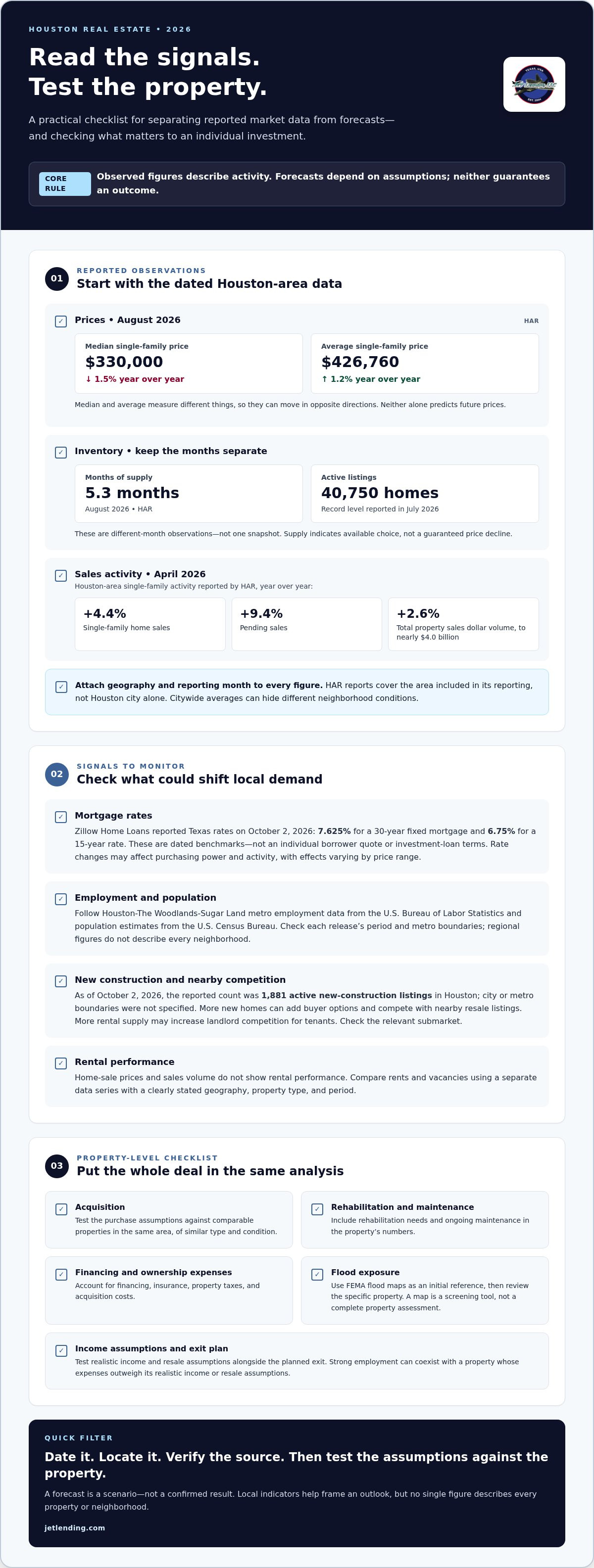
A favorable citywide forecast doesn’t make every property a sound investment. Houston real estate market predictions 2026 can help frame possibilities, but a decision should rest on verified local evidence and a property-level plan. A forecast is a planning input, not a property-level guarantee.
Use this process to turn uncertainty into clear next steps:
Write down your acquisition, rehabilitation, holding, and exit assumptions, then test how they work together. For example, consider whether the deal still makes sense if repairs take longer, the property sits vacant, or the eventual sale price is less favorable than your base case. Use project estimates and comparable evidence, not an invented market average. Include potential financing in the model alongside costs and timing. For a closer look at the numbers behind a renovation resale, read this fix-and-flip deal analysis guide.
Review comparable sales that match the property’s location, type, and condition. For rentals, assess local rental evidence separately from sale prices. Check the property’s condition and flood exposure, review applicable tax records, and use realistic insurance and financing assumptions. Update the model when new data, inspection findings, project costs, or expected timing change. If the deal only works under one optimistic forecast, pause and revise the assumptions before moving ahead.
Houston real estate market predictions 2026 offer useful context, but a citywide trend can’t tell you whether a specific deal works. Bring local market evidence together with the property’s condition, expected costs, financing plan, and exit strategy. Then test whether the project still makes sense if your assumptions change.
Short-term, asset-backed financing can support an investment-property acquisition or rehabilitation project. It is one part of the capital plan, not a forecast or a promise of project performance. Assess financing alongside the full timeline and budget, including purchase, rehabilitation, holding costs, and the expected sale or other exit.
This type of financing is designed for real estate investment projects. It differs from financing for an owner-occupied home and from unsecured personal borrowing. Compare the financing assumptions with both your base case and a less favorable scenario. Consider how a delayed renovation, higher costs, or a slower exit could affect the project.
For more context on investment financing in the area, read this Houston hard money lender guide. Use it as part of your research, then return to the specific property and its numbers.
Refresh market data before making a time-sensitive decision. Check recent comparable sales for the property type and location, and use relevant rental evidence if the plan depends on rental income. Review property-level details, including condition, rehabilitation scope, tax records, insurance assumptions, and flood exposure. Keep the date and geography attached to each market statistic so you know what it represents.
Next, put the project assumptions in one place. An investment property calculator can help you examine potential outcomes by adjusting inputs such as purchase costs, rehabilitation, financing, holding period, and exit assumptions. It won’t remove uncertainty, but it can show which assumptions matter most. If the deal only works when every estimate is favorable, pause and revisit the numbers.
Choose financing as part of that broader plan, not as a substitute for due diligence. Jet Lending provides short-term, asset-backed real estate investment financing for acquisitions and rehabilitation, alongside an investment property calculator. Consider how financing fits your project’s needs and downside scenarios before deciding on your next step.
The strongest Houston real estate market predictions 2026 are useful as context, not as a substitute for local research. Track dated market data, compare cautious and stronger scenarios, and focus on the neighborhood and property type you’re considering. Most of all, test the deal itself. A citywide outlook can’t account for every property’s condition, expenses, financing, or exit plan.
For real estate investors, financing is one part of that plan. Jet Lending is a Texas-based, asset-backed lending firm founded in 2004 that provides short-term financing for investment-property acquisitions and rehabilitation. Its investment property calculator can help you examine deal assumptions and potential outcomes. Use these tools alongside careful property-level due diligence, not as a guarantee of results.
Stay grounded in the numbers, update your assumptions as conditions change, and move forward when the property fits your goals and risk limits. A disciplined plan can help you assess Houston opportunities with clarity.
Houston home prices may rise, hold steady, or soften depending on location and property type. HAR reported a mixed picture for single-family homes in August 2026: the median price was down 1.5% year over year, while the average was up 1.2%. Those figures describe completed sales, not what will happen for the rest of the year. Use Houston real estate market predictions 2026 as possible scenarios, not guaranteed outcomes.
It can be a good time if a specific property fits your goals and its numbers hold up under realistic assumptions. Assess recent comparable sales, condition, potential rental income, financing, taxes, insurance, repairs, and exit options. Test a less favorable scenario alongside your base case. A positive citywide outlook alone doesn’t establish that a particular Houston investment property is suitable or profitable.
Mortgage rates, buyer affordability, employment, population change, construction, and available inventory can all influence Houston housing demand. Property-level expenses, including insurance, taxes, and repairs, also affect investment decisions. For context, Zillow Home Loans reported a Texas 30-year fixed mortgage rate of 7.625% on October 2, 2026, while the U.S. Bureau of Labor Statistics reported Houston metro unemployment of 5.2% in June 2026. These indicators have different dates and measure different conditions.
Don’t infer rental trends from home-sale prices. Rental performance can vary by neighborhood, property type, competing supply, and tenant demand. Before evaluating a Houston rental, review recent local rent comparisons and vacancy evidence for similar properties, then model income conservatively. Update your assumptions as new, relevant rental data becomes available.
Use forecasts to frame possibilities, then base your decision on the property and current local evidence. Compare recent sales of similar homes, review the property’s condition, and use relevant rental data if income is part of the plan. Build a base case and a less favorable case that account for acquisition, rehabilitation, financing, holding costs, and exit assumptions. If the deal only works under the most optimistic forecast, pause and reassess.
They can change a property’s ongoing costs and risk profile, so review them before deciding whether a Houston deal fits your plan. Use FEMA flood maps as an initial reference, then assess flood exposure for the specific property. Review Harris County Appraisal District records for property-tax research, and include realistic insurance assumptions in your analysis. Don’t rely on citywide averages; verify relevant details and costs for the individual property.
Tags:

The best hard money lenders Houston TX investors consider aren’t automatically the ones with the fastest pitch or broadest claims. The right fit depends on whether the loan structure matches your...

What if your Houston BRRRR deal looks profitable on paper but the refinance can’t return the capital you expected? Finding the right BRRRR method lenders Houston investors can work with starts with...

The lender who says yes first may not be the right fit for your Houston deal. When searching for private money lenders for real estate Houston investors can trust, start with the property, project...