
Written By: Stephanie Rojas | September 25, 2026
Time to Read 12 Minutes
The lender who says yes first may not be the right fit for your Houston deal. When searching for private money lenders for real estate Houston investors can trust, start with the property, project plan, and repayment strategy, not just speed. Financing terms that don’t fit your numbers can put pressure on projected returns.
Before comparing options, get clear on the project costs, expected performance, and exit plan. The right match depends on your investment strategy and the details of the property.
This guide explains how to assess Houston lenders, compare financing terms, and prepare a credible deal package for lender discussions. You’ll also learn how property and rehabilitation details can shape those conversations and how an investment property calculator can help you review your assumptions. Jet Lending, a Texas-based lender founded in 2004, offers short-term, asset-backed financing for real estate investment purposes, making it one option to consider as you evaluate your choices.
Private money lending is a broad category of financing provided outside the conventional bank lending channel. A lender might be an individual, a privately held company, or another nonbank source. The label alone doesn’t tell you how a loan is structured, what it costs, or which properties it may suit. Investors comparing private money lenders for real estate Houston has to offer should review each lender’s terms and approach against the details of a specific deal.
Some private financing is asset-backed. In plain English, the investment property helps secure the loan, and the lender considers factors such as the property and its intended investment use. That differs from an unsecured personal loan, which isn’t secured by real estate. It also differs from conventional real estate financing, which may have a different application, documentation, and evaluation process. Neither category has one universal set of terms, so confirm the structure, costs, requirements, and repayment expectations directly with each lender. For background on the related terminology, see this overview of the Hard money loan.
Don’t assume that “private money” and “hard money” describe identical products or requirements. Lenders can differ in how they assess property value, borrower experience, project plans, and repayment strategy. Conventional lending also varies by loan program and borrower. Compare the actual process and written terms, not broad labels or general claims about which option is faster or easier.
Acquiring an investment property or buying one that needs rehabilitation may prompt a discussion about short-term, asset-backed financing. The property’s condition, purchase details, planned work, and intended exit can help frame that conversation. They don’t guarantee that a particular project will qualify. A lender must assess the specific deal under its own requirements.
Keep the purpose of the financing clear. Investment property financing is intended for a real estate investment, not a home you plan to occupy as your residence. If you need financing for an owner-occupied home, look for a lender and loan option suited to that purpose. Jet Lending, LLC provides short-term, asset-backed financing for real estate investment acquisitions and rehabilitation. Houston investors can use that information as a starting point, then ask whether the lender’s approach fits their property and project. The right fit depends on the deal, not the label.
A useful comparison starts with your project, not a lender’s headline rate. As you evaluate private money lenders for real estate Houston investors may consider, use the same deal details and questions with each one. That makes it easier to spot differences in property fit, process, and repayment expectations.
| What to compare | Questions to ask |
|---|---|
| Property fit | Does the lender consider this property type, condition, and investment use? |
| Financing structure | How does the proposed structure work for acquisition, rehabilitation, or both? |
| Documentation | What property, purchase, project, and financial details should you provide? |
| Communication | Who will be your point of contact, and how will questions and updates be handled? |
| Exit planning | How does the lender assess your plan to repay, such as selling or refinancing? |
Request the complete proposal from each lender. Review all applicable costs and terms directly, including how payments, fees, and any project-related draws would work. Don’t rely on a verbal summary or compare offers using one figure alone. The Corporate Finance Institute explains how asset-based loan financing may relate loan amounts to property value. This is a useful reminder to ask how the lender evaluates both the asset and the deal.
Bring specific questions to the conversation: Which property and project details affect the lender’s evaluation? How do draws, payments, fees, and other terms apply to this proposal? Who handles communication, and what information is needed at each stage? Clear answers help you understand the process before committing time or revising your project plan.
Short-term financing may not suit every investment or timeline. Compare the complete written terms and check whether the structure fits your project milestones, from acquisition through rehabilitation and your planned exit. Notice whether the lender explains its requirements and responds clearly. Don’t assume a particular closing speed. Confirm the expected steps and timing with the lender.
If you’re considering short-term financing for an investment acquisition or rehabilitation, explore Jet Lending’s real estate investment financing as one option to compare against your deal needs.
For a real estate investment, lender discussions are shaped by more than the property’s address. Be ready to explain the acquisition plan, the work needed, your budget assumptions, and how you expect to repay the loan. These details help you assess whether a financing structure fits the project. Investors comparing private money lenders for real estate Houston options should connect each proposal to the deal’s actual numbers, not an optimistic resale estimate.
A useful analysis starts with the property’s current condition and a realistic improvement plan. Break rehabilitation work into specific items, estimate costs using information you can support, and include a contingency for unexpected work. For a step-by-step look at deal assumptions, review how to analyze a fix and flip deal.
After-repair value, or ARV, is an estimate of what a property might be worth after planned improvements. It is not a guaranteed sale price. Support your estimate with relevant comparable properties and a clear account of the work required. The real estate ARV guide can help you understand this estimate and how to use it in deal analysis.
Itemize the rehabilitation scope instead of relying on a single broad estimate. Consider how your plan could change if work takes longer or costs more than expected. A documented analysis gives you a clearer basis for evaluating financing and discussing assumptions with a lender.
Decide how you intend to repay the loan before you borrow. A sale and a refinance are different exit plans, and each depends on assumptions you should test. Include possible project delays and carrying obligations in your analysis. Check whether your budget and timeline still make sense if the work or sale takes longer than expected.
Asset-backed financing may suit some acquisition and rehabilitation plans, but it won’t fit every property or investment timeline. Use a simple pros-and-cons check:
Jet Lending’s investment property calculator can help you review deal assumptions. Treat it as an analysis tool, not an approval decision or a promise of project performance.
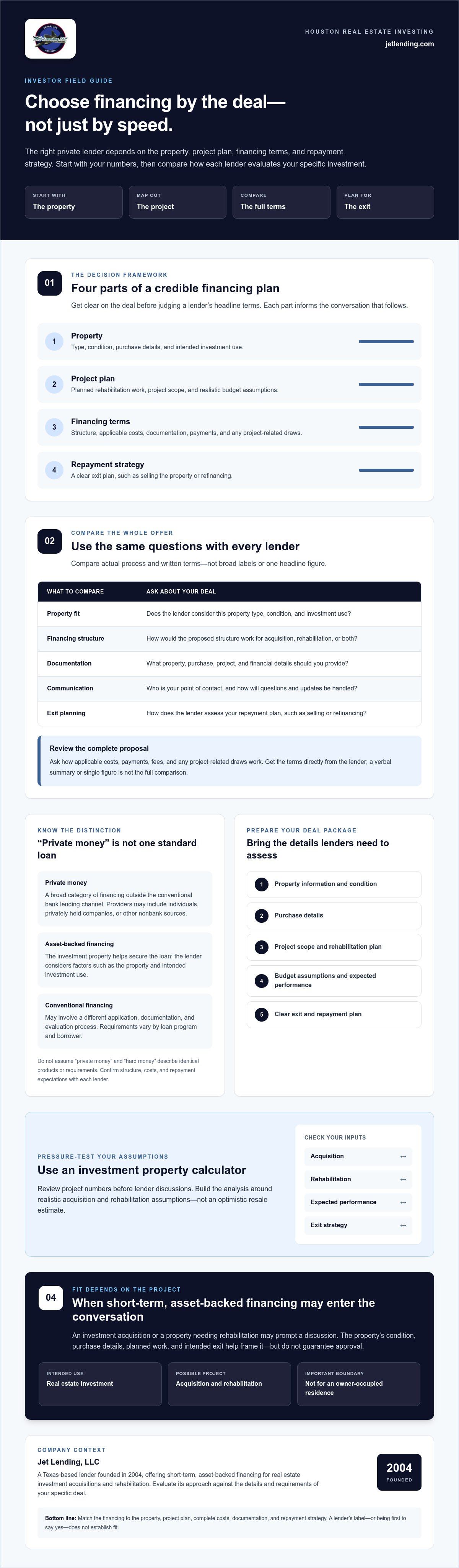
A clear deal package helps you explain what you’re buying, what work you plan to complete, and how you expect to repay the loan. Requirements vary by lender, borrower, property, and project, so use this sequence to organize your discussion, not as a universal application checklist. For more local financing context, read the Houston hard money lender guide.
Keep the information easy to review. You might organize it in a folder with separate sections for the property, purchase, rehabilitation, budget, comparable sales, and exit plan. This gives you a practical starting point when speaking with private money lenders for real estate Houston investors are assessing, while leaving room to provide lender-specific information as requested.
Before making a commitment, request the proposed financing terms and obligations in writing. Review them carefully and ask about anything unclear, including how project draws, payments, and applicable fees work for your proposal. For a Houston-area property, verify relevant property records and permitting requirements with the appropriate local authority. Don’t assume the process is identical across jurisdictions. Confirm which authority applies to the property and planned work.
Arrive prepared, but stay open to follow-up questions. A complete, well-organized package can make it easier to discuss the deal clearly, while the lender’s own review determines what information is still needed.
After preparing your deal details, compare them with a lender’s actual focus. Jet Lending, LLC is a Texas-based firm founded in 2004. It provides short-term, asset-backed financing for real estate investment acquisitions and rehabilitation. That may make it relevant to investors planning to purchase an investment property, complete improvements, and repay the loan according to a defined exit strategy.
Jet Lending’s investment property calculator can help you examine deal assumptions as you assess a project. Use your own figures and supporting information to understand how changes to acquisition or rehabilitation estimates may affect your analysis. The calculator is a planning resource, not a lending decision or a guarantee that a project will perform as expected.
Start by matching the property and plan to the financing purpose. If you’re considering short-term funding for an investment acquisition or rehabilitation, share the project details and ask which requirements and terms apply to your situation. Clarify how the proposed financing would work for the property and project, and review the full terms before deciding whether to proceed.
As you compare private money lenders for real estate Houston investors may consider, keep the purpose of the loan clear. Jet Lending’s financing is for real estate investment purposes. It does not offer owner-occupied residential mortgages or unsecured personal loans. If you’re financing a home you intend to occupy, this offering isn’t designed for that need.
Before contacting a lender, review the property details, project budget, and exit assumptions you’ve prepared. Be ready to explain what you plan to acquire or rehabilitate and how you expect to repay the loan. Then ask about the terms and requirements that would apply to your proposed deal. A focused discussion can help you assess fit without relying on assumptions about rates, approval, or timing.
The best lender choice depends on the individual property, investment plan, and proposed financing. If Jet Lending’s short-term, asset-backed approach may align with your project, contact Jet Lending about an investment property.
Choosing among private money lenders for real estate Houston investors may consider starts with matching the financing to the property, project scope, and exit plan. Compare complete written terms, ask how the lender evaluates your deal, and prepare realistic budget and resale assumptions before making a commitment.
Jet Lending, LLC is a Texas-based firm founded in 2004. It provides short-term, asset-backed financing for real estate investment acquisitions and rehabilitation. Its investment property calculator can help you examine deal assumptions, but lender fit depends on the specifics of your property and proposed financing.
Review your property details, project budget, and repayment plan, then ask questions about any requirements or terms you need clarified. A well-prepared conversation can help you decide whether an option aligns with your investment goals.
Build your next step on clear numbers and a plan you understand. Review your deal with Jet Lending and ask about financing for your Houston investment property.
A private money lender for real estate is a nonbank or privately sourced financing provider that may lend against an investment property. Asset-backed means the property helps secure the loan, while the investment purpose and project details inform financing discussions. “Private money” describes a broad category, not one standardized loan structure. Lenders can differ in how they assess properties, set terms, and request documentation, so confirm specifics directly.
Private money and hard money are often used to describe overlapping types of real estate financing, but the terms aren’t universally identical. Both may refer to loans where the property plays a central role in the lender’s evaluation. However, the label alone doesn’t establish the lender’s structure, requirements, or costs. Ask how a specific lender defines its financing and review the actual written terms rather than relying on terminology.
Start by researching private money lenders for real estate Houston investors may consider, then compare each lender’s fit for your property and project. Request written terms and review the full proposal, including applicable costs, payment structure, documentation, and repayment expectations. Ask who will communicate with you and what steps their process involves. A clear comparison helps you assess options without assuming every lender handles deals the same way.
Some private lenders consider financing for investment properties acquired and rehabilitated for resale, but eligibility depends on the lender and the specific project. Be prepared to explain the purchase, property condition, rehabilitation scope, budget assumptions, and plan for repaying the loan. Ask the lender directly whether your property and proposed work fit its requirements. Don’t treat the general use case as confirmation that a particular deal will qualify.
Review factors vary by lender and transaction, but discussions may cover the investment property, acquisition details, planned rehabilitation, budget assumptions, and repayment or exit plan. Prepare information that supports your estimates, such as an itemized scope of work and the basis for your projected value. Ask what else the lender needs to assess your specific deal. There isn’t one universal checklist or set of qualifying criteria.
Closing time depends on the lender, the property and deal, how quickly documentation is provided, and the due diligence required. Ask for the lender’s expected steps and timing for your particular transaction, and confirm what could affect the schedule. Organizing purchase details, property information, project scope, and budget assumptions can help you respond to questions. Don’t rely on a general estimate as a promise of a specific closing date.
No. Jet Lending’s described financing is short-term, asset-backed, and intended for real estate investment purposes, including property acquisition and rehabilitation. It does not offer owner-occupied residential mortgages or unsecured personal loans. If you’re evaluating an investment property in Houston, prepare the property details, project plan, budget assumptions, and exit strategy, then ask Jet Lending which requirements and terms apply to your proposed deal.
Tags:

The "cheapest" interest rate in the 2026 Houston market is often the most expensive choice an investor can make. While a lower conventional rate looks good on paper, it doesn't matter if you lose the...

In the 2026 Houston market, the cheapest loan isn't necessarily the one with the lowest interest rate; it's the one that lets you close before your competition even gets an appraisal. You've likely...

Why are you still waiting weeks for a bank appraisal while your competitors are already swinging hammers on the best off-market deals in Harris County? In a market where average flip profits...