
Written By: Stephanie Rojas | October 23, 2026
Time to Read 13 Minutes
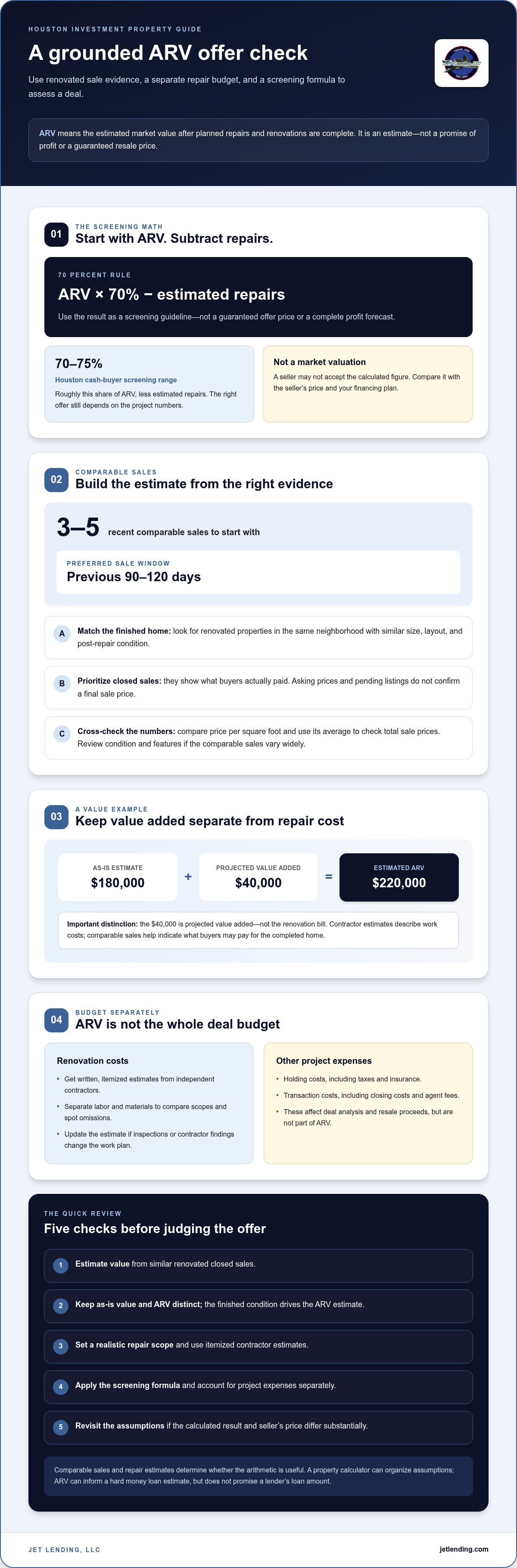
Calculating ARV for Houston properties means estimating what a home could sell for after renovation, using recent closed sales of similar renovated homes. To check an offer, start with the 70 percent rule: multiply the estimated ARV by 70%, then subtract estimated repair costs. Treat that as a screening guideline, not a guaranteed offer price.
It’s easy to focus on a home’s finished value and overlook how renovation, resale, and holding costs can change a deal. Repair spending also doesn’t necessarily add the same amount to a property’s value.
This guide walks you through choosing comparable Houston sales, estimating the home’s after-repair value, and building repair costs into an offer. You’ll also see how the 70 percent rule can help you assess a deal and how ARV can inform a hard money loan estimate. Use the steps to make your numbers more grounded before deciding whether a property fits your investment plan.
Assess the renovated value, repair budget, and offer separately before deciding whether a Houston deal works. The same ARV can support different offers when renovation scope and project costs vary.
Start with three to five comparable properties that sold recently, ideally within the previous 90-120 days. Look for renovated homes in the same neighborhood with similar size, layout, and condition after repairs. Closed sales in a multiple listing service provide stronger evidence than asking prices or pending listings, which don’t show what buyers actually paid.
Compare each sale’s price per square foot, then use the average to cross-check total sale prices. If renovated comparables differ widely, review their condition and features before relying on an average. Differences in bedroom count or renovation level can skew your ARV estimate.
Keep the property’s current, as-is value separate from its projected after-repair value. An online estimate can provide a starting point, but may not reflect the home’s condition or planned finishes. Compare it with actual sales and adjust your analysis to fit the property and its intended finished condition.
For example, a home valued at $180,000 with renovations estimated to add $40,000 has an estimated ARV of $220,000. The $40,000 represents projected value added, not the renovation bill. A contractor’s estimate describes what work may cost; comparable sales help indicate what buyers may pay for the completed home.
List planned repairs and upgrades, then compare the finished features with those of renovated homes nearby. Share planned finishes and additions with an appraiser estimating after-repair value. Don’t assume that spending more automatically raises ARV by the same amount. Nearby sales provide the market reference for the finished property.
Request written, itemized estimates from independent contractors. Each should separate labor and materials so you can compare scopes and spot omissions. List project expenses, such as carrying costs, taxes, insurance, and closing costs, separately from ARV. These expenses affect your deal analysis, but aren’t part of the home’s estimated resale value.
After-repair value, or ARV, estimates a property’s market value after planned work is complete. Use it to assess a real estate investment, not as a promise of profit.
Write down the planned scope, including major repairs, finishes, and additions. Then compare the intended finished condition with similar renovated homes. This keeps your estimate focused on what buyers may pay for the completed property, not what the work costs.
Use comparable sales to test the projected finished value. If planned upgrades exceed the standard of nearby homes, don’t assume buyers will pay extra for every improvement. A realistic ARV helps investors assess the purchase price and expected resale proceeds.
This calculation is a screening tool, not a full profit forecast. It helps investors compare an asking price with the project’s projected value and repair budget. A different ARV or repair estimate changes the result, so keep each input separate and traceable.
Review the scope for unforeseen repairs before relying on a maximum offer. Hidden issues can increase the project budget without adding equivalent resale value. Update your estimate when inspections or contractor findings change the work plan, then reassess the offer and projected profit.
Build your ARV estimate from closed sales that resemble the home after renovation. When calculating ARV for Houston properties, focus on comparable homes and local market conditions.
Match bedroom and bathroom counts, square footage, age, style, construction, and projected renovated condition. A 3-bedroom, 1,500-square-foot home is not a strong match for a 4-bedroom, 2,400-square-foot sale. Compare final sale prices and price per square foot, but don’t treat a larger home’s higher total price as evidence for a smaller property’s ARV.
Review each sale’s condition and renovation level alongside its price. If a comparable has substantially different features, separate it from the strongest matches instead of letting it skew the average. The closer the properties align in size and finished condition, the more useful their sale prices are for your estimate.
Check whether each comparable shares the subject home’s neighborhood context, flood-zone characteristics, and school district. Appraisers consider nearby surroundings and amenities, including shopping, parks, and schools. If a sale has different surroundings or is in another district, account for that difference rather than transferring its price directly.
Keep location factors visible in your notes. A sale with similar square footage may still be a weaker comparable if its amenities or setting differ. When calculating ARV for Houston properties, prioritize sales that reflect both the planned renovation and the location buyers will evaluate.
Use ARV to frame financing for a Houston investment, but keep the loan estimate separate from your offer calculation. The property’s projected completed value, repair cost, and transaction expenses each affect the deal differently.
Give the appraiser details about planned finishes and additions. The estimated completed condition should match the comparable properties behind your ARV. Square footage alone isn’t enough: layout, condition, and location differences can affect the value used in the analysis.
These figures answer different questions: one screens the purchase price, while the other illustrates a possible loan amount.
Use written contractor estimates to identify labor, materials, and the planned scope. If repair findings change, update the budget before relying on the original financing calculation. Higher repair costs can reduce the amount an investor can pay while increasing the funds needed to complete the work.
Location helps determine which renovated sales can support an ARV estimate. Compare the property with Houston homes that share its neighborhood context and relevant location characteristics.
Jet Lending offers Short-Term Loans for real estate investors evaluating investment-property financing. After estimating ARV, repairs, and project expenses, use those figures to assess whether a potential deal fits your investment plan. Jet Lending’s Investment Property Calculator can help organize assumptions and review the numbers behind a property.
Short-term financing may be relevant when you’re evaluating a real estate investment and considering financing alongside the purchase and renovation plan. Keep comparable sales, repair estimates, and the project budget together as you assess the opportunity. These inputs give you a clearer view of the investment as you consider financing.
Visit jetlending.com to explore Jet Lending’s short-term loan options and Investment Property Calculator.
Use your ARV analysis as a decision record, not just a figure in a spreadsheet. Keep the assumptions behind each offer together, including the sales selected, renovation scope, and financing needs. This makes it easier to revisit your analysis when a contractor’s estimate changes or a new comparable sale shifts your view of the finished property.
A disciplined approach to calculating ARV for Houston properties can help you make a clearer investment plan. Jet Lending’s Investment Property Calculator can help organize deal assumptions, and Short-Term Loans may be relevant when financing an investment property. Focus on the next decision your numbers need to support, whether you’re refining the budget or evaluating financing.
Consider what each assumption means for the deal. Thoughtful analysis gives you a stronger foundation for your next investment decision.
Estimate the home’s value in its planned, renovated condition by comparing it with similar completed sales. Check that comparable homes have similar features and finishes, rather than relying only on asking prices. Then use the estimated ARV to assess the deal separately from repair spending. For an offer screen, investors often apply a percentage of ARV and subtract projected repairs.
In real estate, ARV is the estimated resale value of a property after planned renovations are complete. It helps investors assess a project before buying, including whether the completed home’s likely value supports the purchase and work involved. ARV is a market-based projection, not a guaranteed sale price. The planned finish and nearby buyers’ expectations both matter.
An exact property-specific ARV or cash offer requires details about the home, its condition, planned work, and comparable sales. You can still model the calculation: with a $400,000 ARV and $50,000 in repairs, the 70 percent rule gives a maximum bid of $230,000 ($400,000 × 0.70 − $50,000). That figure is a screening estimate, not a buyer’s commitment or a formal valuation.
ARV is the projected value of a home in its completed renovation condition. To estimate it, compare the planned result with renovated homes sold in a similar market. An appraiser can assess the estimate using details about intended finishes and additions. A new feature supports the projection only if comparable buyers value homes with similar improvements.
ARV estimates a Houston home’s value after renovation; a cash-offer screen applies a percentage to that estimate and subtracts repairs. Houston cash buyers commonly use roughly 70-75% of ARV, less repair costs. The chosen percentage leaves room for resale and closing expenses, carrying costs, renovation surprises, and profit. A property’s neighborhood and completed condition shape the ARV input, while the repair estimate affects the resulting offer.
ARV stands for “after-repair value,” also called “after-repaired value.” Both terms refer to an estimate of what a property may be worth once planned renovation work is complete. They describe the home’s projected condition, not the amount spent on repairs. Keep the distinction clear in your spreadsheet: projected resale value and renovation budget are separate inputs in an investment analysis.
ARV is an investor’s estimate of a property’s value after renovation. It helps frame decisions about purchasing, improving, and potentially reselling a home. It isn’t the same as the loan amount: financing calculations may use ARV as an input, while loan terms and project details determine the financing outcome. A well-supported estimate reflects the planned finished home and market evidence from similar properties.
A simple value-added formula is: current property value + estimated value added by renovations = estimated ARV. Keep renovation spending separate, because the cost of work and the value it adds may differ. For offer analysis, a separate formula is often used: ARV × 0.70 − estimated repairs. Label each calculation clearly so you don’t mistake a projected resale value for a maximum purchase price.
Tags:

What if you could make a strong Houston offer without waiting for a bank’s full approval process? For investors competing with cash buyers, bridge loans for real estate investors Houston can provide...

A promising Houston deal can change quickly when a rehab runs late, holding costs rise, or the exit takes longer than planned. That’s why Houston real estate investment case studies should show more...

A strong fix-and-flip loan supports the full project, not just the property purchase. When comparing fix and flip loans Houston TX, look at how financing relates to both acquisition and renovation,...