
Written By: Stephanie Rojas | August 09, 2026
Time to Read 12 Minutes
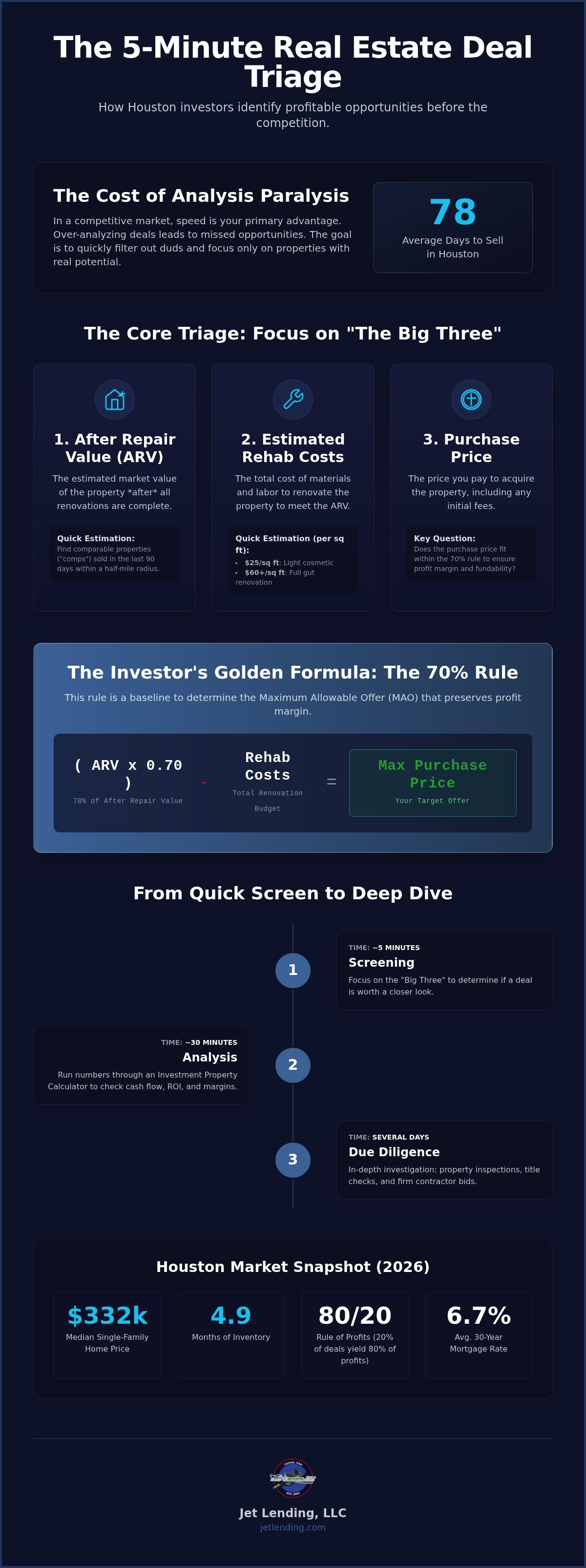
In the high-speed 2026 market, the most successful investors aren't the ones who analyze the most data. They're the ones who say "no" the fastest. You've likely felt the sting of analysis paralysis while a prime Houston property slipped away to a quicker buyer. It's exhausting to spend hours on a spreadsheet only to realize a lender won't fund the asset anyway. Mastering how to quickly screen real estate deals criteria is the only way to stay competitive when the average time to sell in Houston has climbed to 78 days.
You deserve a system that gives you the confidence to make initial offers without the constant second-guessing. We're going to master a 5-minute triage process designed to separate profitable opportunities from time-wasting duds. This guide covers the essential filters you need to align with lender requirements from the very start. You'll learn exactly which numbers to plug into an investment property calculator to get an instant green light or a hard pass. Let's streamline your workflow so you can stop chasing dead ends and start closing more deals.
Success in this industry follows the 80/20 rule. You'll likely find that 80% of your profits come from just 20% of the properties you review. If you spend hours analyzing every listing that hits your inbox, you're burning your most valuable asset: time. You need to understand real estate financial indicators to separate the winners from the duds in minutes. Crucially, your screening must account for "fundability" alongside profit. A deal can look great on paper, but if the asset doesn't meet lender requirements early on, it's a dead end. Learning how to quickly screen real estate deals criteria ensures you only chase deals that can actually reach the closing table.
Over-analyzing bad deals doesn't just waste time; it leads to spreadsheet fatigue. This emotional drain makes you hesitate when a "Green Light" opportunity finally appears. By the time you've triple-checked your math on a mediocre property, a savvy investor has already signed the contract on the neighborhood's best flip. Deal screening is the essential survival skill that allows you to act with certainty while others are still staring at their screens. It keeps your mind sharp and your pipeline moving without the weight of unnecessary data.
Don't confuse a quick screen with full due diligence. They serve entirely different purposes in your workflow. Effective screening requires only a few data points to determine if a deal is worth a closer look. You aren't looking for every cracked tile or leaky faucet yet; you're looking for the broad strokes of profitability.
Stop screening and start making the call the moment the math pencils out. Moving fast doesn't mean being reckless; it means being efficient with your most limited resource.
Your screening process lives or dies by three numbers: After Repair Value (ARV), Estimated Rehab, and Purchase Price. These are the "Big Three" that determine if a deal has legs. In the 2026 market, where the Houston median single-family home price sits at $332,000, you can't afford to be vague with these figures. Effective deal screening means finding the intersection where a property is both profitable for you and safe for your lender. Asset-based lenders prioritize the property's potential over your personal credit score, so the asset must stand on its own merits.
The classic 70% rule (Purchase Price = [ARV x 0.70] minus Rehab) remains a solid baseline, though it's often adjusted in high-demand Texas submarkets. With 30-year mortgage rates hovering between 6.66% and 6.75%, your exit strategy needs to be ironclad. If the numbers don't fit a What is a Hard Money Loan? framework, you're likely looking at a retail deal rather than an investment opportunity. Understanding how to quickly screen real estate deals criteria allows you to discard the retail fluff and focus on the equity-heavy wins.
Don't wait for a formal appraisal to guess the ARV. Look for "Quick Comps" within a half-mile radius that sold in the last 90 days. For rehab, use a standard price per square foot based on the level of finish needed. A light cosmetic refresh in Houston might run $25 per square foot, while a full gut could exceed $60. Check out our guide on How to Estimate Rehab Costs for a Flip to sharpen your on-site math.
A deal isn't a deal until it's funded. You must screen for the "as-is" value and ensure the property meets basic safety standards for short-term financing. Lenders typically look at Loan-to-Value (LTV) and Loan-to-Cost (LTC) limits to manage risk. If the property's current condition is too distressed for even a bridge loan, you need to know that in the first five minutes. Use an Investment Property Calculator early in your search to see if the deal aligns with typical lending leverage.
Once the initial math passes the "Big Three" test, you need to look at the physical and legal realities of the property. Knowing how to quickly screen real estate deals criteria means having a mental checklist that triggers an immediate "pass" or "pursue." In Houston's current market, where inventory has risen to 4.9 months, you have the luxury of being picky about quality even while moving fast on price. Your goal is to identify properties that fit the "path of progress." Look for areas where values are rising due to new infrastructure or commercial development rather than declining zones with stagnant growth.
Property type and occupancy status are your next vital filters. Single-family homes remain the gold standard for liquidity and ease of financing. Conversely, non-conforming properties or homes with "weird" layouts can stall your exit strategy. Always check if the home is occupied before making an offer. Resolving a squatter situation or an existing tenant lease can add months to your timeline, effectively eating your profits through holding costs. Finally, verify the financial "Green Light." If the initial triage doesn't show a minimum 15% ROI after all costs, including financing, it's likely not worth the risk of a short-term project.
Some issues are simply too expensive or time-consuming to fix within a standard flip window. Houston's expansive clay soil is notorious for wrecking foundations. If you see massive stair-step cracks in the brick or doors that won't close, you're looking at a major structural expense that can vary wildly. High-risk flood zones are another major hurdle. Without proper mitigation or affordable insurance, these properties are difficult to sell to retail buyers who are increasingly wary of Houston's weather patterns. Lastly, watch for title issues. A "cloudy" title or unresolved probate can prevent a quick closing, turning a fast flip into a legal nightmare. If the title isn't clear, the deal is dead until the seller resolves the dispute.
In the fast-paced real estate environment of 2026, your smartphone is your most effective acquisition tool. High-speed screening isn't about working harder; it's about letting technology filter the noise before you ever leave your office. By mastering how to quickly screen real estate deals criteria through specialized software, you can eliminate 90% of bad leads without making a single phone call. Tools like Google Street View allow you to "drive" a neighborhood in seconds. Look for signs of pride of ownership, such as recent renovations or well-kept yards, which signal a healthy exit market for your future flip.
On-site efficiency is equally critical for the modern investor. Use mobile apps to pull property tax and ownership data the moment you pull up to a curb. Knowing if a property is in pre-foreclosure or if the owner has significant equity changes your negotiation strategy instantly. Setting up automated alerts on platforms like the MLS or local data aggregators ensures you're the first to see properties that fit your specific "buy box." This proactive approach turns deal finding from a manual hunt into an automated funnel that feeds your pipeline while you sleep.
The centerpiece of your screening toolkit should be a robust Investment Property Calculator. By plugging in your estimated ARV and rehab costs, you get an immediate picture of your potential loan amount and profitability. This tool removes the guesswork, showing you exactly how much "Cash to Close" you'll need before you ever pick up the phone to talk to a lender. Our calculator helps you speak the language of lenders by focusing on the asset-backed metrics that professional financiers prioritize. It's the fastest way to verify if a deal is fundable or just a fantasy before you waste hours on deep due diligence.
Run your next deal through our Investment Property Calculator
While national sites like Zillow are useful for a surface-level glance, local Houston market knowledge trumps national data every time. Accessing direct MLS data or specialized aggregators provides the granular detail needed for accurate screening. These tools allow you to build a specific "buy box" that filters for property type, square footage, and neighborhood trends. In a market where Houston single-family homes average $428,709, precision matters. Automating your screening process through these platforms ensures you only spend time on deals that meet your exact criteria. This keeps your pipeline clean and your focus sharp on the 20% of deals that will actually generate profit.
Once you've applied your how to quickly screen real estate deals criteria and identified a winner, don't wait. Make your lender your first call. In a market where high-margin Houston properties move in hours, having a pre-vetted asset-based partner is your secret weapon. You've done the triage. Now you need to turn that "Green Light" into a recorded deed. Moving fast doesn't just help you beat other investors; it signals to the seller that you're a serious professional who can perform.
Jet Lending specializes in the rapid asset-backed financing Texas investors need to scale. We evaluate the asset just like you do, focusing on the equity and the exit strategy. When you present your screened deal, lead with the "Big Three" numbers we discussed in the previous sections. Providing a clear picture of the ARV, rehab budget, and purchase price allows us to move toward an approval at lightning speed. This alignment between your screening and our funding criteria is what makes the process feel seamless and uncomplicated.
Working with a local Texas lender prevents the common closing delays that plague national institutional firms. We understand the nuances of Texas-specific real estate laws and the unique soil conditions that affect Houston foundations. Since our founding in 2004, we've seen every market cycle the Gulf Coast has to offer. This deep experience helps you avoid bad deals that might look good on a generic spreadsheet but fail in the local reality. We aren't just a source of capital; we're a partner invested in your journey.
Prepare your "Deal Package" using the notes from your rapid screening process. A clean package includes your ARV comps, a high-level rehab list, and the signed contract. This preparation allows you to compete with, and often beat, cash buyers who might be slower to pull the trigger. Rapid funding gives you the leverage to negotiate better prices because you can offer a certain, fast closing date. Transitioning from a checklist to a formal loan application should be the easiest part of your day. Let's get your next project off the ground.
Success in the 2026 Houston market belongs to the investors who can separate profit from noise in minutes. You now have the triage tools to filter for ARV, rehab costs, and essential fundability. By mastering how to quickly screen real estate deals criteria, you protect your time and ensure your energy is focused on the 20% of opportunities that actually pencil. Don't let analysis paralysis hold you back while competitors close on the best flips in the neighborhood.
Jet Lending is here to help you move from the initial screen to a closed deal in days. With over 20 years of experience in Texas real estate lending, we specialize in providing the rapid asset-backed funding required for Houston fix and flip projects and rental portfolios. We evaluate the asset with the same precision you do; this ensures your growth is built on a solid financial foundation.
You have the checklist and the technology to scale your business. It's time to put these screening habits into practice and secure your next win with confidence. We're ready to partner with you on the journey ahead.
The most important criteria is the relationship between the After Repair Value (ARV) and your total acquisition cost. You must ensure there is enough equity to cover rehab, financing, and selling costs while still leaving a healthy profit. In the 2026 Houston market, focusing on properties with a clear "path of progress" ensures your exit strategy remains viable even if market conditions shift during the renovation.
An initial triage screen should take no more than five minutes. This phase is designed to discard the 80% of deals that don't meet your basic profit or fundability requirements. You aren't performing a full inspection yet; you're simply verifying if the "Big Three" numbers—ARV, rehab, and purchase price—align with your investment goals. If they do, you can then commit to a more detailed 30-minute analysis.
Yes, you can perform a high-level screen virtually using digital tools and data aggregators. Use Google Street View to check the neighborhood's pride of ownership and local MLS data to pull recent comparable sales within a half-mile radius. Virtual screening is an essential part of how to quickly screen real estate deals criteria because it allows you to filter dozens of leads from your desk before spending time on the road.
The 70% rule states that your purchase price should be 70% of the ARV minus rehab costs. It remains a powerful baseline for many investors, though some in competitive Texas submarkets adjust this to 75% to account for higher demand. It works because it builds in a 30% buffer for financing, closing costs, and profit, which is vital when 30-year mortgage rates are hovering near 6.75%.
Use a "price per square foot" multiplier based on the level of renovation needed. A light cosmetic refresh in Houston typically runs around $25 per square foot, while a full gut renovation can exceed $60. This ballpark figure is perfect for the five-minute triage stage. You'll only need to bring in contractors for firm bids once the deal has passed your initial screening and moved into due diligence.
Avoid non-conforming properties or those with "functional obsolescence," such as a home with a tiny kitchen or a bizarre floor plan. These properties are difficult to comp accurately and often sit on the market longer than the current Houston average of 78 days. Stick to standard single-family homes that appeal to the largest pool of retail buyers to ensure a fast and predictable exit.
Hard money lenders focus primarily on the asset's value and your exit strategy rather than your personal credit score. They look at Loan-to-Value (LTV) and Loan-to-Cost (LTC) ratios to ensure the property provides enough collateral for the loan. Presenting a screened deal with a clear ARV and a realistic rehab budget shows the lender that the asset is fundable and the project is professional.
No, liquidity and fundability are just as important as your projected Return on Investment (ROI). A deal can show a 20% return on paper, but if the property is in a high-risk flood zone or has major title issues, it may be impossible to fund or sell. Your screening process must verify that the property meets lender safety standards so you don't get stuck with an asset you can't exit.
Tags:
Is the lower interest rate on a primary home worth the risk of a federal mortgage fraud investigation? Many investors weigh the choice of an investment property loan vs primary residence to see if...

Why are you still letting big banks and their rigid debt-to-income ratios kill your deals while cash buyers snatch up the best Houston zip codes? In a market where 8,000 new jobs are fueling rental...

Why do most new investors lose their entire profit margin before the first wall even comes down? It usually happens because they're guessing on the numbers. You know the feeling of standing in a...