
Written By: Stephanie Rojas | October 24, 2026
Time to Read 12 Minutes
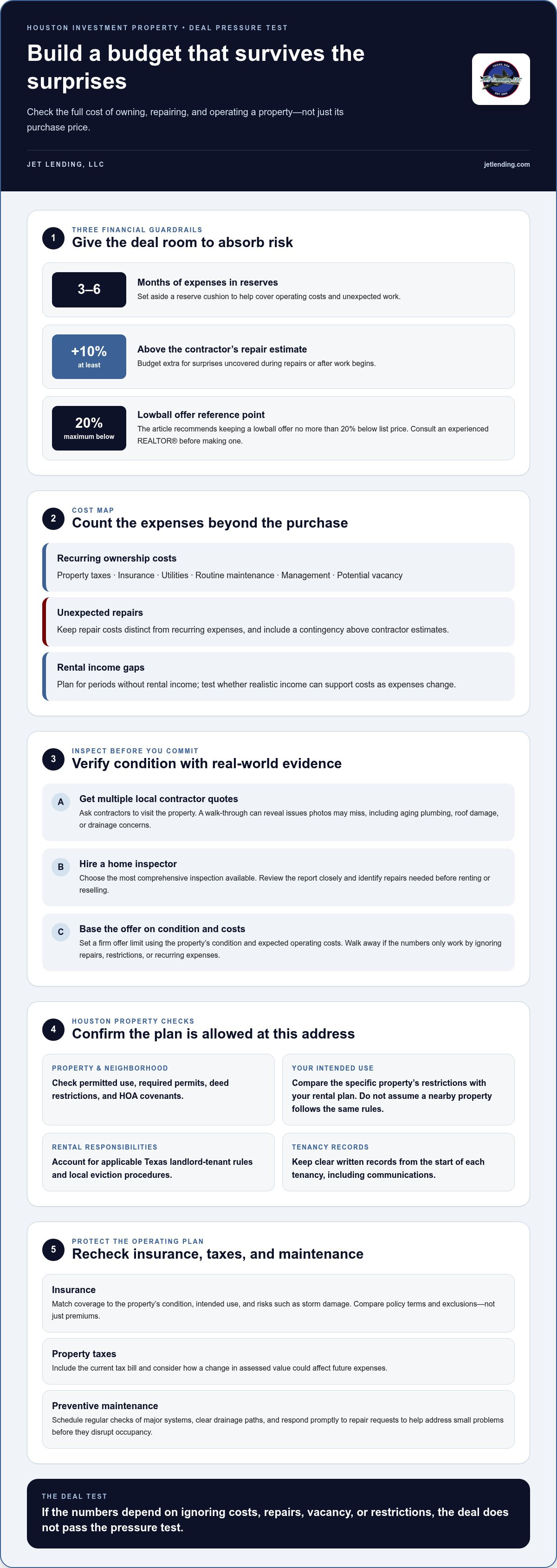
The practical guide to real estate investor mistakes to avoid in Houston starts with one rule: budget for the full deal, not just the purchase. Set aside 3-6 months of expenses as reserves, and budget at least 10% above a contractor’s repair estimate. Those cushions can help keep operating costs and unexpected work from undermining your plan.
A promising property can still become a costly investment if the numbers rely on optimistic assumptions. You’ll learn how to assess expenses, match a strategy to the property, research local demand, estimate returns, and avoid overpaying.
Use these steps to pressure-test a Houston deal before committing. A realistic view of costs, repairs, and potential income can help you make a more informed investment decision.
Calculate the full cost of owning each Houston property, not just its purchase price. List property taxes, insurance, utilities, routine maintenance, management, and potential vacancy. Separate recurring costs from unexpected repairs. This makes it easier to judge whether projected income can support the property as expenses change.
Get multiple local contractors to visit the property and provide quotes. A walk-through can expose issues that photos miss, such as aging plumbing, roof damage, or drainage concerns. Hire a home inspector before buying, and choose the most comprehensive inspection available. Review the report closely, then identify repairs needed before renting or reselling. Budget at least 10% above the contractor’s repair estimate to allow for surprises.
Research the parcel and neighborhood before estimating rent. In Houston, check the property’s permitted use, required permits, deed restrictions, and HOA covenants. These may affect whether your rental plan is allowed and what changes you can make. Review the restrictions for the specific property and compare them with your intended use. Don’t assume a nearby property follows the same rules.
Rental owners also need to account for applicable Texas landlord-tenant rules and local eviction procedures. Lease terms, required notices, communication records, and court procedures can affect how a dispute is handled. Include these responsibilities in your operating plan, and keep clear written records from the start of each tenancy.
Review insurance separately. Match coverage to the property’s condition, intended use, and exposure to risks such as storm damage. Compare policy terms and exclusions, not just premiums. Include the current property tax bill in your analysis and consider how a change in assessed value could affect future expenses. Revisit both estimates if the property’s condition or use changes.
Preventive maintenance helps you address small problems before they disrupt occupancy. Schedule regular checks of major systems, clear drainage paths, and respond promptly to repair requests. Keep reserves equal to 3-6 months of expenses. An Investment Property Calculator can help organize projected income and costs, but accurate inputs matter. Use contractor quotes, insurance details, tax records, and realistic vacancy assumptions.
Finally, set a firm offer limit using the property’s condition and expected operating costs. A low offer can offend a seller, so consult an experienced REALTOR® before making one on a property you want. The recommendation is to keep a lowball offer no more than 20% below the listing price. Walk away if the numbers only work by ignoring repairs, restrictions, or recurring expenses.
Choose a rental strategy before making an offer. A property suited to long-term tenants may not work as a short-term rental, even if its listing photos look ideal. Consider your available time, operating capacity, target renter, and expected income. Then compare those needs with the property’s layout, location, and permitted use.
Long-term rentals depend on sustained tenant demand and lease income. Short-term rentals can bring frequent bookings but require ongoing guest communication, turnover, cleaning, and prompt repairs. In Houston, compare the property’s rules and neighborhood conditions with your intended rental model. A strategy that conflicts with deed restrictions or HOA rules can undermine the deal before it earns income.
How do Houston short-term rental rules and economics compare with long-term rentals? Short-term rentals require a plan for local requirements, property restrictions, guest turnover, and emergency repairs; maintain a network of repair providers available 24/7. Long-term rentals generally involve fewer turnovers, but income depends on attracting and retaining tenants under suitable lease terms.
Match the strategy to how actively you want to manage the property. An investor with limited time, for example, may find frequent guest turnover difficult. A property near visitor destinations might suit short stays if local rules and demand support them. A long-term rental may fit a steadier routine, but still requires tenant screening, maintenance coordination, and vacancy planning.
Before choosing, build a separate forecast for each strategy. Estimate rent or booking income, vacancy, cleaning, management, utilities, maintenance, and insurance. Include the financing terms and the time needed to prepare the property. A conventional mortgage agreement may have a 30-year term, while short-term financing has a different repayment horizon. Compare the payment schedule with your expected income and exit plan.
Treat the listing as a starting point, not proof of performance. Check nearby rental options, property condition, access to employment or visitor destinations, and features renters value. Consider whether the floor plan suits your target tenant. A spare room may help with a shared-rental strategy, while a private entrance may matter more for another type of renter.
Finally, write down the conditions that would make you switch strategies or pass on the property. Consider whether the numbers still work if bookings soften, a tenant leaves, or repairs take longer than planned. An investment property calculator can help compare projected income and expenses across different scenarios.
Evaluate a Houston deal by cash flow after expenses, not projected rent alone. Estimate operating income, subtract taxes, insurance, maintenance, management, vacancy, and financing costs, then compare the remainder with the cash invested. Create one estimate for expected performance and another for a weaker rental period. This makes the assumptions behind potential profit easier to assess.
Financing terms can shift the result quickly. In a Houston apartment portfolio, the interest rate rose from 3.4% to around 8%, and loan costs increased 135%. The investors had acquired 3,200 units between August 2021 and April 2022. They later defaulted on $229 million in loans across four Houston properties. The example shows why a deal needs to withstand higher borrowing costs, not just work under its original assumptions.
What financing and cash-flow mistakes should first-time Houston real estate investor mistakes to avoid Houston? Don’t base a purchase on the initial interest rate, gross rent, or uninterrupted occupancy. Model payment obligations, vacancies, repairs, and income delays together, then confirm you have enough cash to cover costs when rent falls short.
Build a month-by-month cash-flow forecast around the property’s actual rental plan. Record expected rent separately from income after vacancy, then subtract recurring expenses and scheduled debt payments. Add a stress case with lower occupancy or slower leasing. If one repair or delayed tenant payment creates a shortfall, you may need more working capital or a lower purchase price.
Review the inspection report before finalizing return estimates. List repairs that affect safety, habitability, or the ability to rent or resell, then use contractor estimates to revise the acquisition budget. Budget at least 10% more than a contractor’s repair-cost estimate. That added allowance helps keep a repair overrun from erasing projected profit or disrupting planned cash flow.
Separate the property’s performance from the financing’s. A property can generate operating income while loan payments still consume too much cash. Compare projected income after operating expenses with scheduled debt obligations, accounting for the loan term and payment structure. Don’t assume refinancing or resale will solve a cash-flow gap.
Test whether the expected return justifies the risks. Compare cash invested with cash flow after expenses, then repeat the calculation using less favorable rent and borrowing assumptions. Write down your assumptions. Jet Lending, LLC's Investment Property Calculator can help organize income and expense estimates, but each input should reflect the property’s actual condition and financing terms.
Review the inspection report and identify repairs needed before renting or reselling. Include those costs when assessing the investment.
Houston’s real estate market varies by neighborhood and property type. Don’t treat citywide demand as proof that a specific rental will attract tenants. Define your target renter, then assess whether the property’s location, layout, and access suit that renter’s needs.
Which Houston neighborhoods have the strongest rental demand and investment potential? No single neighborhood is strongest for every strategy. Compare tenant demand, nearby jobs and services, competing rentals, and property costs in each area. Match those findings to your intended renter and the property before choosing a location.
Define a search area around the property. Map nearby employers, schools, transit options, grocery stores, and healthcare facilities. Then compare available rentals with similar bedrooms, amenities, and lease terms. If comparable listings offer features your property lacks, account for that difference when estimating achievable rent.
Look for evidence of demand, not just an appealing neighborhood reputation. Track how long comparable listings remain available, whether asking rents change, and which features appear repeatedly. If nearby rentals emphasize parking or in-unit laundry, for example, consider whether your property offers those features and how that may affect renter interest.
Check supply as carefully as demand. A cluster of new rental properties can give tenants more choices and put pressure on pricing. Compare your property’s condition and amenities with those alternatives. Ask whether it would stand out for a specific reason, such as a practical floor plan or convenient access to a major employment area.
Separate current conditions from expectations about future growth. A proposed development or infrastructure project may change an area, but it isn’t evidence of present-day rental activity. Record what is operating now, what is under construction, and what remains a proposal. Base your purchase decision on the property and its existing surroundings.
Financing costs also shape which locations fit your strategy. Compare projected rent with the property’s financing obligations and operating costs, then test whether the cash flow holds if leasing takes longer. Even a neighborhood with strong interest may produce a weak investment if acquisition costs exceed realistic income.
Use the same comparison sheet for every Houston property. Record the target renter, nearby rental options, access to daily services, property condition, and likely operating demands. This keeps an attractive showing from overshadowing weak local evidence. Revisit the same indicators before making an offer, especially if the listing’s income assumptions differ from comparable rentals.
Set your maximum offer before negotiating, based on realistic income, property condition, and financing costs. Treat the listing price as the seller’s asking point, not proof of market value. Compare the property with similar local sales, adjusting for differences in condition, layout, location, and rental potential. A polished renovation doesn’t justify paying more than the expected income supports.
Use comparable properties carefully. Focus on similar homes or buildings in nearby locations rather than selecting only the highest-priced examples. Note how each comparison differs from the property you’re considering. A renovated property may command more than one needing repairs, while weaker rental demand may support a lower value. These distinctions help ground your offer in evidence.
Houston’s apartment market shows the potential cost of an aggressive purchase. A local portfolio’s auction sale price was estimated to be at least 30% below what its previous owners paid. That outcome isn’t a direct valuation for another property, but it illustrates why an investor shouldn’t rely on rising values or a future resale to make an overpriced deal work.
Calculate your offer from the investment’s expected performance. Start with rent supported by comparable listings, subtract operating expenses and financing costs, then account for repairs and vacancy. The remaining cash flow should support the price you’re willing to pay. If the return depends on optimistic rent or ignoring known defects, lower your offer or walk away.
Keep negotiation measured. A lowball offer can offend the seller, so consult an experienced REALTOR® before making one on a property you genuinely want. The guidance is to keep a lowball offer ideally no more than 20% below the listing price. Explain your offer through comparable sales, inspection findings, and realistic income assumptions, rather than an arbitrary discount.
Protect your limit during negotiations. Write down the evidence behind your maximum price and review it before responding to a counteroffer. If the seller’s price exceeds your limit, don’t let competition or time spent reviewing the property distort your analysis. Another buyer’s interest doesn’t change the property’s costs or likely income.
Before signing, revisit your offer using the inspection report and updated repair estimates. Confirm that the purchase still fits your rental strategy and financing plan. If new information changes the costs, revise your maximum rather than relying on an earlier calculation. A clear walk-away point preserves capital for a property with stronger fundamentals.
Jet Lending offers Short-Term Loans for real estate investors considering an investment purchase or project. This financing may fit a plan that calls for short-term funding; weigh the repayment obligations against projected cash flow and your exit strategy. Jet Lending’s Investment Property Calculator can help organize income and expense assumptions as you assess a deal. Consider the property’s condition, rental plan, and financing costs before deciding whether the numbers fit your goals.
To learn more, visit Jet Lending.
Turn your investment criteria into a repeatable decision process. Before pursuing another property, define what must be true for the deal to fit your goals, including the income plan, financing approach, and exit path. Apply those standards consistently, even when a listing feels like a rare opportunity. That discipline helps prevent real estate investor mistakes in Houston from shaping your decisions.
When you’re ready to explore financing for an investment property, talk with Jet Lending about its Short-Term Loans. Use the Investment Property Calculator to organize your deal assumptions as you evaluate the next opportunity.
Keep learning, trust your analysis, and take your next step with a clear plan.
Real estate investor mistakes to avoid in Houston often begin with assumptions: rent will arrive immediately, repairs will stay minor, or resale value will rise. Write down the evidence behind each assumption before making an offer. Match projected rent to comparable properties, for example, and decide what you’ll do if the unit takes longer to lease. Treat unsupported assumptions as risks, not income.
Property taxes reduce the income left after operating expenses, so include them in your net cash-flow calculation, not just as a closing detail. Review the current tax bill and compare it with projected income. Then test whether the deal still works if assessed value changes. When estimating the tax burden for a specific parcel, account for its taxable value and applicable exemptions.
Assess mapped flood exposure and look for signs of prior water intrusion. Check the lot, access roads, and building in relation to drainage paths, and examine the roof, windows, foundation, and lower-level finishes for storm damage. Ask about past flooding and insurance claims, then review insurance terms for applicable flood and wind coverage, exclusions, and deductibles. The property’s condition and insurance requirements can affect repair exposure and your operating plan.
Compare flood maps with property-specific evidence, since a map alone won’t reveal every drainage issue. Review seller disclosures and available claim records, inspect the yard and nearby streets for water marks or pooling, and look for drainage features that direct runoff away from the structure. A survey or elevation certificate can help clarify building and land elevations. Ask an inspector to note moisture in the foundation, crawlspace, and lower walls.
Prepare separate, property-specific estimates for each expense. Base repairs on inspection findings and contractor visits; compare insurance proposals by coverage and exclusions; and ask property managers to outline their services and charges. For vacancy, review comparable rentals and how long similar units remain available. Keep assumptions separate so a change in one category doesn’t hide its effect on cash flow or expected profit.
Start with a comprehensive property inspection, adding specialist reviews when visible conditions warrant them. Check the roof, foundation, plumbing, electrical systems, HVAC, drainage, and signs of pests or moisture. Review title documents, existing leases, seller disclosures, permits for major work, utility arrangements, and applicable deed or HOA restrictions. Confirm the intended rental use suits the property before closing, and compare inspection findings with the seller’s description of its condition.
Tags:

What if the next property deal doesn’t need more research, but a clearer point at which to decide? Investors know due diligence matters. But when every opportunity brings new numbers, risks, and...

In Houston's fast-moving 2026 real estate market, a lender who doesn't know the difference between the Heights and the Third Ward isn't just a partner; they're a liability. You've likely felt the...

What if the right loan for a Spring Branch investment depends less on a standard mortgage checklist and more on the property, project, and exit plan? Comparing real estate investment loans Spring...