
Written By: Stephanie Rojas | November 21, 2026
Time to Read 13 Minutes
A cash sale can make the path to closing faster, but speed may come with a lower offer. If you're asking what happens if you can't sell your flip in time in Houston, start by comparing the certainty and timing of a cash offer with the potential reach of an agent-listed sale. A traditional agent sale in Houston or elsewhere in Texas can take 30 to 90 or more days.
That timing matters when loan payments and carrying costs are eating into your margin. A cash buyer may simplify the sale, while listing with an agent can expose your renovated property to more buyers. The right move depends on your deadline, the offer in hand, and what you could gain or spend by waiting.
This guide compares cash and agent sales, explains how Greater Houston market conditions can affect your timeline, and outlines practical next steps if your flip isn’t selling. You’ll be better equipped to weigh speed against sale price and choose a plan that fits your project.
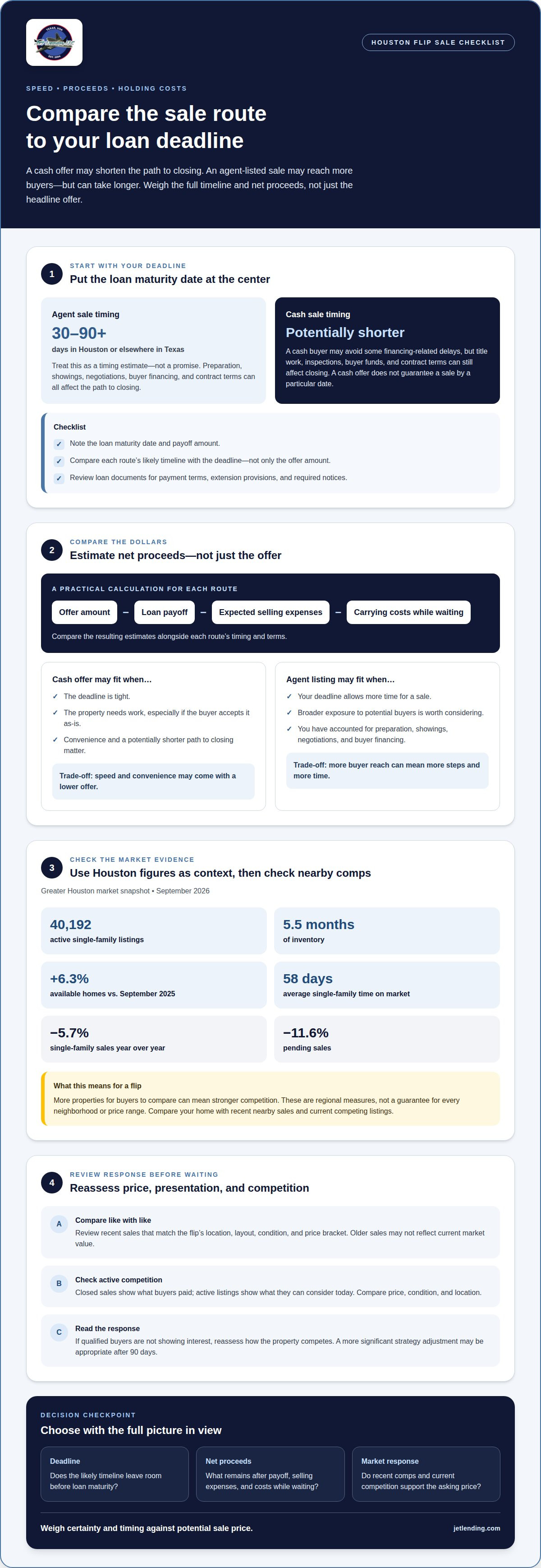
A cash offer can shorten the path to closing, but it doesn’t guarantee a sale by a particular date. A traditional agent sale in Houston or elsewhere in Texas can take 30 to 90 or more days. That estimate makes your deadline central: compare each option’s likely timeline with your loan maturity date, not just its headline offer. A cash buyer may avoid some financing-related delays, while title work, inspections, buyer funds, and contract terms can still affect closing.
Start with net proceeds, not the offer alone. For each offer, subtract your loan payoff and expected selling expenses, then account for carrying costs while you wait. An agent-listed property can reach more potential buyers, but preparation, showings, negotiations, and buyer financing add steps. A cash offer may suit a tight deadline or a property that needs work, especially if the buyer accepts it as-is. The trade-off is that speed and convenience may come with a lower offer.
Market response can also change the comparison. Another agent reported receiving 13 offers on a flip, including five at $330,000 and two at $340,000. These examples show that agent listings can attract strong interest, but they don’t predict what a specific Houston property will receive. Neighborhood, condition, asking price, and competing listings all affect buyer response.
Use a simple decision process. First, note your loan’s maturity date and the payoff amount. Next, estimate net proceeds and ongoing expenses under both sale routes. Then compare the cash offer’s closing terms with the time an agent sale may take. If the agent route leaves little time before maturity, a potentially higher sale price may not offset the risk of carrying the property longer. If your deadline allows more time, broader market exposure may be worth considering.
Also review the listing’s response before assuming that waiting will solve the problem. Review the property's market response and reassess how it competes if it isn't attracting offers. A more significant strategy adjustment may be appropriate after 90 days. Compare the asking price with recent comparable sales and the condition of competing homes. For a flip that isn’t drawing qualified interest, adjust the strategy before carrying costs narrow your choices further.
Greater Houston recorded 40,192 active single-family listings in September 2026, with 5.5 months of inventory. Available homes were 6.3% higher than in September 2025. For a flipper, that means buyers have more properties to compare, so a renovated home must compete on price, condition, and location. Inventory is a regional measure, not a guarantee that every neighborhood or price range faces the same competition.
Sales activity also signals a more measured market. Greater Houston single-family home sales declined 5.7% year over year in September 2026, while pending sales fell 11.6%. The average single-family home spent 58 days on the market that month. These figures describe different parts of the sales process: closed sales show completed transactions, pending sales indicate homes under contract, and days on market reflect time before a sale. Together, they help explain why a flip may need more time to attract a buyer.
Use that figure as regional context, not as a pricing target for a specific renovation. A property’s likely value depends on nearby comparable homes, its size and condition, and the features buyers can get for a similar price. A custom home and a modest renovated house may attract different buyer pools, even within Greater Houston.
Refresh your comparable-sales review before deciding whether to hold, reduce the asking price, or change your plan. Sales from several months ago may not reflect current market value. Look for recent sales that match your flip’s location, layout, condition, and price bracket. Compare active listings, too: closed sales show what buyers paid, while competing listings show what they can consider today.
What are the risks of foreclosure or a short sale if you can’t repay your Houston flip loan? If the loan matures unpaid, foreclosure may become a risk under the loan documents. A short sale means selling for less than the amount needed to repay the debt. Lender consent and responsibility for any remaining balance depend on the loan terms.
Use the September 2026 figures as a market snapshot, then assess your property’s immediate competition. If similar homes are attracting offers while yours is not, price or presentation may be out of step. If comparable listings are also sitting, factor that slower demand into your timing and carrying-cost decisions. Local evidence matters more than a single metro-wide median.
If your Houston flip hasn’t sold by the loan maturity date, first find out the payoff amount and what options your lender may offer. Review the maturity date, payment terms, extension provisions, and required notices in your loan documents. Contact the lender before the deadline with a clear update: the property’s listing status, buyer activity, expected sale proceeds, and proposed next step. Waiting until the due date leaves less room to discuss a workable plan.
Build your decision around this property’s numbers. Estimate its current sale value using comparable homes, calculate the loan payoff, and add the cost of holding the home. Then compare those figures with a revised sale plan or rental scenario. A lower asking price may bring a quicker sale but reduce the proceeds available to repay the loan. Holding longer may give you more time to find a buyer, while adding expenses and delaying repayment.
Renting can be another route if the property is ready and the numbers support it. One forum participant suggested renting an unsold property for 3-12 months before trying to sell again. Another suggested considering short-term or medium-term rental for 6-9 months before returning to the sale market. Treat these as possible strategies, not guaranteed timelines. Rental income, operating costs, the property’s condition, and your loan terms all shape whether this approach fits.
Before changing plans, map out the practical steps. Confirm the loan payoff process and any extension requirements with the lender. Check whether the property is ready for tenants, estimate likely rent against taxes, insurance, utilities, maintenance, and debt payments, and identify the funds you’ll need during any vacancy. If selling remains the goal, compare the current listing price with recent nearby sales and competing homes. Renting as a bridge only helps if the property’s income and your financing can support the additional holding period.
Work backward from maturity to create a written timeline. Include time for buyer negotiations, closing, or preparing the property for rent. A sale can take longer than expected, so don’t base repayment plans on an offer that hasn’t closed. If your flip still needs repairs or has weak buyer interest, factor those issues into the decision now. Address the maturity date early, compare realistic paths, and communicate your plan before the deadline.
Each extra month with a Houston flip adds costs that reduce your eventual net proceeds. Property taxes, insurance, utilities, loan payments, and maintenance continue while the home remains unsold. Build a holding-cost worksheet with a separate line for each expense. Use the actual property tax bill, current insurance documents, utility statements, and loan terms. Divide costs by the expected holding period to see how time affects the project, and update the worksheet if your sale timeline changes.
Property taxes are easy to overlook during renovation because they don’t appear in contractor invoices. Include the amount shown in the property’s tax records in your project forecast, and set aside funds as needed. Don’t treat a projected sale price as available cash before closing. If the listing takes longer than planned, the tax obligation remains part of your carrying costs. Keep the property’s tax paperwork with your purchase, renovation, and financing records.
Insurance is another ongoing cost, and the right coverage depends on the property’s use and condition. A vacant home under renovation may need different coverage from an occupied rental. Review the policy documents for covered property, exclusions, vacancy terms, and renovation-related conditions. Tell the insurer about material changes in use or occupancy. Don’t assume an existing policy still fits after construction ends or tenants move in. Record the premium and renewal date in your forecast.
Utilities matter before and after renovation. Electricity may support lighting, heating, cooling, tools, or showings; water may be needed for construction and cleaning. A vacant property still needs upkeep, so don’t budget as though every meter is inactive. Review bills to see actual usage, identify which services must stay on, and account for the cost of keeping the home sale-ready. Track changes as renovation work winds down.
To see how costs add up, group expenses into fixed and usage-based categories. Taxes, insurance, and loan payments generally belong in your recurring-cost view; electricity and water can vary with activity and occupancy. Add maintenance, lawn care, and repair reserves as separate lines when they apply. Compare the total with projected sale proceeds or potential rental income. An investment property calculator can help organize deal assumptions, but accurate estimates still depend on the property’s bills and loan terms.
Use the worksheet to compare choices, not just total past spending. Estimate the added carrying cost of waiting against the expected proceeds from a revised sale plan. If you’re considering renting, include vacancy, utilities, insurance, and upkeep in that scenario. Keep receipts and statements together so you can replace estimates with actual figures. A clear cost picture helps you judge whether holding the Houston flip longer still supports your financial plan.
Start with the property’s exact address. A Houston mailing address doesn’t always establish which government jurisdiction handles the property. Identify whether the home falls within Houston city limits or another local jurisdiction, then contact the relevant planning and permitting office. Ask how the intended rental use affects permits, inspections, or occupancy approvals. Keep written responses with your renovation records. Don’t assume renovation approval automatically answers every question about operating the finished home as a rental.
Next, review the work completed during the flip. Compare the renovations with permits, inspection records, and contractor documents. If you changed the layout, added rooms, or altered major systems, ask the local permitting office whether approvals or inspections remain outstanding. A newly finished room may look ready for a tenant but still need documentation related to the renovation. Resolve outstanding items before advertising the property or setting a move-in date.
Check that the planned use fits any private restrictions attached to the property. Review deed restrictions, community rules, and homeowners association documents that apply to the address. These materials may affect leasing, tenant access, parking, or shared spaces. A Houston-area flip in a deed-restricted community may face different practical limits from a detached home without an association. Read the actual documents rather than relying on a neighbor’s description or assumptions based on another property.
Prepare the home for safe occupancy and set clear expectations for tenants. Walk through each room, test essential fixtures, and document the condition with dated photos. Confirm that the lease covers rent, maintenance responsibilities, access, and how tenants should report problems. Check which disclosures or notices apply to the property and rental arrangement before signing. Requirements can depend on the home and agreement, so use applicable local and state guidance rather than copying a lease from another Houston rental.
Also update the financing and insurance picture before changing the property’s use. Review the loan documents for terms related to occupancy, leasing, or a sale delay. Tell the insurer that the property will be rented, and confirm that the policy reflects its new use. Then compare expected rent with taxes, insurance, utilities, maintenance, vacancy, and loan payments. An investment property calculator can help organize those assumptions, but the inputs should reflect this specific Houston home and its documents.
Make the conversion a documented sequence: establish jurisdiction, resolve renovation approvals, review private restrictions, prepare rental documents, and update financing and insurance. Keep permits, inspection records, written guidance, the lease, and the updated policy together. If a requirement depends on your address or planned work, ask the authority responsible for the property before proceeding. This helps you avoid treating a general Houston rule of thumb as a decision about your exact home.
Jet Lending, LLC can help you assess financing and deal numbers as you decide whether to sell, hold, or convert a Houston flip to a rental. Its Short-Term Loans serve real estate investors, and its Investment Property Calculator can help organize property assumptions and evaluate a deal. These tools can help you compare a potential rental plan with the cost of continuing to hold the property. Bring projected income and expenses into one analysis, then consider whether financing fits your investment strategy. Contact Jet Lending, LLC to discuss your real estate investment needs.
If you’re weighing what to do when you can’t sell your flip in time in Houston, set a decision date before uncertainty takes over. Decide what new information would change your plan, such as a credible offer, updated project numbers, or a workable rental scenario. That gives you a practical point to reassess instead of relying on hope or reacting under pressure.
Tie your next step to the property’s current position, not just the money and effort already invested. A focused review can help you choose a direction and communicate it clearly. Jet Lending’s investment-focused tools and financing options can support your evaluation.
You’ve put work into this project. Take the next step with a plan that supports your goals.
A cash sale can often move faster because it removes the buyer’s mortgage approval process. The transaction still requires agreed terms, title work, and coordination before closing. A buyer’s inspection or title issue can affect timing even without lender underwriting. Compare the proposed closing date and contingencies with your loan maturity date, and make sure the contract allows enough time to complete the sale.
To improve your chances of a quicker sale, set an asking price that reflects current competition and make the home easy to view. Prepare clean, well-lit rooms, clear away renovation debris, and have permit or repair records ready for interested buyers. Flexible showing times can make it easier for buyers to see the property. If the home receives little qualified interest, review feedback and competing listings promptly, then decide whether the price or presentation needs attention.
Choose based on buyer response and the net proceeds you need. A price reduction can make the listing more competitive in search results and against similar homes. A seller concession may help a buyer manage a specific transaction expense without changing the advertised price. Before deciding, compare the likely net from each option and confirm that any concession fits the buyer’s offer and your sale documents.
Review your loan documents for the maturity date, extension process, and required notices. Then prepare a written request describing the property’s current condition, renovation progress, listing or rental plan, and a realistic repayment path. For refinancing, assemble updated property information and the existing payoff details. Contact the current lender before maturity, since an extension or replacement loan depends on its terms and the new financing review.
There isn’t one standard extension fee, rate, or deadline for every Houston hard money loan. The signed agreement controls the maturity date, extension conditions, and any charges. Review those terms and request a written payoff and extension breakdown from your lender before making plans. Compare the extension’s total cost with the likely cost of selling, refinancing, or holding the property as a rental.
If you can’t sell your flip in time in Houston, compare a price change, rental plan, and refinancing against your deadline and project finances. Lower the price if comparable homes and buyer feedback show your listing is positioned too high. Consider renting if projected income can cover operating expenses and debt payments. Refinancing may fit if the property and repayment plan qualify for replacement financing.
Renovated homes don’t share one reliable Houston price or marketing timeline. Results vary by neighborhood, property type, finish quality, asking price, and nearby competition. A metro-wide benchmark can provide context, but it can’t tell you what a particular renovated home will sell for or how long it will take. Compare recent sales and active listings with similar homes in the same area and price range.
If you’re asking what to do when you can’t sell your flip in time in Houston, start by reviewing showing activity, buyer comments, presentation, and comparable listings. Check whether the asking price fits similar homes and whether unfinished repairs or missing project records are slowing buyer decisions. Then choose a next move: adjust the listing, assess a rental plan, or discuss financing before maturity. Set a date to reassess your decision.
Tags:

An illustrative Galveston short-term rental model produces a 0.90x debt-service coverage ratio (DSCR), showing how projected income can fall short of loan payments. Financing for short-term rentals...

What if the financing that gets you the keys leaves too little cash to finish the renovation? Learning how to finance a house flip in Houston means looking beyond the purchase price. Rehab costs,...

A promising Houston deal can change quickly when a rehab runs late, holding costs rise, or the exit takes longer than planned. That’s why Houston real estate investment case studies should show more...