
Written By: Stephanie Rojas | October 01, 2026
Time to Read 11 Minutes
A high after-repair value (ARV) alone won’t make a Houston flip financeable. To understand “what lenders look for in a fix and flip deal Houston,” look beyond the projected resale price. Lenders also need to assess the property’s condition, the renovation scope, the deal’s numbers, and your plan for completing the work.
A property that looks profitable on paper may still need stronger documentation or a more workable execution plan before it’s ready for a financing conversation. Renovation costs, contractor availability, and project timelines can all affect your assumptions, so make those assumptions clear.
This Houston-focused checklist explains how lenders may evaluate the property and ARV, purchase and rehab figures, borrower readiness, and project timeline. It also covers what to organize and what to compare when reviewing financing options. Use Jet Lending’s investment property calculator to organize your assumptions, then confirm current eligibility and underwriting requirements before moving forward.
A strong projected resale price is only one part of a financeable flip. Lenders may review how the property, purchase price, repair plan, borrower, and exit strategy fit together. Property requirements and collateral reviews vary by lender and loan program, so don’t assume one lender’s criteria apply everywhere.
For investors asking what lenders look for in a fix and flip deal Houston, start with the property’s location, condition, access, and resale potential. A property that’s difficult to inspect or renovate can raise practical questions. So can an exit plan that depends on a resale price the local market doesn’t support. Houston market context can help you assess the deal, but it can’t guarantee approval. The goal of real estate flipping is to rehabilitate and resell a property, so the plan needs to make sense from acquisition through sale.
Document the property as it is, not as you hope it will be. Note visible damage, deferred maintenance, and work needed to prepare the home for the market. Separate cosmetic updates, such as paint or flooring, from structural repairs or major systems work. These types of work can affect cost, timing, and project complexity, and lenders may assess them differently.
Build a room-by-room scope of work. Identify priorities, who will complete each part, and which contractor estimates are available. A clear scope helps explain how the renovation budget relates to the property’s condition and your intended resale.
Nearby sales can help support your after-repair value (ARV), the estimated property value after planned renovations. Compare properties with similar features and condition, and consider how differences in location could affect buyer demand. Lenders may verify your ARV using their own comparable sales and valuation methods, so treat your research as a reasoned estimate, not a guaranteed valuation. Ask each lender how it selects and evaluates comparables.
Check Harris County Appraisal District records for property details, then verify important facts against current documents and the property itself. Also investigate flood exposure, insurance availability, and neighborhood-specific resale factors. These are due diligence questions, not automatic disqualifiers. Jet Lending’s investment property calculator can help organize deal assumptions before you discuss an eligible project. Confirm current property eligibility and underwriting requirements with the lender.
A deal’s numbers need to tell one consistent story. After-repair value (ARV) is the estimated market value once planned renovations are complete. Acquisition cost is what you pay to purchase the property. The renovation budget covers planned work, while carrying costs include expenses during ownership, such as insurance and utilities. Expected resale proceeds are the projected sale amount after estimated selling costs.
Lenders may calculate project costs, eligible expenses, and value differently. Ask each lender how it evaluates ARV and which costs it includes. There isn’t one formula for what lenders look for in a fix and flip deal Houston. Your assumptions need to fit the property and the proposed exit.
Support your estimate with completed sales that resemble the renovated property in location, size, features, and condition. A nearby home in a different neighborhood or one with substantially more living space may not be a useful comparison. Unsupported price premiums or mismatched comparables can make your analysis harder to assess. Be ready to explain why each sale belongs in your comparison.
Keep the estimate grounded in verifiable market evidence. Guidance on illegal property flipping highlights the importance of accurate property valuations. Don’t inflate an ARV to make a deal appear stronger.
Separate contractor estimates from contingency assumptions and carrying expenses. Connect each cost to the scope of work and expected schedule. The following figures are illustrative inputs only, not a lender threshold, cost estimate, or forecast.
| Illustrative deal input | Example |
|---|---|
| Projected ARV | $300,000 |
| Purchase price | $180,000 |
| Renovation budget | $45,000 |
| Carrying costs | $12,000 |
| Estimated resale costs | $18,000 |
| Estimated proceeds after resale costs | $282,000 |
| Illustrative margin before financing, taxes, and other expenses | $45,000 |
Consider whether your intended exit is a resale, refinance, or another approach. Document the assumptions behind it, but don’t treat any outcome as certain. Link renovation milestones to the planned exit, with enough detail to show how the work fits the schedule.
Use Jet Lending’s investment property calculator to organize your deal assumptions, then confirm the lender’s current calculation methods and requirements.
No. A high projected after-repair value (ARV) doesn’t establish that a deal is fundable. Lenders may consider how well the valuation is supported, whether the repair scope and budget are realistic, whether you’re prepared to manage the work, and whether your exit assumptions fit the project. These factors connect. A higher projected resale price won’t resolve an incomplete renovation plan or weak comparable evidence.
That’s central to what lenders look for in a fix and flip deal Houston, but the weight given to each factor varies by lender and loan program. Houston due diligence can include flood exposure, insurance availability, and whether comparable sales genuinely match the property. Treat these as questions to investigate, not automatic reasons for approval or denial. An overview of how borrowers may qualify for a fix and flip loan can help you prepare, but confirm each lender’s current criteria directly.
Before presenting your numbers, test the assumptions behind them. Is the resale projection supported by comparable properties? Do the repair estimates cover the full scope, or are key items still unpriced? Does the schedule allow for contractor coordination and any permitting or inspection steps that apply to the planned work? A short timeline with no room for those dependencies may need another look.
Label verified property facts separately from estimates. Distinguish documented property details and contractor quotes from your projected sale price, contingency allowance, or completion date. This helps a lender see which assumptions are supported and which may need confirmation.
Start by asking what the concern affects: property eligibility, possible loan structure, or missing documentation. Don’t guess or change the numbers without understanding the question. If the ARV needs stronger support, provide relevant sales and explain your comparisons. If the scope is unclear, submit a more detailed breakdown or revise it to reflect work you can substantiate.
If the schedule is a concern, share an updated sequence of milestones and identify dependencies that could affect the exit. If flood exposure or insurance raises questions, ask what property information or documentation the lender needs to review. A concern isn’t automatically a final decision. Clear, updated information gives both sides a better basis for assessing the deal.
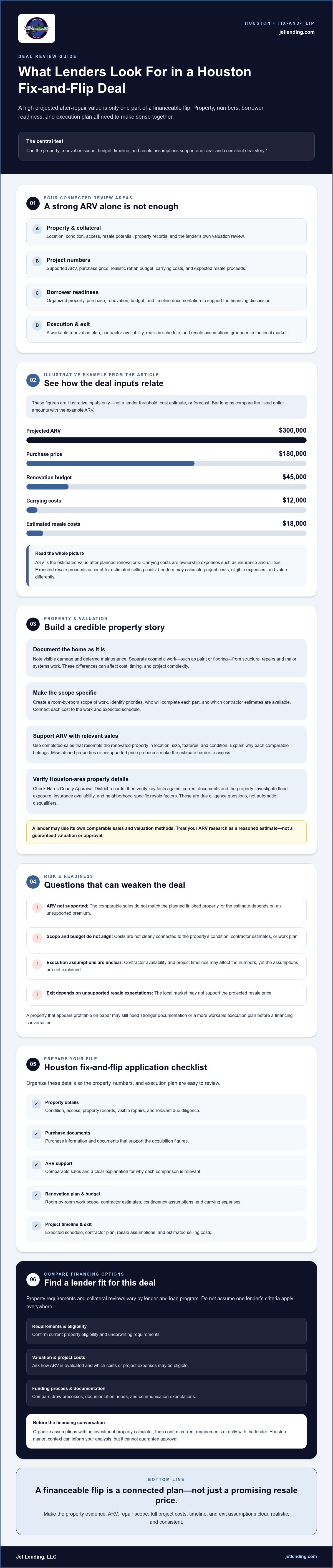
An organized file helps a lender understand the property and your plan without having to chase missing details. Requirements vary, so use this checklist to prepare for an initial conversation, then confirm which documents the lender needs.
Use the conversation to clarify how the lender handles renovation draws, inspections, eligible project costs, and timeline expectations. Ask which assumptions need more support and what documents are needed next. If something is uncertain, identify it clearly instead of presenting an estimate as a verified fact. This helps you understand how the lender evaluates your specific project.
For investors researching what lenders look for in a fix and flip deal Houston, preparation means more than collecting paperwork. A clear file connects the property, purchase, work plan, and expected exit, giving the lender a practical picture of how you intend to execute the deal.
The right lender is one whose property requirements, project-cost rules, and process align with your investment plan. Compare more than headline terms. Ask how each lender reviews the property, which costs may be eligible, how renovation draws and inspections work, what documentation it requires, and how it communicates during review. A process that fits your contractor schedule and project complexity can matter as much as the initial numbers.
There’s no universal best fit. A project with substantial rehabilitation may need a different review process from one involving mostly cosmetic updates. Your experience, available documentation, and planned exit also shape the questions to ask. Understanding what lenders look for in a fix and flip deal Houston can help you compare options based on your project instead of assuming every lender assesses it the same way.
Ask for clear answers and verify current requirements directly with each lender. If an answer depends on your specific property or scope, share the relevant details before assuming the deal is a fit.
Short-term, asset-backed financing is one option for eligible real estate investment acquisitions and rehabilitation. It’s intended for investment purposes, not an owner-occupied residential mortgage. Whether it fits depends on the property, project plan, and lender’s current requirements. No financing category guarantees approval or a particular outcome.
Jet Lending provides short-term, asset-backed financing for real estate investors in Houston. Use its investment property calculator to organize your assumptions before discussing a project, then confirm eligibility, documentation, draw procedures, and applicable terms directly with the lender.
A strong fix-and-flip application connects the property, renovation scope, budget, borrower preparation, and exit plan. A high projected ARV can support the case, but it can’t replace credible comparables or realistic project assumptions. Lender requirements vary, so confirm eligibility, documentation, and terms directly before moving forward.
Knowing what lenders look for in a fix and flip deal Houston helps you spot gaps before applying and compare options against your project’s needs. Organize your numbers with Jet Lending’s investment property calculator, then consider whether short-term, asset-backed financing may suit your investment acquisition and rehabilitation plans.
Every project has its own moving parts. With clear assumptions and a practical plan, you can approach the financing conversation better prepared. Use Jet Lending’s investment property calculator to review your deal assumptions, then discuss your Houston investment project with the team.
They typically assess the property and the full investment plan, not just one number. That can include the purchase price, comparable sales supporting the projected after-repair value, renovation scope and budget, timeline, and planned exit. Lenders may also review the borrower’s relevant experience and financial documents. For a Houston project, use local comparable sales and ask each lender about its current property and program requirements.
No. A high projected after-repair value doesn’t guarantee approval or establish that a deal is fundable. The valuation needs credible comparable sales, and the renovation plan, costs, timeline, and exit assumptions need to fit the property. Lenders may assess these factors differently. Support your estimate with relevant sales and clear documentation, then confirm how the lender will review the property and project.
Lenders may compare the proposed work with the property’s visible condition, renovation scope, budget, and schedule. Organize costs by room or trade, separate contractor estimates from preliminary assumptions, and identify contingency and carrying expenses. Explain how each major repair supports the planned resale. Ask the lender which costs may be eligible and how it reviews renovation funds, since methods vary by lender and program.
Possibly, but eligibility depends on the lender and the deal. A first-time investor can strengthen the project presentation with a detailed scope, realistic budget, workable timeline, and a clear plan for managing the renovation. A lender may request information about your contractor or financial readiness, but requirements vary. Ask directly what experience or supporting documentation it expects before relying on any particular assumption.
Start with the property address, photos, purchase contract, known disclosures, and comparable sales supporting your projected resale value. Add a room-by-room repair scope, contractor bids where available, budget assumptions, and project timeline. Prepare relevant project history and financial or liquidity records if requested. Requirements differ, so ask the lender for its current checklist and clearly label estimates separately from verified property facts.
A lender may ask about flood exposure and insurance availability when reviewing a Houston property, but neither issue should be assumed to automatically approve or disqualify a deal. Check available property records, investigate insurability, and ask the lender what information it needs. Include confirmed findings in your project file, and distinguish verified details from assumptions that still need checking.
They evaluate whether the property, purchase, renovation plan, borrower information, and exit assumptions form a credible project, using criteria that vary by lender and program. For investors asking what lenders look for in a fix and flip deal Houston, the practical steps are to document the numbers, support the projected value, and confirm eligibility and required records directly before proceeding.
Tags:

The best hard money lenders Houston TX investors consider aren’t automatically the ones with the fastest pitch or broadest claims. The right fit depends on whether the loan structure matches your...

Why are you still waiting weeks for a bank appraisal while your competitors are already swinging hammers on the best off-market deals in Harris County? In a market where average flip profits...

Your ability to close a deal in the 2026 Houston market depends less on your personal credit score and more on the speed of your capital. You've likely felt the sting of losing a prime investment...