
Written By: Stephanie Rojas | November 11, 2026
Time to Read 14 Minutes
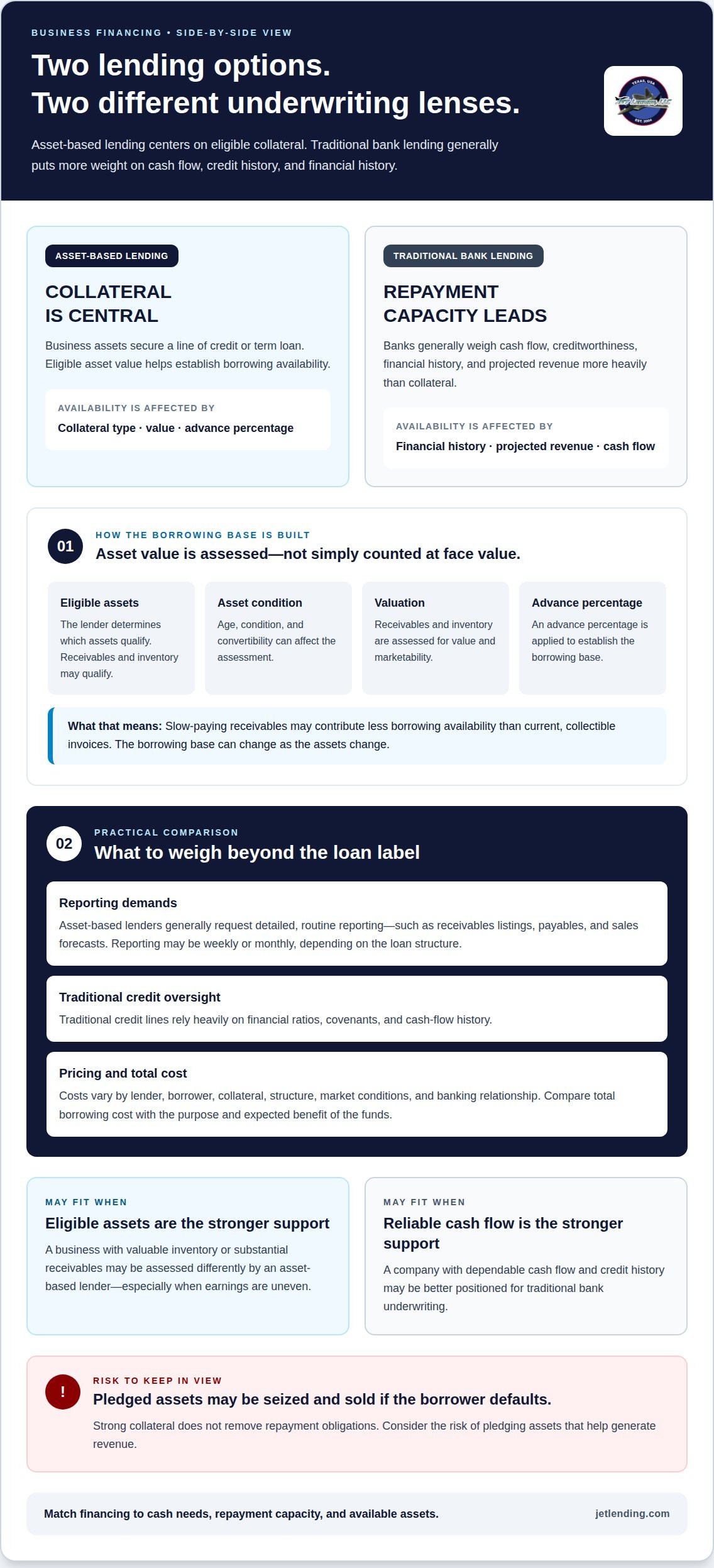
A business’s assets can matter more than its credit profile. In an asset-based loans vs traditional bank loans comparison, the key difference is what supports the financing: asset-based lending centers on eligible collateral, while traditional bank lending generally gives more weight to creditworthiness, financial history, cash flow, and projected revenue. Asset-based financing can take the form of a line of credit or a term loan, so the right structure depends on the funding need and the assets available to pledge.
Look beyond the loan label. Both options can support business goals, but they assess risk differently, and pledged assets may be at risk if the borrower doesn’t repay. This guide compares borrowing capacity, repayment, processing, reporting, and flexibility. It also explains when an asset-based term loan may be worth considering, so you can match the financing structure to your cash-flow needs, financial profile, and available assets.
Commercial banks and credit unions generally provide traditional business loans, while asset-based lenders, including specialist lenders and some banks, offer asset-backed financing. If a borrower defaults on an asset-based loan, the lender can seize and sell the pledged assets to cover the debt.
Asset-based lending uses business assets to secure a line of credit or term loan. The lender assesses eligible collateral, such as accounts receivable or inventory, to determine borrowing availability and unlock liquidity. Traditional lending generally weighs cash flow, credit history, and projected revenue more heavily than collateral. For example, a company with valuable inventory but uneven earnings may be assessed differently by an asset-based lender than by a cash-flow-focused bank.
An asset-based lender doesn’t count every asset at its full recorded value. It determines which assets qualify, values them, and applies an advance percentage to establish the borrowing base. Accounts receivable and inventory may qualify, but their age, condition, and convertibility affect the assessment. Traditional lenders may also require collateral, yet their decisions typically give greater weight to cash flow and financial history.
For example, slow-paying receivables may contribute less borrowing availability than current, collectible invoices. Inventory is also assessed for marketability and value. Because the borrowing base can change as assets change, the amount available through an asset-based loan may differ from the total value of the business’s assets.
Traditional bank loans are typically approved based on a borrower’s creditworthiness and financial history. Banks generally consider whether cash flow and projected revenue can support repayment. For borrowers aiming to qualify for conventional financing, working with 750.Credit can help review credit reports and challenge inaccurate or outdated negative items. Asset-based lenders focus more on collateral value, but the borrower’s ability to manage the loan still matters. Strong collateral doesn’t remove repayment obligations, and weak asset quality can limit available credit even when a business needs liquidity.
For instance, a company with substantial receivables may have collateral to support an asset-based facility, while a company with reliable cash flow may be better positioned for traditional underwriting. The distinction is one of emphasis, not an absolute rule: lenders can weigh both financial strength and collateral.
| Option | Primary basis | What affects availability | Typical collateral role |
|---|---|---|---|
| Asset-based lending | Eligible asset value | Collateral type, value, and advance percentage | Central to the borrowing base |
| Traditional bank lending | Cash flow and credit history | Financial history and projected revenue | May be required, alongside repayment analysis |
Choose the route that best matches the strength you can demonstrate: eligible assets for asset-based lending, or dependable cash flow and credit history for traditional bank financing.
Choose financing by matching the structure to your business’s cash needs, repayment capacity, and intended use. A practical comparison of asset-based loans vs traditional bank loans starts with the business’s strongest repayment support, then considers total cost and reporting demands.
Asset-based loan pricing depends on collateral quality, transaction structure, market conditions, and the banking relationship. Advance percentages also vary by collateral and facility terms, so no single US rate or advance applies to every business. Compare the cost with the working capital unlocked and the value of funding a clear goal, such as buying inventory before a seasonal sales period.
For a business with uneven cash flow, timing can shape the financing’s overall value. An advance against eligible assets may bridge the gap between supplier payments and customer receipts. Consider the borrowing base, reporting workload, and planned use of capital together. This helps show whether the funding supports growth efficiently, rather than focusing only on the stated rate.
Traditional business loan interest rates and fees vary by lender and borrower. Financial history, cash flow, collateral, loan structure, and the banking relationship all affect pricing. No single current rate or fee applies to every US business loan. A company with steady revenue may be assessed differently from one with uneven earnings or limited operating history.
Compare the total borrowing cost with the purpose and expected benefit of the funds. For example, a business financing a long-term investment should consider whether its repayment schedule aligns with the investment’s expected cash generation. A lower stated rate alone doesn’t establish that the financing fits the business’s needs.
Financial covenants and reporting also affect day-to-day operations. Traditional credit lines rely heavily on financial ratios, covenants, and cash-flow history. Asset-based lenders generally request detailed, routine reporting, such as receivables listings, payables, and sales forecasts. Reporting may be weekly or monthly, depending on the loan structure. Include the time needed to prepare reports when comparing the practical cost of each option.
Seasonal businesses should map financing to purchases, sales, and customer payments. A manufacturer buying inventory before a busy season needs capital before those sales generate cash. Asset-based financing may fit seasonal working-capital needs, while traditional bank credit relies heavily on cash-flow history and financial ratios. The right choice depends on which structure fits the company’s actual operating cycle.
Canadian business-financing statistics describe Canadian conditions, not US results. They shouldn’t be applied directly to a Houston business or treated as evidence of local approval rates. Base a US financing decision on the company’s own assets, cash-flow pattern, and proposed terms. In a comparison of asset-based loans vs traditional bank loans, what matters is how each option supports this business’s needs.
Start by defining the funding purpose and timing. Then assess whether eligible assets or cash flow better support repayment. Compare terms, reporting requirements, and covenants before choosing. For real estate investment, distinguish property-acquisition financing from general operating capital, since each serves a different purpose.
Asset-based lending turns eligible business assets into a borrowing base, while cash-flow lending sizes funding around repayment capacity. The application and monitoring process reflects that difference, from collateral review to ongoing reporting.
An asset-based lender reviews eligible collateral, applies an advance percentage, and sets borrowing availability against that pool. Cash-flow lenders instead assess operating cash flow, projected revenue, and measures such as EBITDA. This can give an asset-rich company greater borrowing capacity even when earnings are modest, while a business with strong cash flow may qualify to borrow more than its asset value alone would support.
Each approach has trade-offs. Asset-based funding can support a company whose earnings fluctuate, but collateral values and reporting affect continued availability. Cash-flow lending can suit a business with predictable earnings, but financial ratios and earnings requirements may constrain its facility. For example, a growing distributor might rely on inventory and receivables, while a service firm may have fewer such assets and stronger operating cash flow.
To estimate an asset-based borrowing limit, the lender identifies eligible assets, values them, and applies the agreed advance percentage. The resulting borrowing base, rather than total balance-sheet assets, determines availability. If inventory grows or receivables become collectible, availability may rise; if asset values fall, the available amount may shrink.
Traditional bank lending uses a different test. Banks assess financial statements, projected revenue, cash flow, and debt levels. Banks typically will not lend to companies with debt-to-capital ratios greater than four or five to one. A company above that range may find asset-based lending more aligned with its collateral, but the pledged assets still need sufficient value and liquidity.
Asset-based financing funding typically takes 14-21 days, compared with 45-60 days for conventional lending. These are funding timelines, not a guarantee of approval by a specific date. A collateral review, financial analysis, and completion of lender requirements all shape the process, so organize relevant business and asset information early.
Start an application by defining the funding purpose. For asset-based lending, present the proposed collateral and information that helps establish its value and eligibility. For a traditional bank loan, prepare financial statements, credit history, and projected revenue, since those factors inform underwriting. In either case, explain how the borrowing supports operating needs and repayment.
After the initial review, expect the lender’s analysis to follow its underwriting approach. An asset-based lender assesses collateral and borrowing-base details; a bank examines the company’s financial position and repayment capacity. Ask for the proposed reporting cadence and repayment structure before accepting terms. This helps reveal whether ongoing monitoring fits the company’s operating resources.
A business may secure asset-based financing with accounts receivable, inventory, equipment, or a combination of these assets. Each category requires a different borrowing-base assessment. Receivables depend on customer payment and invoice quality; inventory depends on value and saleability; equipment is assessed as a physical asset. Real estate can also be relevant to business financing, but its value and role differ from those of working-capital assets.
Accounts receivable can turn unpaid invoices into working capital before customers pay. Asset-based lenders typically advance 70% to 90% of a business’s accounts receivable value. The exact borrowing availability depends on which invoices qualify and the lender’s advance percentage. For a seasonal distributor, for example, eligible receivables may help fund inventory purchases while customer payments are still outstanding.
Invoice age matters. According to Asset-based lenders, normally, an account is considered ineligible collateral when it is past due by three times the terms, e.g., 90 days for 30-day terms and 21 days for seven-day terms. Receivables more than 90 days past due are typically ineligible, while foreign receivables are generally excluded, although a lender may offer options to lend against them. A receivables listing helps show which invoices are current and collectible.
Inventory can support borrowing when goods have identifiable value and can be sold. The lender assesses eligible inventory rather than treating every item as equal collateral. A manufacturer holding saleable finished goods presents a different inventory profile from one holding specialized items with a narrower market. Changes in inventory levels can affect available funding, so a seasonal increase in stock may alter the borrowing base over time.
Equipment offers another possible source of collateral. Its condition, market value, and usefulness to the business shape its lending value. Pledging equipment involves a trade-off: it may help fund operations, but the business risks losing the pledged asset if it fails to repay. Real estate requires a separate assessment of property value and collateral structure, rather than the invoice-by-invoice analysis used for accounts receivable.
Traditional lending may also require collateral, but its underwriting generally emphasizes cash flow and credit history. To compare it with an asset-based assessment, identify which assets can support the borrowing need and how their value may change during the repayment period.
An asset-based term loan combines a defined borrowing amount with business-asset collateral. Unlike a revolving facility, which can be drawn and repaid repeatedly, a term loan provides a specific amount with an agreed repayment structure. It may suit a business funding a defined project, acquisition, or equipment purchase, rather than managing recurring working-capital swings.
The lender assesses the pledged asset, its value, and how readily it can be converted into cash. Those factors help determine the amount available, while the loan agreement sets repayment obligations. For example, a company seeking funds for a planned acquisition can compare the proposed loan amount with the value of eligible collateral and the cash flow available for repayments.
This structure can provide clearer funding for a defined purpose, but it ties borrowing to assets and repayment terms. A business should weigh the asset’s role in operations before pledging it. If equipment is essential to production, using it as collateral may put an important operating resource at risk if the borrower cannot meet its obligations.
Traditional bank term loans also provide a defined amount and repayment schedule, but banks generally assess creditworthiness, financial history, and cash flow. Asset-based lenders place greater emphasis on collateral value. A business with valuable assets but uneven earnings may therefore present a different borrowing case from one with predictable cash flow and a strong financial history.
Flexibility depends on the facility, not just the word “term.” A term loan is designed around a specific amount and repayment plan; a revolving line may better accommodate changing borrowing needs. Compare the intended use of funds with repayment timing. For example, a one-time expansion project differs from seasonal inventory purchases that require repeated access to capital.
Review reporting, covenants, and collateral requirements before selecting a structure. Asset-based lenders generally require detailed, routine reporting, and asset-based lending may involve fewer financial covenants than traditional bank lending. The business still needs to track pledged assets and understand how changes in their value could affect availability or compliance with loan terms.
A practical comparison starts with the project, then the repayment source, then the collateral. Identify whether the funding need is one-time or recurring, and map expected cash flow against scheduled payments. Next, assess the value and operational importance of the business asset. This helps show whether a term loan’s defined structure fits better than a revolving facility or cash-flow-based financing.
Choose an asset-based term loan when a defined funding need aligns with eligible collateral and a workable repayment plan. Choose another structure if recurring access to capital matters more, or if pledging the asset could disrupt operations. The central trade-off is straightforward: asset-based funding can support borrowing against business assets, while repayment capacity and collateral risk remain essential considerations.
Jet Lending offers short-term loans for real estate investors financing investment properties, including acquisitions and rehabilitation projects. For Houston investors evaluating a potential deal, the Investment Property Calculator can help analyze the numbers alongside funding needs. Jet Lending’s asset-backed financing is for investment purposes, not every type of business loan or owner-occupied mortgage. Match the financing to the property and investment plan.
Consider the property, available assets, and repayment plan as you weigh financing options. Contact Jet Lending to discuss short-term financing for your Houston investment property.
A decision about asset-based loans vs traditional bank loans should support the next stage of your business, not just address an immediate cash need. Before committing, connect the planned use of funds to a realistic repayment plan. Consider what could change if revenue slows, an asset loses value, or funding needs shift. This forward-looking view helps you choose financing that fits both the opportunity and the risks you can manage.
Build your decision around the business’s priorities: preserving key assets, maintaining room for operating needs, and matching repayments to expected cash flow. If the funding supports an investment property, assess the deal’s numbers alongside the financing plan. Clear priorities can make the next conversation more focused and help you move forward thoughtfully.
Take the next step with a plan that fits your goals.
Choose asset-based financing when eligible business assets are central to the funding case; choose cash-flow lending when dependable earnings and repayment capacity are stronger. For example, a distributor with valuable receivables but uneven earnings may assess an asset-based option, while a service firm with steady operating income may emphasize cash flow. Compare how each approach treats your business’s main source of repayment and what ongoing monitoring it requires.
A higher debt-to-assets ratio can signal that a business has less asset value available relative to its debt, which may affect a lender’s risk assessment. It doesn’t determine approval by itself. A lender may also review cash flow, repayment history, collateral quality, and existing obligations. Prepare a current balance sheet and explain significant changes, such as a recent equipment purchase, so the company’s leverage can be understood in context.
Asset-based financing may suit a business with meaningful eligible assets and a funding need tied to working capital, growth, or a strategic transaction. A wholesaler with valuable inventory, for example, may explore whether those goods can support borrowing. It may be less suitable when the business lacks eligible collateral or cannot manage asset reporting and repayment obligations. Consider whether the assets are essential to daily operations before pledging them.
Asset-based funding can provide a financing path for companies whose collateral strength is more compelling than their earnings profile. It may also align available borrowing with eligible assets rather than relying only on projected cash flow. The trade-off is that pledged assets remain at risk if the borrower defaults, and reporting can add administrative work. Consider the funding purpose, repayment source, and business impact of pledging collateral together.
An asset-based loan is financing secured by business assets. The lender identifies eligible collateral, assesses its value, and uses that assessment to establish borrowing availability. For a company with invoices and inventory, the lender may review receivables and stock, then monitor changes through periodic reporting. The borrower repays under the loan agreement; failing to meet payment obligations can put pledged assets at risk.
The central difference is the emphasis in underwriting. Asset-based lending centers on eligible collateral, while traditional bank lending generally focuses more on creditworthiness, financial history, and cash flow. A business with uneven earnings but valuable assets may present a different case from one with steady revenue and limited collateral. Compare repayment terms, reporting, covenants, and the consequences of default, not only the initial borrowing decision.
Business accounts receivable, inventory, and equipment can secure asset-based loans, individually or in combination. Some financing may also involve real estate, depending on the loan structure. Eligibility depends on factors such as asset value, collectability, condition, and marketability. For example, current customer invoices may be assessed differently from overdue receivables. A business should also weigh the operational impact of pledging equipment it needs to keep producing or serving customers.
There isn’t one credit score, revenue level, or operating-history threshold that applies to every lender or loan. Traditional banks commonly assess credit history, financial statements, cash flow, and projected revenue. Asset-based lenders place greater weight on eligible collateral, though the borrower’s repayment ability still matters. For Houston real estate investors, Jet Lending offers short-term investment loans and an Investment Property Calculator to help analyze potential deals.
Tags:

A strong fix-and-flip loan supports the full project, not just the property purchase. When comparing fix and flip loans Houston TX, look at how financing relates to both acquisition and renovation,...

What if you could make a strong Houston offer without waiting for a bank’s full approval process? For investors competing with cash buyers, bridge loans for real estate investors Houston can provide...