
Written By: Stephanie Rojas | August 19, 2026
Time to Read 13 Minutes
In the 2026 Houston real estate market, the investor who closes in seven days always beats the investor who waits for the perfect interest rate. Speed is your greatest leverage when competing for inventory in a city where the median home price has climbed to $358,000. You've likely felt the frustration of losing a prime property to a cash buyer while a traditional bank was still shuffling your paperwork. It's exhausting to deal with terminology confusion or uncertainty about exit strategies when you should be focused on your bottom line.
We know that choosing between a bridge loan vs hard money loan Houston can feel like a high-stakes guessing game. This guide clears the fog. You'll discover the critical differences in speed, cost, and structure to help you choose the most profitable financing for your next deal. We'll look at current 2026 market trends, compare specific loan-to-value ratios, and show you exactly how to pivot from acquisition to a long-term hold without losing your momentum. Get ready to turn your financing into a competitive advantage and scale your portfolio with confidence.
Investors in Houston often use "hard money" and "bridge loan" as if they're the same thing. In a 2026 market where speed determines who wins the deal, knowing the nuance between a bridge loan vs hard money loan Houston is essential. While both are asset-backed and fast, they serve different masters in your portfolio. Using the wrong term with a lender can lead to a mismatched loan structure that eats your profits. You need to know exactly which tool to pull from your belt for the specific deal on your desk.
Every loan discussed here follows the strict 'Investor-Only' rule. These are short-term loans for business purposes. They are never for owner-occupied residences. If you're looking for a traditional mortgage for your family home, these aren't the right fit. However, if you're looking to scale a rental portfolio or flip a house in the Heights, these are your primary engines. They provide the liquidity you need when a traditional bank says "no" or "not yet."
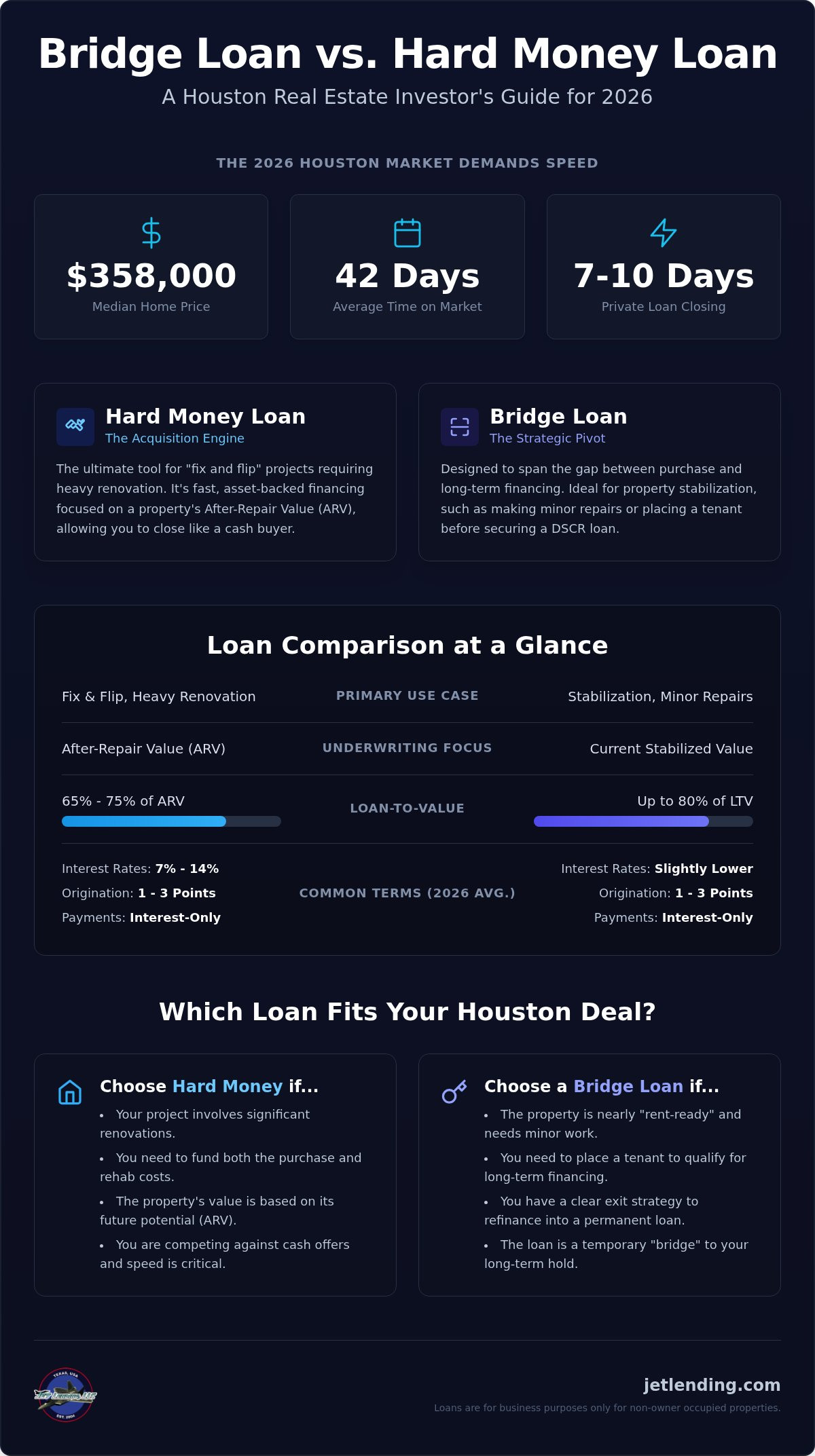
Hard money is your acquisition engine. It's the ultimate tool for "fix and flip" projects that require heavy renovation. Unlike a bank, a hard money lender focuses on the property's current value and the After-Repair Value (ARV) rather than your personal debt-to-income ratio. This focus allows for closing times as fast as 7 to 10 days. In a competitive market with inventory stabilizing around 4.5 months, being able to close like a cash buyer is a massive advantage. You're buying the opportunity to create value in neighborhoods like Sunnyside or the Third Ward where others see a wreck. Speed isn't just a luxury; it's your primary competitive advantage in a bidding war.
A bridge loan is your strategic pivot. It serves a specific purpose: to span the gap between your purchase and your long-term debt. If you're wondering What is a Bridge Loan?, think of it as a temporary placeholder. It's often used for property stabilization. This might mean making minor repairs or placing a tenant to meet the requirements of a long-term DSCR loan. Bridge loans typically offer slightly lower interest rates than pure hard money because the risk to the lender is lower. The property is usually closer to being "move-in ready." However, the duration is often shorter. You aren't looking for a multi-year commitment. You're looking for the cleanest path to permanent financing. Understanding this helps you plan your exit strategy before you even sign the closing docs.
Success in the 2026 Houston market requires more than just finding a good house; it requires knowing your numbers. When evaluating a bridge loan vs hard money loan Houston, you'll notice that interest rates have stabilized compared to the volatility of previous years. In the second quarter of 2026, the average interest rate for both loan types in Houston was 9.84%. While rates can range from 7% to 14% depending on the specific asset and your experience level, the speed of funding often matters more than a half-point difference in interest. In a city where homes sell in an average of 42 days, waiting on a bank for 45 days is a recipe for a lost deal.
The choice between these products often comes down to Loan-to-Value (LTV) versus Loan-to-Cost (LTC). Bridge loans often allow for higher LTV ratios, sometimes reaching 80% for residential properties. Hard money lenders typically focus on the future, financing 65% to 75% of the property's projected value. This distinction is vital because hard money is designed to fund the purchase and the rehab, whereas bridge loans focus on the property's current stabilized state. Documentation is the biggest bottleneck with traditional banks. For a private loan in Houston, you'll generally need a clean title, a solid renovation budget, and an internal valuation. You don't need two years of tax returns or a mountain of personal financial statements.
Most private lenders in Texas charge between 1 and 3 points as an origination fee. These are upfront costs paid at closing. To keep your monthly overhead low, these loans usually feature interest-only payment structures. This setup maximizes your cash flow during the renovation or stabilization phase. You should always factor these fees into your After-Repair Value (ARV) calculations to ensure the deal still makes sense. Before you commit to a term sheet, it's a good idea to analyze your potential ROI with a local partner who knows the nuances of Houston zip codes.
Banks focus on your past; private lenders focus on the property's future. While a credit score of 660 is a common benchmark for some products, the 'Experience Factor' often carries more weight for Houston investors. If you've successfully flipped three houses in Harris County, you're a lower risk. This asset-heavy approach is why you can move from application to funding in as little as 2 to 7 days. Knowing when to use a bridge loan versus a hard money loan allows you to move faster than the competition. This streamlined process is why the Texas market remains a powerhouse for residential bridge loans, with average loan amounts reaching over $370,000 in early 2026.
Every Houston deal has a unique pulse. Your choice between a bridge loan vs hard money loan Houston shouldn't be a coin flip. It should be a calculated move based on your exit strategy. While we've established that speed and asset value are the foundations of private lending, the way you deploy that capital changes based on whether you're renovating a shell or stabilizing a rental. You need to match the loan's structure to the property's lifecycle to keep your ROI high.
For many, hard money is the undisputed king of the "fix and flip." If you're looking at a distressed bungalow in Independence Heights, you need capital that moves at the speed of your vision. This type of funding is designed for rapid acquisition and the heavy lifting of a full rehab. However, it's vital to weigh the pros and cons of hard money loans before diving in. The costs are higher, but the ability to secure a property under market value in a 4.5-month inventory market is often worth the premium. Wholesalers also utilize this speed for double closings, ensuring they can move contracts without tying up their own cash for long periods.
If your goal is long-term wealth, the bridge loan is your best friend. It's the perfect middle ground for the the BRRRR method. You use the bridge to acquire and stabilize the property, then refinance into a permanent DSCR loan once a tenant is in place. This transition allows you to pull your initial capital back out and move on to the next deal.
Hard money is the right choice when the property's condition prevents traditional financing. If the roof is leaking or the plumbing is shot, a bank won't touch it. It's also essential for auction purchases where you must fund within 24 to 48 hours. In 2026, many off-market deals in Houston are won simply because the investor could close before the weekend. If speed prevents a bidding war, hard money pays for itself.
A bridge loan shines when the property is "turn-key" or needs only cosmetic updates. Use it when you need to close fast to beat out other offers but don't need a massive rehab budget. It's also a smart way to consolidate multiple short-term debts into a single "bridge" before you move into a larger portfolio loan. This keeps your monthly payments manageable while you finalize your long-term debt structure.
Houston's real estate market in 2026 is a battlefield of data and speed. With inventory levels sitting between 4.5 and 4.8 months, the market has shifted toward a more balanced state, but competition remains fierce. You aren't just competing with other local flippers; you're often up against institutional "Wall Street" buyers who use massive lines of credit to sweep up inventory. To win, you need more than just capital. You need a partner who understands why a house on one side of a street in the Third Ward is worth $50,000 more than the house across the street. This localized knowledge is the deciding factor when choosing between a bridge loan vs hard money loan Houston.
In neighborhoods like Sunnyside or the Heights, ARV varies wildly by the block. A historic rehab in the Heights requires a different underwriting approach than a new construction townhome in urban areas. Local lenders evaluate these deals through a Houston-specific lens, particularly when it comes to flood zones and drainage issues. National lenders often see a flood plain and immediately decline the file. A local expert knows which areas have seen improved infrastructure and how that impacts your long-term value. This prevents you from getting stuck with a property that won't qualify for a DSCR exit later due to insurance hurdles.
Texas is one of the most lender-friendly states in the country, thanks to non-judicial foreclosure laws. The "Power of Sale" clause in Texas deeds of trust allows lenders to move quickly if a project fails. While no one plans for a default, this legal framework gives private lenders the confidence to fund deals faster and with higher leverage than in "judicial" states. Working with a local Houston hard money lender ensures your paperwork is formatted for Texas law from day one. You'll close with local title companies who understand investor-specific hurdles, preventing the "appraisal shock" that often kills deals at the last minute when using out-of-state banks.
Securing a bridge loan vs hard money loan Houston shouldn't feel like an interrogation. It should feel like a strategy session with a partner who wants you to win. At Jet Lending, we've spent over two decades moving away from the cold, detached model of traditional banks. We operate as a mentor and facilitator for your success. Since 2004, our Houston-based team has focused on building long-term partnerships rather than just processing one-off transactions. We want to see you scale your portfolio, whether you're tackling your first flip in Sunnyside or your fiftieth rental in the Heights.
Our process is built for the speed of the 2026 market. We know that a delay of even 48 hours can cost you a prime property. That's why we've streamlined every step from the initial analysis to the final signature at the closing table. You get the benefit of in-house underwriting and a team that understands the local zip codes as well as you do. We don't just provide capital; we provide the confidence you need to make bold moves in a competitive landscape.
The first step to any successful deal is a reality check on the numbers. Don't guess your margins or rely on a napkin sketch. Use our professional investment property calculator to verify your ROI and ensure your deal can withstand 2026 market fluctuations. This tool is designed specifically for the way Houston deals are structured, accounting for the costs that matter to local investors. Our team acts as a mentor throughout this process, helping you refine your budget and tighten your exit strategy. Jet Lending evaluates the asset's potential and the deal's underlying profitability first, placing the borrower's personal financial profile in a secondary position. This "deal-first" approach is how we fund projects that traditional lenders won't even consider.
Success favors the prepared. When you're ready to move, have your executed contract, a detailed rehab budget, and a clear exit plan in hand. Whether you're planning a quick sale or a transition to a long-term hold, we help you map out the most profitable path. Our "can-do" attitude means we look for every possible way to fund your deal rather than looking for excuses to kill it. We're proactive, transparent, and ready to move at your pace. If the numbers work, we want to help you get the keys. Let's get your next Houston project off the ground and turn your vision into a high-performing asset.
Choosing between a bridge loan vs hard money loan Houston is the difference between simply finding a deal and actually closing it. You now have the roadmap to distinguish between these two powerful tools. Hard money is your engine for rapid acquisition and rehab, while bridge loans provide the stability you need to pivot toward long-term rental income. Both paths allow you to bypass the red tape of traditional lending and move at the speed of the 2026 Houston market.
Jet Lending has been a cornerstone of the Texas investment community since 2004. As local Houston experts, we specialize in asset-based lending with no owner-occupied restrictions, ensuring our goals align perfectly with your business growth. We prioritize the strength of your deal and the clarity of your exit strategy. This approach transforms a simple loan into a true partnership that values your time and your vision.
The 2026 market offers incredible opportunities for those ready to act. We're standing by to help you secure the capital you need to scale your portfolio with confidence. Let's get to work on your next project today.
No, they aren't identical. Hard money is an umbrella term for asset-backed financing, while a bridge loan is a specific type used to "bridge" the gap between acquisition and long-term debt. Hard money is your tool for rapid acquisition and heavy rehab. A bridge loan is better for stabilizing a property. Understanding the bridge loan vs hard money loan Houston distinction helps you choose the right financing for your specific project timeline.
Interest rates in 2026 vary based on the asset and your experience. During the second quarter of 2026, the average interest rate for Houston hard money loans was 9.84%. Most investors see a range between 9% and 14%, with origination fees typically landing between 1 and 3 points. These rates reflect the speed and flexibility of private capital compared to traditional banks. Always check current rates against your projected ROI before closing.
Yes, you can. Because these are asset-based loans, the property's potential and After-Repair Value (ARV) carry more weight than your personal credit score. While a score of at least 660 is often preferred for specific long-term products, your track record as an investor is a major factor. We look for ways to fund your deal by focusing on the underlying collateral rather than just your past financial mistakes.
We typically fund deals in 7 to 10 days. For experienced investors comparing a bridge loan vs hard money loan Houston, we can often move even faster, sometimes reaching the gold standard of 2 to 7 days. This speed is possible because of our in-house underwriting and localized expertise. We eliminate the bureaucratic delays found at traditional banks, allowing you to compete with cash buyers and secure properties before they leave the market.
The most common exit strategy is refinancing into a long-term DSCR loan once the property is stabilized and occupied. Alternatively, many investors choose to sell the property for a profit after completing renovations. Your exit plan should be finalized before you sign the loan documents. Having a clear path to permanent debt or a sale ensures you don't get stuck with short-term interest rates longer than necessary for your project.
Most deals require some skin in the game, but 100% financing options are available for qualified deals in Texas. Typically, you should have at least six months of interest payments and one-third of the renovation budget in reserves. Lenders may finance up to 90% of the purchase price and 100% of the rehab costs for experienced investors. This flexibility allows you to keep more of your own capital ready for your next acquisition.
No, Jet Lending does not provide loans for primary residences. We focus strictly on investment and commercial use. Our products are designed for fix-and-flip projects, rental property acquisitions, and property stabilization. We never offer owner-occupied residential mortgages or unsecured personal loans. This specialization allows us to provide faster service and more flexible terms for real estate professionals who are building a portfolio in the competitive Houston market.
In Houston, the maximum Loan-to-Value (LTV) for residential bridge loans can go up to 80%. For fix-and-flip projects, many lenders finance up to 70% of the After Repair Value (ARV). Jet Lending's maximum LTV is typically 70% for most asset-based products as of August 2026. These ratios ensure you have sufficient leverage to secure the deal while maintaining a safe margin for both the investor and the lender during the project.
Tags:

What if your ability to scale a portfolio didn't depend on your personal debt-to-income ratio or a stack of tax returns? In the fast-moving 2026 Houston market, waiting 60 days for a traditional bank...

In the 2026 real estate market, the loan with the lowest interest rate is often the most expensive one you can take. Deciding between a hard money vs conventional loan for investment property is...

Why are you still letting big banks and their rigid debt-to-income ratios kill your deals while cash buyers snatch up the best Houston zip codes? In a market where 8,000 new jobs are fueling rental...