
Written By: Stephanie Rojas | August 10, 2026
Time to Read 13 Minutes
Your profit isn't made when you sell a flipped house; it's secured the moment you run your initial numbers. Many investors face the constant fear of overestimating a property's final sale price or getting rejected by lenders because their deal analysis is thin. Understanding exactly what is arv serves as the foundation of every successful real estate investment. It's the single most important metric that determines your profit ceiling and your ability to borrow capital in a market where Houston median prices hover around $332,000.
We know how stressful it is to worry about underestimating renovation costs or missing a key detail in your math. This guide will help you master the ARV formula so you can calculate property potential with absolute precision. You'll learn how to use this metric to secure the funding you need for your next flip and gain the confidence to make offers that stick. We'll break down the latest 2026 analysis techniques to ensure your next investment is a win.
ARV stands for After-Repair Value. It represents the estimated market value of a property once all planned renovations, repairs, and upgrades are fully completed. Think of it as a snapshot of the future. It isn't a hopeful guess about what you want the house to be worth; it's a professional projection based on hard market data. For anyone involved in real estate flipping or wholesaling, this number is the North Star. It guides every decision from the initial offer you make to the final choice in kitchen hardware.
Understanding exactly what is arv allows you to work backward from a successful exit. In the 2026 market, where inventory levels in places like Houston have risen to 4.9 months, precision is everything. You cannot rely on general appreciation to save a bad deal. You must know the value you are creating before you ever pick up a hammer. ARV is distinct from Fair Market Value, which usually describes a property's worth in its current, general state. Instead, ARV focuses specifically on the "post-rehab" version of the home, assuming it has been brought up to the highest standards of the surrounding neighborhood.
The gap between the "As-Is Value" and the ARV is where your profit lives. The As-Is Value is what the property is worth right now, usually in a distressed or dated condition. This is typically the price you pay the seller. The ARV is your target sale price. The spread between these two figures must be large enough to cover your renovation costs, holding costs, and your profit margin. Lenders look closely at this difference to calculate the "forced equity" you are creating through your labor and investment. If the spread is too small, the risk becomes too high for both you and your financial partners.
This approach to valuing distressed assets is a standard practice for professional buyers; for example, Nuhome Capital uses detailed market analysis to offer cash for residential properties in Southern California, regardless of their current state.
Your ARV dictates your Maximum Allowable Offer (MAO). Without a solid grasp of what is arv, you're essentially gambling on how much you can afford to pay for a property. In Houston, where median home prices are roughly $332,000 as of spring 2026, even a small error in your valuation can lead to a significant financial loss. ARV is the projected stabilized value of a property post-rehabilitation. It serves as the primary metric for short-term loans. Asset-based lenders like Jet Lending, LLC use this future value to determine how much they can safely lend you. They prioritize the potential of the finished project over the current condition of the structure, making it the most critical number in your deal analysis.
The basic math for calculating what is arv looks simple on paper: Purchase Price + Value of Renovations. However, seasoned investors know that the cost of your upgrades doesn't always translate dollar-for-dollar into market value. A $50,000 renovation might only add $40,000 in equity if the finishes exceed what the neighborhood can support. To get this right, you must prioritize market comparables over your construction budget. Your goal is to determine what buyers will actually pay for a finished home in today's specific market conditions.
The 70% Rule is the industry standard for protecting your margins. It suggests that your purchase price should not exceed 70% of the ARV minus your estimated repair costs. That remaining 30% serves as a vital buffer for the business of the flip. It typically breaks down into three key areas:
To find your MAO, start with a firm ARV based on recent sales from the last 90 days. Multiply that ARV by 0.70 to establish your baseline. Finally, subtract every penny of your estimated rehab costs. The resulting number is your hard ceiling. If a seller won't budge below this figure, the deal likely doesn't have enough meat on the bone to justify the risk. Use the investment property calculator from Jet Lending, LLC to run these numbers quickly and ensure your math is airtight before you sign a contract.
Market conditions in late 2026 are shifting, and some investors in hyper-competitive Houston neighborhoods now use a 75% rule to win bids. While this can help you secure properties when inventory is tight, it significantly increases your risk. "Skinny deals" with margins lower than 20% leave very little room for error. The 70% rule accounts for the inherent risks of construction and market shifts. If a foundation issue appears or local prices dip slightly, that 30% buffer is what keeps your project in the black. Stick to the rule whenever possible to maintain a sustainable investment business.
Calculating what is arv requires more than a quick look at a real estate app. You must start with a thorough property inspection to determine your exact scope of work. Without a clear plan for every square foot, your valuation will be built on sand. Once you know exactly what you intend to change, you can begin gathering comparable sales, or "comps." In the 2026 Houston market, look for homes sold within the last 90 to 120 days. Stay within a one-mile radius of your subject property to ensure the data reflects the same neighborhood dynamics.
Adjust your estimated value based on specific features like bedroom count, square footage, and lot size. If your target house has a 7,000 square foot lot but the comps are on 5,000 square foot lots, you need to account for that premium. Finally, consult with a local expert or a lender with deep Texas roots. Validating your assumptions with a professional who sees hundreds of deals a month can prevent a costly mistake before you commit your capital. This extra layer of verification is what separates the pros from the amateurs.
A valid comp must mirror your property in age, style, and location. Don't look at active listings to determine what is arv. Active prices represent what sellers hope to get, while sold prices represent what buyers actually paid. Houston's lack of zoning makes this process uniquely challenging. You might find a renovated bungalow right next to a commercial warehouse. This is why you must stay within the same ward or micro-neighborhood. Crossing a major thoroughfare can completely change the market value, even if the houses are only blocks apart.
Your ARV projection is only as reliable as the rehab estimate supporting it. Categorize your repairs into cosmetic fixes and structural overhauls. Cosmetic updates like fresh paint and luxury vinyl plank flooring are predictable and high-impact. Structural issues involving the roof or foundation are where budgets often explode. Mastering the art of estimating rehab costs for a flip is essential to avoid inflating your ARV. If your repair budget is off by $20,000, your projected profit could vanish before you even list the property for sale. Realism is your best friend in deal analysis.
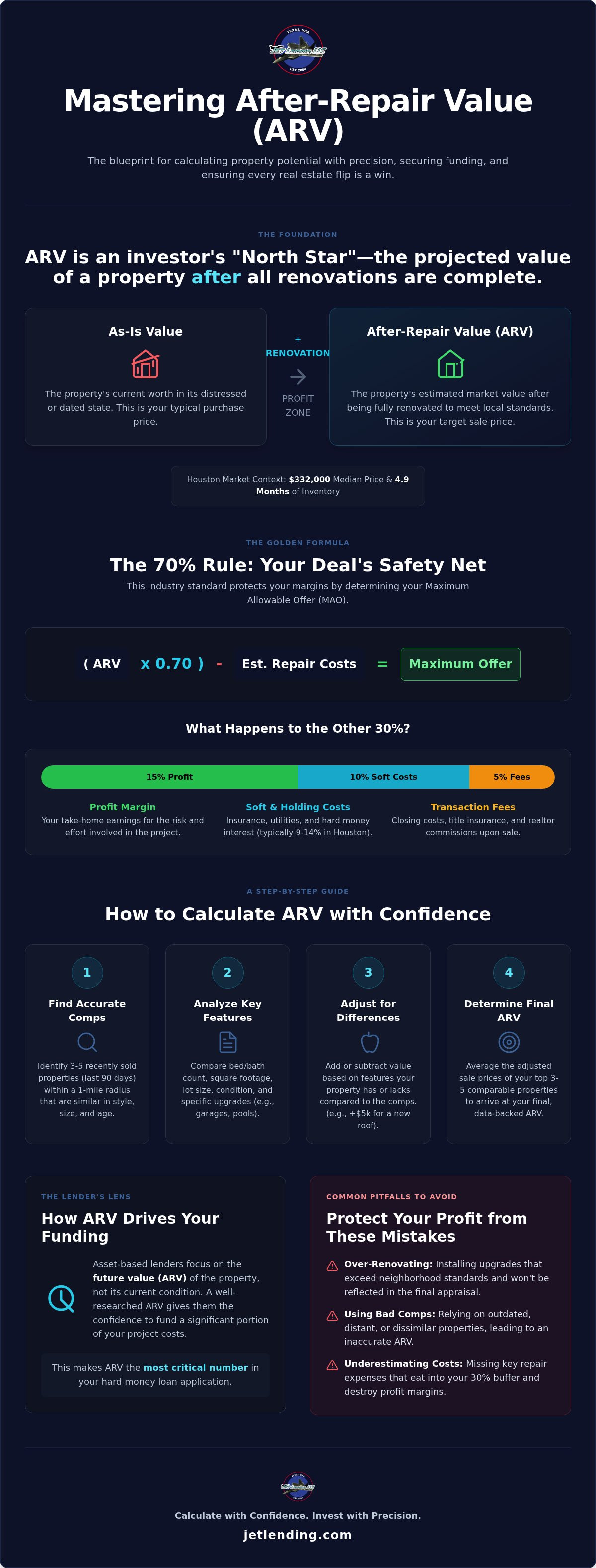
Hard money lenders don't look at properties through the same lens as traditional banks. While a standard mortgage company focuses on the current state of a home, asset-based lenders like Jet Lending, LLC prioritize the potential. Understanding exactly what is arv allows you to access capital that covers not just the purchase, but also the renovation. This is the core of leverage in real estate. Most lenders in 2026 cap their funding at 70% to 75% of the ARV to maintain a safe margin for both parties.
The appraisal process is the bridge between your estimate and the lender's approval. Lenders order a "Subject-to-Completion" appraisal. This report doesn't just value the peeling paint and dated kitchen you see today. Instead, the appraiser reviews your specific scope of work and finds comparable sales that match what the house will become. If your rehab plan is solid and your comps are tight, the appraisal will validate your ARV and green-light your funding. However, a high ARV doesn't always guarantee a bigger loan. If the "As-Is" value is extremely low compared to a massive rehab budget, lenders may adjust the loan amount to manage the increased construction risk.
You'll often hear two acronyms in hard money circles: LTV and LTC. Loan to Value (LTV) is calculated using the ARV. If a house will be worth $400,000 and the lender offers 75% LTV, your max loan is $300,000. Loan to Cost (LTC) looks at your total investment, which includes the purchase price plus the rehab budget. Most lenders use a combination of both to determine your required down payment. For example, they might fund 75% of the ARV but cap the loan at 90% of the total cost. Whichever number is lower becomes your loan limit. Knowing these ratios helps you prepare your cash reserves before you ever make an offer.
Your ARV is more than just a profit target; it's the lender's insurance policy. If something goes wrong and you default on the loan, the lender needs to know the property can be sold quickly to recover the debt. A realistic, data-backed ARV builds immediate trust with your lending partner. It proves you understand the local market and have a clear path to a successful sale. You can learn more about how these asset-based structures work in our guide on hard money loans. When your numbers align with market reality, you transition from a borrower to a trusted partner.
Identifying exactly what is arv is a science. Many investors treat it like an art form. This leads to dangerous mistakes that can sink a project before the first wall is demolished. One of the most common errors is over-improving a property. If you're flipping a house in a Houston neighborhood where the median price is $332,000, don't install a $100,000 designer kitchen. You'll never recoup that investment. Your upgrades must align with what local buyers expect and can actually afford. Stay grounded in the reality of the block you are building on.
Market trends in late 2026 are showing a distinct shift toward normalization. With 4.9 months of housing inventory in Greater Houston, buyers have more options than they did during the post-pandemic frenzy. If you assume 2025's rapid appreciation will continue into your 2026 exit, your ARV will be dangerously high. Always use the average sale price of comparable homes. Selecting the single highest "aspirational" sale in the neighborhood as your benchmark is a shortcut to a financial loss. It's better to be pleasantly surprised by a higher sale than devastated by a lower one.
Don't forget the "quiet" costs that eat your profit while you wait for a buyer. In the current market, hard money interest rates range between 9% and 14%. When you add in property taxes and insurance, every extra day on the market costs you money. If your initial calculation of what is arv didn't leave room for the current 66-day average time on market, your bottom line will suffer. These holding costs are just as real as your lumber bill. Factor them into your 30% buffer from the very beginning.
It's easy to fall in love with a property and inflate the numbers to justify the purchase. This is "emotional" ARV. It's a recipe for disaster. If a deal only works if you hit the absolute highest possible sale price, it's not a deal; it's a gamble. Keep your ego out of the spreadsheet. Be conservative with your exit price and aggressive with your repair estimates. Ask a local realtor or a professional appraiser for a "gut check" on your numbers. A third-party opinion can save you from a bad investment that looked good through rose-colored glasses.
You don't have to guess at these numbers or build complex spreadsheets from scratch. We've developed a professional tool to help you stay objective and fast. Our investment property calculator automates the 70% rule and helps you find your Maximum Allowable Offer with precision. By entering your projected ARV and estimated rehab costs, you get an instant reality check on your potential profit. It removes the guesswork and ensures you aren't overpaying in a changing market. Use it before you make your next offer to ensure your business remains profitable and protected.
Mastering the math behind your investments is the fastest way to scale your business. You've learned that determining what is arv isn't just about picking a number; it's about analyzing hard data, applying the 70% rule, and understanding how lenders view your exit strategy. By avoiding emotional valuations and focusing on realistic comps, you protect your capital and build a reputation as a savvy investor. Accurate projections are the foundation of every successful flip.
Jet Lending has served as Houston's premier hard money lender since 2004. We provide the expert deal analysis you need to avoid bad investments and offer fast funding based on your property's potential. We aren't just a lender; we're a partner invested in your growth. We're here to help you get the math right before you ever sign a contract.
Your next successful flip starts with a single, accurate calculation. We're ready to help you turn that projection into a profitable reality. Let's build your portfolio together with confidence and clarity.
ARV is your estimated target value, while an appraisal is a formal valuation performed by a licensed professional. You calculate the after-repair value during your initial deal analysis to determine if a property is worth pursuing. The lender then orders a "subject-to-completion" appraisal to verify your numbers and ensure the property serves as sufficient collateral for the loan.
You can calculate it using public records, tax data, and specialized investment tools. While Realtors provide valuable MLS access, many experienced investors use property data platforms to find sold comps themselves. Just ensure you are looking at actual sales prices rather than active listings. Localized expertise is vital, so always double-check your math against recent market trends in the specific neighborhood.
The 70% rule remains a reliable safety net, though it requires flexibility in the current market. With Houston's housing inventory rising to 4.9 months in spring 2026, buyers have more leverage, and prices are moderating. Sticking to the 70% rule protects your profit margin if a property sits on the market longer than the current 66-day average. It provides the buffer you need to handle unexpected repair costs.
You will likely need to renegotiate the purchase price or increase your down payment. If the appraisal comes in low, the lender will reduce the loan amount to maintain their required loan-to-value ratio. This situation highlights why understanding exactly what is arv and validating your comps early is so important. A low appraisal can quickly turn a profitable flip into a "skinny" deal with high risk.
No, the ARV is strictly the projected final sale price of the property. Closing costs, realtor commissions, and holding fees are separate expenses that you must subtract from your projected profit. Most investors allocate about 5% of the ARV for selling costs and another 10% for soft costs like interest and insurance. Keeping these figures separate ensures your profit projections remain realistic and attainable.
Look for properties with similar utility and architectural style in nearby micro-markets. If your immediate area lacks data, expand your search to neighborhoods with similar school ratings or amenities. In Houston, be careful not to cross major thoroughfares or highways. These often act as invisible price barriers that can make a property a few blocks away feel like it's in a completely different market.
It represents the true strength of the collateral. Hard money is asset-based lending, meaning the property's potential value is more important than your personal financial history. Lenders like Jet Lending use the after-repair value to ensure there is enough equity to protect the investment if the project fails. A strong, data-backed value gives the lender confidence to fund your purchase and your renovation costs quickly.
Tags:

Is the lower interest rate on a primary home worth the risk of a federal mortgage fraud investigation? Many investors weigh the choice of an investment property loan vs primary residence to see if...

Why are you still letting big banks and their rigid debt-to-income ratios kill your deals while cash buyers snatch up the best Houston zip codes? In a market where 8,000 new jobs are fueling rental...

In the fast-moving 2026 Houston market, your property is your strongest financial credential, not your tax returns. You've likely felt the sting of watching a prime investment or a lucrative...