
Written By: Stephanie Rojas | September 08, 2026
Time to Read 13 Minutes
In the 2026 Houston real estate market, your ability to close a deal isn't determined by your credit score, but by how fast you can move. While a traditional bank spends sixty days scrutinizing your personal history, a prime value-add opportunity can vanish in forty-eight hours. You've likely seen it happen; a promising distressed asset hits the market, but the gatekeepers at the bank refuse to fund commercial property rehab loans Houston because the building isn't move-in ready. It's a common hurdle that stops many talented investors before they even begin.
We're here to change that narrative. This guide shows you how to master the complexities of commercial rehab financing to turn neglected shells into high-yield assets. You'll learn how to secure capital based on the property's future value, allowing you to bypass rigid institutional requirements. We will explore the mechanics of asset-based lending that allow you to close in days, helping you beat out cash buyers and scale your commercial portfolio with confidence. From mastering debt-service coverage ratios to navigating current Houston market trends, you're about to gain the tools to dominate the local landscape.
Houston is a city defined by constant motion and reinvention. Right now, the commercial market is splitting into two distinct paths. While trophy buildings thrive, older Class B and C properties face rising vacancies, with some reports placing overall office vacancy as high as 26.5% in early 2026. This gap is exactly where you find your profit. Transforming these distressed assets into boutique offices or mixed-use spaces requires capital that traditional institutions simply won't provide. Most banks demand a 1.25x debt-service coverage ratio (DSCR) before they'll even consider an application. If your property is currently a shell, you're stuck at the starting line. This is why private capital is the engine behind the city's revitalization. By using a hard money loan structure, you can focus on the future potential of the asset rather than its current struggling state.
The Inner Loop remains a powerhouse for boutique office and retail rehab. Areas like the Heights and Montrose see high demand for walkable, amenity-rich spaces that cater to fitness centers and restaurants. Meanwhile, the Northside and Second Ward represent the true path of progress. These neighborhoods offer lower entry points for investors willing to tackle larger scale renovations. Houston's lack of formal zoning is your secret weapon. It allows for creative conversions, like turning a mid-century warehouse into a mixed-use creative hub, without the heavy bureaucratic hurdles found in other major Texas metros. You've got the freedom to build what the market actually wants, and for residential developers and builders, Evoque Lending provides the specialized construction and development financing needed to realize these high-potential projects.
Competition for distressed assets is fierce. In the first half of 2026, office sales volume in Houston surpassed $1.1 billion, proving that the appetite for local real estate is still massive. Sellers aren't just looking for the highest price; they're looking for the most certain closing. They prioritize proof of funds over bank-contingent offers that might take sixty days to fall through. To compete with institutional cash buyers, you need commercial property rehab loans Houston that fund in days, not months. Working with an experienced source like Black Onyx Corporation, LLC ensures you have the commercial financing solutions necessary to move at the speed of the market. Current interest rate trends mean you can't afford to let a property sit idle. You need to buy, rehab, and stabilize quickly to stay ahead of the curve. Using commercial property rehab loans Houston gives you the agility to secure the deal and start your renovation before your competition even finishes their bank appraisal.
Commercial rehab loans are short-term, asset-backed financing solutions designed specifically for property renovation and stabilization. Unlike traditional bank loans that weigh heavily on your personal income and three years of tax returns, these loans prioritize the property itself. In the fast-moving 2026 market, commercial property rehab loans Houston act as a bridge. They provide the capital needed to acquire a distressed asset and fund the construction required to make it income-producing. The lender looks at the project's potential rather than just its current state of disrepair.
The "north star" of any commercial rehab deal is the After-Repair Value (ARV). This is the estimated value of the property once all renovations are complete and the building is stabilized. Lenders use this figure to determine your total loan amount. Because the funds aren't all released at once, you'll navigate a "Draw Process." As your contractor hits specific milestones in your scope of work, the lender releases portions of the renovation budget. This ensures the project stays on track and the capital is used efficiently. When planning your renovation, check for Houston economic development incentives that might provide additional support for your specific sub-market or property type.
Loan-to-Value (LTV) is typically used for the initial acquisition, representing the percentage of the current purchase price the lender will cover. However, for heavy-rehab projects, Loan-to-Cost (LTC) is the more critical metric. LTC accounts for the entire project budget, including both the purchase price and the hard costs of construction. In 2026, Loan-to-Cost (LTC) acts as the definitive measure of an investor’s leverage by comparing the loan amount to the combined total of the purchase price and all hard renovation expenses. Before you commit to a deal, use an investment property calculator to see how these ratios impact your required cash-in-pocket.
Most commercial property rehab loans Houston are structured as interest-only payments with durations ranging from 6 to 24 months. This keeps your monthly carrying costs low while you focus on the renovation. You'll typically encounter origination fees, often called "points," which are paid at closing as a percentage of the loan amount. Every successful rehab needs a clear "Exit Strategy." This is your plan to pay off the short-term loan, usually by selling the asset for a profit or refinancing into a long-term DSCR loan once the building is occupied and generating steady cash flow. Having this plan ready from day one makes your application much stronger.
When you apply for commercial property rehab loans Houston, the asset is the star of the show. Traditional lenders often get bogged down in your personal debt-to-income ratios or years of tax returns. In the world of commercial hard money, the property's potential value carries the most weight. Your credit score matters, but it doesn't build the project; the property's potential does. To see if your deal actually pencils out, use an investment property calculator to stress-test your margins. You need to know exactly how much capital is required for the acquisition and how much is reserved for the renovation draws.
Your Scope of Work (SOW) must be detailed and realistic to pass underwriting. Vague estimates lead to funding gaps mid-project. If you're converting a Class C office space into a creative mixed-use hub, your contractor bids should reflect the actual costs of modernizing HVAC systems and meeting 2026 energy codes. Finally, your exit strategy is the most critical part of your pitch. Whether you plan to sell the asset or refinance into a long-term loan, you must show a clear path to repayment based on current Houston market conditions.
Determining the 2026 value of a commercial asset requires more than just looking at nearby sales. While comparable sales are helpful, most lenders prioritize the "Income Approach." This method calculates value based on the Net Operating Income (NOI) the property will generate once stabilized. Cap rates in Houston play a massive role here. If cap rates for retail in the Inner Loop are compressed, your property's value could be significantly higher even with moderate rent growth. For a deep dive into these calculations, read our guide on what is ARV to master your valuation strategy.
Houston presents unique challenges that can sink a budget if you aren't prepared. You must account for Houston-specific costs like windstorm insurance, especially for properties closer to the coast or in designated high-wind zones. Property taxes are another heavy hitter that requires careful planning. Check the latest economic forecasts from the Greater Houston Partnership to understand how 2026 infrastructure projects might shift traffic patterns near your site. A new transit line or highway expansion can dramatically increase tenant demand for your specific commercial asset class, turning a decent deal into a home run.
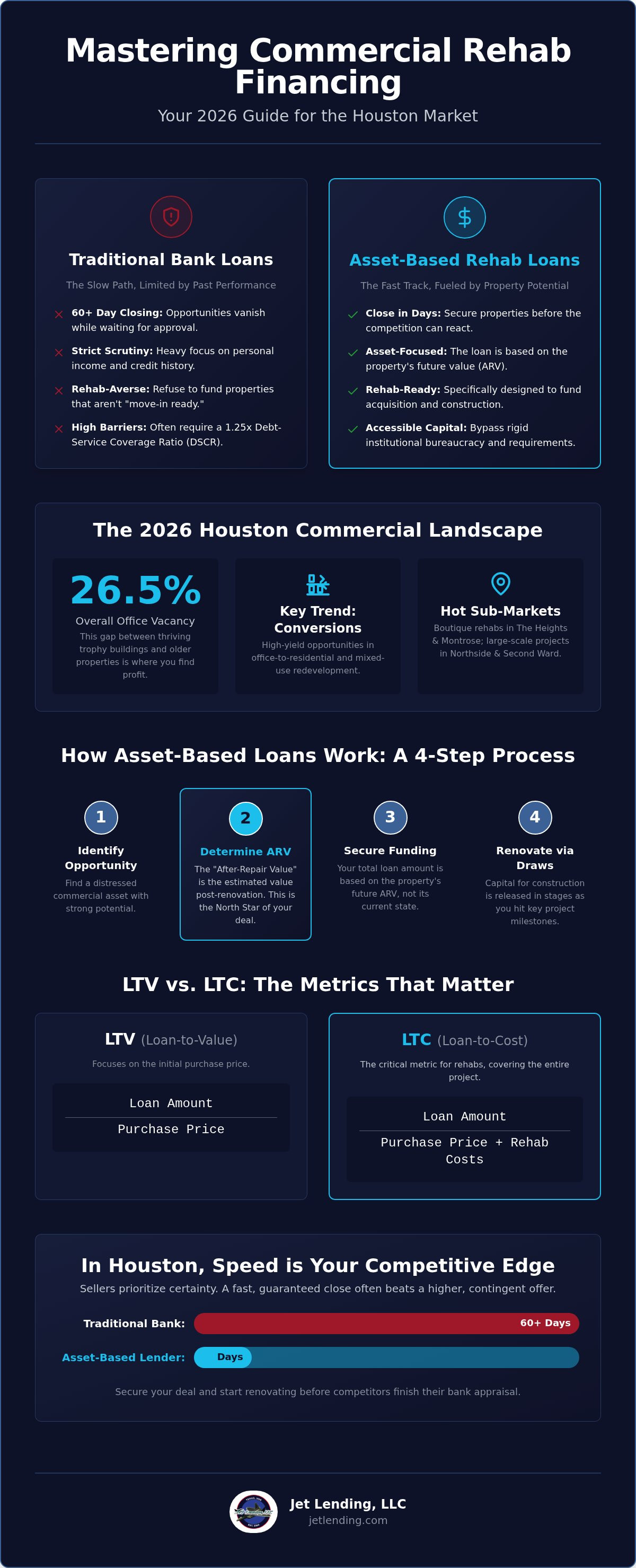
Securing capital for a commercial project is a structured process that rewards preparation. Unlike residential mortgages, commercial property rehab loans Houston are issued to business entities. Your first step is ensuring your LLC or Corporation is in good standing with the state. This entity-based structure protects your personal assets and signals to the lender that you're a professional operator. Once your entity is ready, you must finalize a granular Scope of Work (SOW). This document should include detailed contractor bids for every phase, from structural repairs to cosmetic finishes. A vague budget is a red flag that can slow down your funding.
After submitting your SOW and entity docs, the deal moves into rapid asset-based underwriting. The lender will order a commercial appraisal and a property inspection to confirm the current state and the projected future value. Because the property is the collateral, this step is the most critical part of the timeline. Once the appraisal aligns with your projections, you move to closing. In the Houston market, this can happen in a fraction of the time a bank would require. After closing, you'll initiate your first renovation draw to get your contractors on-site immediately.
One of the biggest advantages of asset-based lending is the reduced focus on personal paperwork. You don't need to provide stacks of personal tax returns or pay stubs. Instead, you need an "Experience Resume." This document should highlight your past success with flips or rehabs, even if they were residential. Showing that you can manage a project from start to finish helps you secure better rates and terms. Your primary focus should be on the property's title. Ensure there are no outstanding liens or legal disputes that could prevent a clean transfer of ownership. A clear title is the foundation of any successful commercial acquisition.
Your loan isn't a lump sum; it's a partnership in progress. You'll request funds through a draw schedule as you hit specific renovation milestones. When a phase like roofing or plumbing is complete, you'll notify the lender. A local Houston inspector will visit the property to verify the work matches your original SOW. Once approved, the funds are released to reimburse your costs. To keep your cash flow stable during a typical six-month commercial rehab, always keep a small cash reserve for materials and labor between draws. This ensures the project never stops moving while you wait for the next inspection.
Local expertise is your greatest asset in 2026. Jet Lending, LLC understands the specific nuances of Houston’s sub-markets, from the East End to the Northside. We provide the speed and transparency you need to navigate commercial property rehab loans Houston without the institutional friction of a traditional bank. We aren't just a lender; we're a partner invested in your growth. Our investor-first tools, like our in-house investment property calculator, help you analyze deals quickly. This ensures you never miss a value-add opportunity because of slow underwriting or rigid corporate gatekeepers.
Scaling requires a repeatable system. The BRRRR method isn't just for single-family homes; it's a powerful strategy for commercial assets too. You buy a distressed property, execute your rehab, and lease it to quality tenants. Once the building is stabilized and income-producing, you refinance into a long-term loan and pull your capital back out to fund the next project. This cycle allows you to build a massive portfolio with a finite amount of initial capital. We help you move through these phases with speed and clarity.
To grow faster, you need advanced strategies. Cross-collateralization allows you to use the equity in your existing properties to fund new commercial property rehab loans Houston. This strategy eliminates the need for massive cash down payments on every new acquisition. Once your projects are stabilized, we help you transition into DSCR loans that focus on the property's cash flow rather than your personal income. Jet Lending, LLC has been a direct lender in Texas since 2004. Our twenty-year history means we've seen every market cycle and know how to help you navigate the unique challenges of the Houston landscape in 2026. We know the streets, not just the spreadsheets, giving you a distinct edge over out-of-state lenders.
Speed starts with preparation. Get a pre-approval letter today to show sellers and brokers you have the backing of a professional, asset-based lender. This strengthens your offer and puts you at the front of the line in a competitive market. For more local context on the lending environment and to see how we compare, check out our hard money lenders Houston guide. It's time to stop waiting on bank gatekeepers and start building your commercial legacy with a partner who understands your goals.
The 2026 Houston market moves fast, and your financing needs to keep pace. We've covered how to master the income approach for valuations and why a detailed scope of work is your most powerful tool in underwriting. By utilizing commercial property rehab loans Houston, you can stop fighting bank bureaucracies and start focusing on the actual potential of your real estate deals. You now have the roadmap to identify, qualify, and fund high-yield value-add projects across the Inner Loop and beyond.
Jet Lending, LLC has served as a direct lender in this city since 2004. We understand that in a competitive year, speed is your primary currency. Our asset-based approach allows us to close in as little as 2 to 7 days, giving you the leverage to beat out cash buyers and institutional competitors. You have the vision to revitalize our aging commercial corridors; we have the localized expertise and capital to help you scale your portfolio with confidence.
Your next project is waiting. Take the first step today and partner with a team that knows the Houston streets as well as you do. Let's build your commercial legacy together.
A commercial property rehab loan is a short-term, asset-backed financing tool designed for real estate investors to purchase and renovate distressed commercial assets. Unlike traditional mortgages, these loans focus on the property’s after-repair value (ARV) rather than its current condition. This allows you to secure capital for acquisition and construction costs simultaneously. These loans are strictly for investment purposes and cannot be used for owner-occupied residential properties or personal use.
You can close on commercial property rehab loans Houston in as little as 2 to 7 days when working with a direct local lender. Traditional banks often take 45 to 60 days to process commercial applications, which can cause you to lose out on competitive deals. Our streamlined, asset-based underwriting process prioritizes the deal’s potential over institutional red tape. This speed allows you to compete with cash buyers and secure distressed assets quickly.
You don't necessarily need a perfect credit score because the property itself serves as the primary collateral. Asset-based lending focuses on the deal's profitability and the property's value rather than just your personal financial history. While we do review your credit, your ability to execute the renovation and the strength of the asset carry more weight. This makes hard money an ideal solution for investors with strong deals but unconventional credit profiles.
Yes, mixed-use properties are excellent candidates for commercial rehab financing in the Houston market. Whether you're converting a mid-century building into a combination of retail and office space or updating an existing multi-use asset, asset-based loans provide the necessary flexibility. Houston’s unique lack of formal zoning often creates creative opportunities for these types of value-add projects. We evaluate the projected income from both the residential and commercial components to determine the loan amount.
In 2026, you can typically secure up to 90% of the purchase price and 100% of the renovation costs for commercial property rehab loans Houston. However, the total loan amount generally cannot exceed 70% of the property’s after-repair value (ARV). These ratios ensure that you have sufficient leverage to complete the project while maintaining a safe equity position. Using an investment property calculator during your due diligence phase is the best way to confirm requirements.
Renovation funds are released in stages through a reimbursement process known as draws. As your contractors complete specific milestones outlined in your scope of work, you request a fund release. A local inspector will visit the Houston site to verify that the work is finished according to the agreed-upon standards. Once the inspection is approved, the capital is released to cover those specific costs. This system keeps the project on schedule and ensures transparency.
You can qualify for a commercial rehab loan even without extensive commercial experience, though having a solid plan is vital. Providing a detailed "Experience Resume" that highlights successful residential flips or general business experience can strengthen your application. We also look closely at your contractor's track record and the detail in your scope of work. A well-prepared exit strategy and a high-potential asset often outweigh a lack of specific commercial history.
Once your renovation is complete and the property is stabilized, you execute your pre-planned exit strategy. Most investors choose to either sell the asset for a profit or refinance into a long-term DSCR loan. Refinancing allows you to pay off the short-term rehab loan and pull out equity to fund your next acquisition. This transition from a short-term bridge loan to a permanent financing solution is a key step in scaling a commercial portfolio.
Tags:

Why do most new investors lose their entire profit margin before the first wall even comes down? It usually happens because they're guessing on the numbers. You know the feeling of standing in a...

In the 2026 Houston market, the cheapest interest rate on the planet is worthless if it takes sixty days to close. You've likely seen institutional buyers snatch up distressed 10-unit buildings with...

With a record 40,750 active listings currently saturating the Houston market, your biggest risk isn't finding a house; it's buying a liability. You've likely felt the pressure of a deal that looked...