
Written By: Stephanie Rojas | October 06, 2026
Time to Read 12 Minutes
Financial freedom through real estate investing Houston investors can work toward starts with more than finding a promising property. It takes a strategy that fits your goals, available capital, and time, followed by consistent, careful decisions. Houston offers a range of investment opportunities, but every deal needs property-level review, including neighborhood risks, repair needs, taxes, insurance, and potential rental income.
If you’re weighing rentals, rehabs, or another approach, start by defining what you want your investments to do. You don’t need to settle every question before looking at properties. First, clarify your financial goal and take stock of how much time and capital you can commit.
This practical 2026 roadmap explains how to choose a strategy, assess Houston-area properties, and plan for costs and risks before making an offer. It also covers how an investment property calculator can help organize deal assumptions and where short-term investment property financing may fit. The goal isn’t to promise a quick win. It’s to help you make informed decisions and build a plan you can adjust over time.
Financial freedom isn’t a property count or a promise of effortless income. It’s a personal goal: having enough dependable resources to cover some or all of the expenses you choose, or gaining more flexibility over how you spend your time. A practical plan for financial freedom through real estate investing Houston starts by defining what that means for you, then measuring progress without assuming every property will perform as expected.
Goal vs. result: A financial-freedom goal is a target you set for your life and finances. An investment result is uncertain. Real estate can produce income or build value, but it can’t guarantee rental income, appreciation, or financial independence.
Track the different ways a property may contribute, and don’t treat them as interchangeable:
These fundamentals are part of real estate investing, but how they apply depends on the property, financing, and plan.
Start with your monthly expenses. Identify which costs you’d like investment income to cover, how much flexibility you want, and your target timeline. Then estimate potential income after operating costs and debt obligations, rather than using rent alone. Revisit your assumptions when your income, expenses, property needs, or priorities change. A useful target should guide decisions without locking you into an outdated plan.
Houston is the focus, but the city’s name alone can’t tell you how an individual property will perform. Rental income may be reduced by vacancies, repairs, property taxes, and insurance. Costs and conditions can vary between properties, so investigate the specific deal instead of relying on broad assumptions about the city.
Financial freedom means using investment resources to support the life you want, while recognizing that returns and timing remain uncertain. That distinction keeps the goal motivating and the decisions grounded. Define your target first, then assess each opportunity against it.
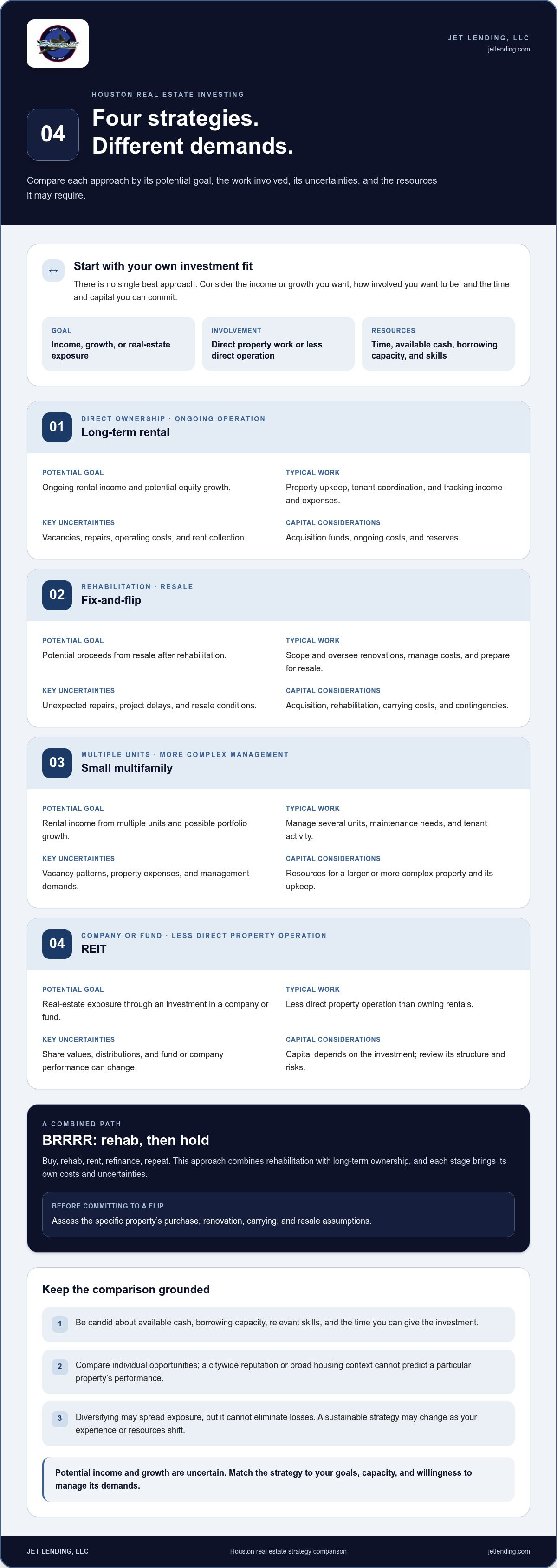
There’s no single best way to invest. The right approach depends on the income or growth you’re seeking, how involved you want to be, and what resources you can commit. Use this comparison to narrow your options, then examine individual opportunities. For local context, the Rice University Kinder Institute’s 2026 State of Housing report can help you understand broader Houston-area housing conditions, but it can’t predict the performance of a particular investment.
| Strategy | Potential goal | Typical work | Key uncertainties | General capital considerations |
|---|---|---|---|---|
| Long-term rental | Ongoing rental income and potential equity growth | Property upkeep, tenant coordination, and income and expense tracking | Vacancies, repairs, operating costs, and rent collection | Funds for acquisition, ongoing costs, and reserves |
| Fix-and-flip | Potential proceeds from resale after rehabilitation | Scope and oversee renovations, manage costs, and prepare for resale | Unexpected repairs, project delays, and resale conditions | Capital for acquisition, rehabilitation, carrying costs, and contingencies |
| Small multifamily | Rental income from multiple units and possible portfolio growth | Manage several units, maintenance needs, and tenant activity | Vacancy patterns, property expenses, and management demands | Resources for a larger or more complex property and its upkeep |
| REIT | Real-estate exposure through an investment in a company or fund | Less direct property operation than owning rentals | Share values, distributions, and fund or company performance can change | Capital depends on the investment; review its structure and risks |
Buy-and-hold investing centers on operating a property over time. Plan for tenant management, maintenance, and possible vacancies. A fix-and-flip involves buying, rehabilitating, and reselling a property, so it requires close oversight of renovation scope and costs, as well as a realistic resale plan. The BRRRR approach, buy, rehab, rent, refinance, repeat, combines rehabilitation with long-term ownership, but each stage brings its own costs and uncertainties. Assess a flip using the specific property’s purchase, renovation, carrying, and resale assumptions before committing.
Be candid about available cash, borrowing capacity, relevant skills, and the time you can give the investment. Diversifying across investments may spread exposure, but it can’t eliminate losses. Your best fit may change as you gain experience or your resources shift. The goal of financial freedom through real estate investing Houston investors pursue is better served by a strategy they can sustain than by one that only looks attractive on paper.
Use an investment property calculator to organize deal assumptions alongside your own review of costs, risks, and reserves.
A property can look promising on a spreadsheet and still require more time, cash, or attention than expected. Real estate isn’t automatically passive, predictable, or profitable. Vacancies can interrupt rental income, repairs can exceed initial estimates, and managing tenants or contractors takes work. For investors pursuing financial freedom through real estate investing Houston, sound decisions start with the specific property, not a broad assumption about the city.
Citywide data can provide context, but it can’t tell you whether a parcel has flood exposure, what insurance coverage may be available, or how much maintenance a particular building needs. The Rice University Kinder Institute’s 2025 State of Housing Report offers regional background. Pair that perspective with property-level research and current estimates for taxes, insurance, utilities, repairs, and management.
Projected returns only matter after you account for operating costs, financing obligations, and the uncertainty that can change both income and expenses.
Review the address in FEMA’s Flood Map Service Center and investigate available property-specific records. Flood-map information is a research starting point, not a guarantee about future risk or insurance coverage. Check Harris County Appraisal District records for relevant property information, and use current local estimates when evaluating taxes and ongoing costs.
Build conservative, expected, and adverse scenarios. For each one, test rent, vacancy, repair, and resale assumptions. If a short vacancy or an unplanned repair wipes out the projected cushion, revisit the deal before moving forward. An investment property calculator can help organize assumptions, but it can’t replace accurate inputs or property-specific due diligence.
For a resale-focused project, estimate after-repair value using comparable properties and realistic renovation assumptions. Don’t rely on hoped-for appreciation to make weak fundamentals look stronger. A deal should make sense under cautious assumptions, not only in the most favorable scenario. If the numbers depend on everything going right, take another look at the risk.
Turn your goal into a process you can repeat. Before searching listings, decide what you can commit, how you’ll evaluate a property, and what would make you walk away. This keeps your search focused and lets you compare opportunities using consistent standards.
Set a maximum level of exposure, an acceptable workload, a timeline, and a minimum reserve before making offers. Keep personal emergency savings separate from funds set aside for an investment project. Plan reserves for vacancies, repairs, and other unexpected expenses. Tax, legal, and insurance questions can affect your decision, so consult qualified professionals in those specialties.
Use the same categories for every opportunity. Review neighborhood comparables, property condition, likely tenant demand, and local risks. Current listings show asking prices, but asking prices don’t prove completed sale values or achievable rent. Compare listings with verified transaction data where available, and keep each assumption distinct.
For financial freedom through real estate investing Houston, make sure you can explain the numbers before pursuing financing. An investment property calculator can help organize assumptions and compare scenarios, but its results are only as useful as the information you enter. Review the figures, property details, and available capital together before deciding whether to move forward.
Financing can help fund an investment property acquisition or rehabilitation, but it can’t turn a weak deal into a sound one. Start with the property’s numbers and your reserve plan. Then consider whether borrowing aligns with the project’s purpose, expected timeline, and exit plan. A loan adds obligations, so include repayment alongside operating costs and funds set aside for surprises.
Short-term asset-backed investment financing is intended for real estate investment purposes and secured by an asset. It differs from an owner-occupied mortgage, which is for a home the borrower lives in, and an unsecured personal loan, which isn’t secured by property. Jet Lending provides short-term investment property loans for acquisitions and rehabilitation. Before pursuing financing, understand how the loan’s purpose and duration fit your project plan and how repayment connects to your intended exit.
For financial freedom through real estate investing Houston, treat capital planning and deal analysis as connected steps. Estimate the full project needs, preserve appropriate reserves, and consider financing as one input in your decision, not proof that an acquisition makes sense.
After an investment, compare actual costs, timelines, and outcomes with your original assumptions. Note what changed, from rehabilitation scope to operating expenses, and consider how those lessons affect your next decision. Review the results before expanding a portfolio or switching strategies. A repeatable process helps you adjust based on experience rather than assuming the next property will follow the same path.
Your next steps are straightforward: refine your financial target, analyze a property, plan the capital and reserves it requires, then consider how investment financing could fit. Jet Lending’s investment property calculator can help organize deal assumptions, while its short-term investment property financing supports acquisitions and rehabilitation. Treat both as parts of a considered plan, keeping in mind that financing does not guarantee returns or financial independence.
A practical path to financial freedom through real estate investing Houston begins with a personal target, a strategy that fits your resources, and careful property-level analysis. Allow for vacancies, repairs, and other costs, then revisit your assumptions as your experience grows. Financing can support a project, but it can’t replace sound numbers or adequate reserves.
Refine your goals, assess a property, and plan your capital before pursuing an acquisition. Jet Lending, LLC has operated since 2004, providing short-term asset-backed financing for real estate investment purposes. Its investment property calculator can help you organize assumptions as part of deal analysis.
Steady progress comes from informed choices, not chasing a perfect deal. Keep learning, stay disciplined, and build a plan that works for you.
Yes, real estate investing in Houston may help you work toward financial freedom, but it can’t guarantee income, appreciation, or financial independence. Start by defining what freedom means for your finances, such as covering selected monthly expenses with investment income. Then evaluate how a property could contribute after operating costs and debt obligations. Rental cash flow, equity growth, and proceeds from a future sale are different measures, each with its own uncertainties.
Start with a clear target, then choose a strategy that matches your available capital, experience, and time. Set financial guardrails and a reserve plan before searching. For each Houston property, review its condition, comparable properties, potential income, ongoing costs, and local risks. Test conservative as well as expected assumptions. An investment property calculator can help organize the numbers, but your decision should also account for property-specific research.
A rental property may support wealth building through rental income and potential equity growth, but its performance depends on the individual property and your plan. Consider tenant demand alongside vacancies, repairs, taxes, insurance, financing obligations, and management needs. Compare expected rent with all operating costs rather than judging a deal by its location or asking price alone. A rental that doesn’t fit your finances or workload may not be the right strategy for you.
There’s no single amount that applies to every Houston investor. The capital required depends on the property, its condition, your investment strategy, and how you plan to fund the project. Account for acquisition and rehabilitation needs, financing obligations, operating costs, and reserves for vacancies or unexpected repairs. Keep personal emergency savings separate from investment funds. Build your estimate around a specific property and financing plan rather than relying on a general figure.
There isn’t one risk that applies equally to every property. A common challenge is underestimating costs or local property conditions, leaving too little room for vacancies, repairs, insurance, taxes, or management. Houston properties need parcel-level research, including flood exposure, rather than assumptions based on citywide averages. Review current property records and estimates, then test how the deal performs if income falls or expenses rise. If the numbers only work in an ideal scenario, reconsider.
Yes. You can hire a property manager to handle some day-to-day tasks, such as coordinating maintenance or communicating with tenants. That arrangement can reduce your direct workload, but management costs affect the property’s net income, and you’ll still need to monitor performance and make decisions. Include management in your expense assumptions from the start. If you prefer less direct involvement, compare that approach with other ways to gain real estate exposure.
Evaluate the property using separate, realistic assumptions for acquisition, repairs, financing, operations, and your planned exit. Research comparable properties and distinguish asking prices from completed sale outcomes. Check property condition, likely tenant demand, taxes, insurance, utilities, maintenance, vacancy, and local risks. Stress-test rent and resale assumptions under conservative and adverse scenarios. An investment property calculator can organize your estimates, but the quality of the analysis depends on accurate, property-specific inputs.
Tags:

What if the financing that gets you into a Houston investment property becomes the biggest risk to getting out? A bridge loan can connect an acquisition or rehabilitation project to its next...

What if the bank's "10-loan limit" was actually just a suggestion rather than a hard rule for your growth? You have built a solid foundation with a handful of rentals in the Heights or Katy, but now...

In Houston’s 2026 real estate market, waiting sixty days for a bank approval isn't just an inconvenience; it's a deal killer. You've likely felt the frustration of watching a prime value-add...