
Written By: Stephanie Rojas | October 10, 2026
Time to Read 13 Minutes
What if the funding partner that looks fastest on paper can’t keep pace with your property, rehabilitation scope, or exit plan? For Houston investors searching for reliable funding for real estate investors Houston, advertised speed is only one part of the picture. The practical question is whether the financing fits the deal and its timeline.
Before moving forward, get clear on what makes a lender dependable, what information will help explain your project, and which assumptions could create delays or pressure. This guide offers a practical framework for assessing funding fit, preparing a Houston deal for discussion, and deciding whether short-term, asset-backed financing suits your acquisition or rehabilitation plan.
You’ll also learn how an investment property calculator can help you examine costs, rehabilitation plans, and exit assumptions. Jet Lending, a Texas-based lender operating since 2004, provides short-term financing for real estate investment projects. Use the criteria below to assess whether its financing aligns with your strategy.
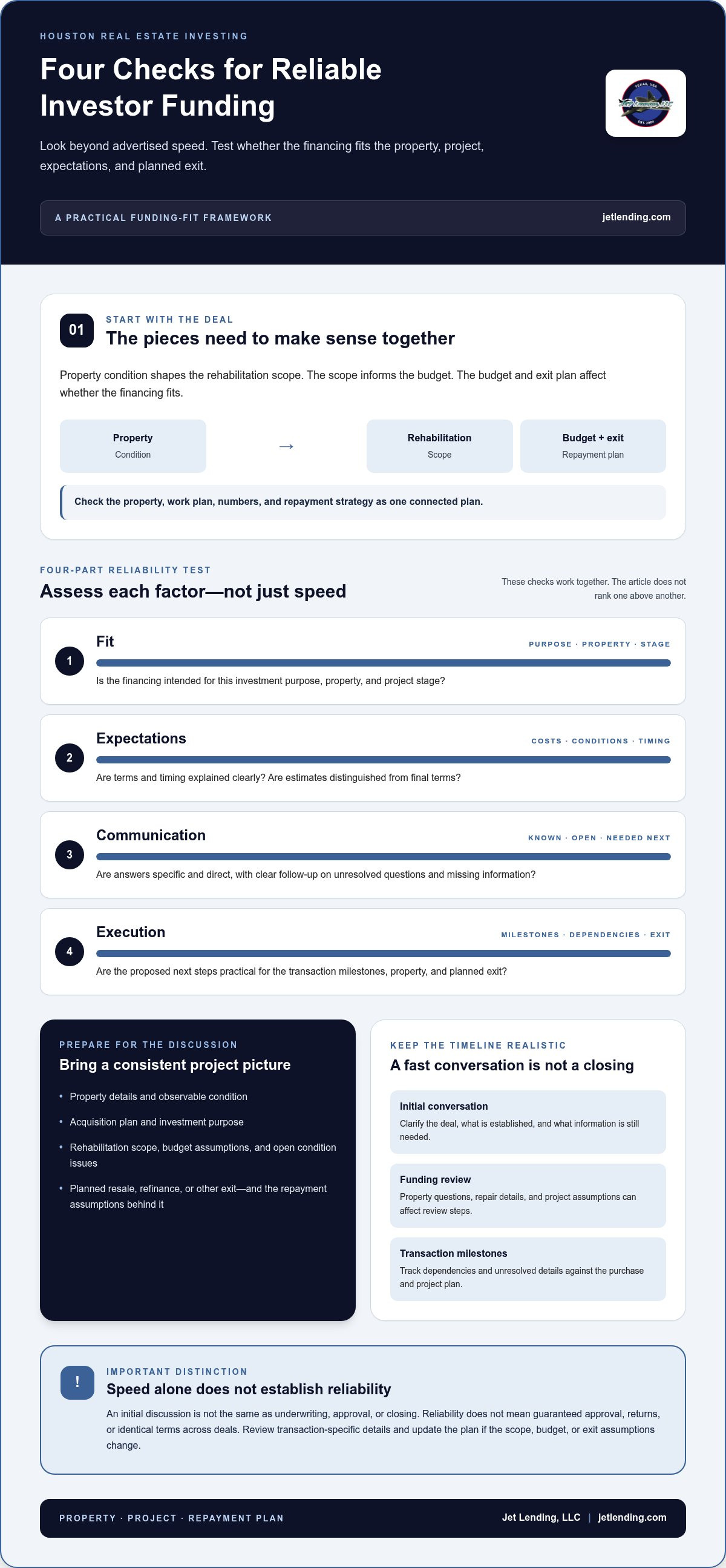
Reliable funding means more than a fast response or a confident promise. The financing needs to fit the investment, expectations should be clear, communication should help resolve questions, and the next steps should be realistic for the transaction. For investors seeking reliable funding for real estate investors Houston, assess the specific property and plan rather than relying on a headline claim.
Real estate deals involve connected decisions. Property condition shapes the rehabilitation scope, the scope informs the budget, and the budget and exit plan affect whether the financing fits. The Real Estate Investing Overview provides background on investment types, valuation, and financing. For your own deal, check that the property, work plan, numbers, and repayment strategy make sense together.
A useful reliability test covers four questions:
Reliability does not mean guaranteed approval, returns, or identical terms across deals. A careful assessment accounts for the property’s condition, project scope, and full transaction. It also distinguishes marketing language from transaction-specific details you can evaluate.
Timing matters when it lines up with milestones in your purchase and project plan. An initial conversation is not the same as underwriting, approval, or closing. For example, a purchase may require a prompt decision, but unanswered questions about repairs or property condition can still affect the funding review. A useful timeline identifies its stages, dependencies, and unresolved details.
Organize the property and project information before discussing funding. If the planned work changes from cosmetic updates to substantial repairs, the initial budget and timeline may no longer reflect the deal. Update your assumptions and discuss the changes rather than relying on a general speed claim.
Look for deal-specific communication that considers the acquisition, rehabilitation plan, and exit assumptions together. Your projected resale or rental strategy informs repayment planning, while the property’s condition and scope shape the capital plan. Explain each part consistently and track what is established and what still needs resolution. The existing Houston hard money lender guide offers related context on this funding category.
Local details matter, too. Record the property’s observable condition and project-specific concerns rather than relying on broad neighborhood assumptions. If the acquisition plan, repair scope, budget, and exit no longer align, revisit the numbers before treating the funding path as workable. That discipline helps you judge whether the financing fits your Houston investment.
Broad claims will not tell you whether financing fits your property or plan. Use a consistent checklist to examine the transaction, then record the answers against your acquisition, rehabilitation, and repayment assumptions. This gives investors evaluating reliable funding for real estate investors Houston a more practical basis for discussion than speed or flexibility claims alone.
Funding reliability means alignment between the capital, the deal’s milestones, and the repayment plan. Use that as your test throughout the funding conversation.
Ask how the property, planned work, and investment purpose shape the review. Clarify which details affect the next steps, what information is outstanding, and which milestones depend on receiving it. Then assess whether the answers are consistent, understandable, and specific to your project. A useful response separates what is known from what still needs resolution instead of presenting an early discussion as a final decision.
Local context can inform your assumptions, but it cannot replace property-level analysis. The 2026 Houston Housing Market Report from Rice University’s Kinder Institute for Urban Research offers broader housing context. Use market research alongside the property’s condition, project scope, and exit plan, not as proof that a particular investment will perform as projected.
Review rates, fees, repayment expectations, conditions, and timing as deal-specific terms. Ask how a rate is applied, when fees are due, what repayment requires, which conditions must be met, and what milestones shape the expected timeline. Treat verbal estimates as preliminary. Request a written summary of material terms, assumptions, and open questions, then compare it with your acquisition and rehabilitation schedule.
Before discussing financing, use Jet Lending’s investment property calculator to examine your deal assumptions. Check whether projected costs, planned work, and your exit still make sense if an assumption changes. A different repair scope or longer project can change the financial picture, so note which estimates are firm and which are provisional.
Start with Jet Lending’s investment property calculator and your deal notes. A clear summary keeps the conversation focused on the property, the project, and the repayment plan.
Choose financing by working backward from the investment plan, not by speed or category name alone. An acquisition that needs rehabilitation has different capital needs from a property intended to produce rental income over the long term. Compare the property, project stage, expected duration, repayment structure, and exit together. This helps you see whether a funding approach supports the deal or creates a mismatch.
The comparison below is a starting point, not a universal rule. Terms and suitability vary by transaction, property, and lender. Short-term asset-backed financing may fit a qualifying investment acquisition or rehabilitation project, while longer-term financing may better match a hold strategy. Neither category guarantees approval or a particular outcome.
Short-term asset-backed funding
Longer-term financing
Separate the funds needed to buy and improve a property from the financing goal for a longer-term rental hold. A project may involve more than one financing stage, each with its own assumptions and timing. If your strategy follows the BRRRR method, evaluate its sequence: buy, rehabilitate, rent, refinance, and repeat. The planned refinance is an assumption to analyze, not a guaranteed exit or repayment source.
Speed alone can lead to a poor fit. A faster option may not suit a project where rehabilitation, lease-up, or the planned hold extends beyond your working timeline. Map expected milestones first, then compare them with repayment expectations and relevant conditions. This helps investors looking for reliable funding for real estate investors Houston avoid choosing an option based only on how quickly it appears to move.
Possible exits include selling the improved property or refinancing into financing suited to a longer-term hold. Treat both as plans to test, not assured outcomes. Revisit the expected sale price, repair scope, carrying assumptions, and schedule using inputs grounded in the specific deal. If a longer repair period changes carrying costs or delays a sale, assess how that affects repayment readiness.
An investment property calculator can help organize assumptions and show how changes affect projected results. For a closer look at calculations for a resale strategy, use the existing fix-and-flip deal analysis guide as a companion. Keep the financing comparison tied to the numbers and exit you can explain, not a best-case projection.
A clear deal file keeps a funding discussion grounded in the property and the plan. Gather the facts in a consistent order, flag details that still need verification, and make sure your budget and exit assumptions tell the same story. Complete assumptions help a lender assess project fit more clearly.
Use this preparation sequence to organize the essentials:
Make the file easy to review by pairing the property description with condition notes, intended use, and work plan. For a Houston-area property, document location-specific factors you have identified rather than relying on broad neighborhood claims. Review relevant Houston or Harris County records and requirements where applicable, and verify details for the property and project.
Flood exposure, insurance needs, and permitting are diligence topics to address, not assumptions to gloss over. Conditions and requirements can depend on the property and planned work, so verify applicable details through current, property-specific sources. Mark unresolved items clearly. This gives the funding conversation a more accurate picture without presenting an unchecked assumption as fact.
Connect the intended sale or rental strategy to the numbers supporting it. If you use after-repair value (ARV), define it as the estimated property value after planned improvements, then explain how comparable-property analysis informs your estimate. An ARV guide can help clarify the concept and its role in deal analysis. Keep the estimate distinct from a guaranteed sale price or refinance result.
Stress-test the assumptions. Consider how a narrower sale-price estimate, expanded repair scope, added carrying time, or delayed exit could change the projected outcome. Use inputs tied to the property and plan, and label estimates that may change. This makes it easier to discuss the deal’s funding needs and repayment path without relying on a best-case scenario.
Before sharing your deal assumptions, review them with Jet Lending’s investment property calculator.
Jet Lending is a Texas-based lender providing short-term, asset-backed financing for real estate investors. Its loans are for investment property acquisitions and rehabilitation projects, making them relevant when a deal needs capital for a defined purchase or improvement plan. Jet Lending has operated since 2004 and serves investors assessing Houston opportunities.
For investors comparing reliable funding for real estate investors Houston, the key question is how a financing approach fits the property, planned work, and intended repayment path. Short-term financing can suit an investment project, while suitability and terms depend on the specific transaction. A prepared deal summary helps keep the discussion focused on the opportunity rather than assumptions about what every project requires.
Consider Jet Lending’s short-term, asset-backed financing for an investment acquisition or rehabilitation. Bring the property’s basic details, intended investment use, planned work, and anticipated exit assumptions. These details help frame a project-specific funding conversation. Financing outcomes are not guaranteed, and suitability depends on the transaction.
Put the main elements of your project in one place before discussing it. Include the property, investment purpose, acquisition plan, rehabilitation scope, budget assumptions, and intended sale or rental strategy. Note which numbers are supported by estimates and which remain provisional. This makes it easier to explain how the project is expected to progress and where the funding need fits.
Jet Lending’s investment property calculator can help you review deal assumptions and see how changes may affect your analysis. Use it as a planning aid, not as a financing decision, approval, or guarantee of results. If a repair estimate, timeline, or exit assumption is uncertain, identify it clearly so it can be discussed rather than overlooked.
A concise, accurate summary creates a stronger starting point. It lets you explain what the investment needs, how you plan to execute, and how the expected exit connects to repayment. Separate projections from confirmed details, then discuss how short-term asset-backed financing may align with your Houston investment strategy.
Your search for reliable funding for real estate investors Houston becomes more focused when you treat each deal as a set of decisions, not a race to secure capital. Before moving forward, identify what needs to remain true for the project to work: the repair scope, budget, timeline, and exit assumptions. If those inputs change, revisit the plan early. That gives you time to make informed adjustments instead of relying on an outcome the numbers do not support.
Bring your investment goals and deal-specific questions to a funding conversation. A clear discussion can help you understand how the financing relates to your project and which decisions deserve more attention. You do not need every detail resolved to begin, but separating solid assumptions from evolving ones makes the conversation more productive.
Keep building with care. A well-considered deal can help you pursue your next opportunity with a clearer view of its risks and assumptions.
It can be useful when the financing structure, property, project plan, and repayment strategy align. For a Houston property, include location-specific diligence in your review. For example, check whether flood exposure could affect insurance considerations or project planning, and verify details for that property rather than relying on general assumptions. Reliability is not a promise of approval or profit, so assess the actual terms, conditions, communication, and timeline for your transaction.
Finding reliable funding for real estate investors Houston starts with sharing a clear, accurate picture of the proposed transaction. Explain the property’s condition, investment purpose, planned work, and intended exit. Pay attention to whether the lender identifies missing information and explains next steps in relation to your deal. Ask for material terms in writing, then compare them with your budget and purchase assumptions. Preparation helps assess fit, but it cannot guarantee approval.
They may support both needs for a real estate investment, depending on the transaction and financing structure. Clarify how the proposed financing addresses the purchase and planned work, and how the repayment plan accounts for project progress. Jet Lending provides short-term asset-backed financing for real estate investment purposes. Review the scope, budget, and transaction-specific terms together before deciding whether this approach suits your Houston deal.
Prepare a concise deal brief with the property address, current condition, acquisition assumptions, intended use, work plan, budget, and exit strategy. Add open diligence items, such as property-specific insurance, flood exposure, or permitting questions where relevant. Separate confirmed information from estimates, and note how you plan to resolve each unknown. This makes gaps visible early and keeps the funding discussion focused on decisions that could affect the project.
Asset-backed investment lending gives the property an important role, but the lender may consider more than its estimated value. The investment purpose, property condition, planned rehabilitation, borrower information, and repayment strategy can all be relevant to the transaction. Evaluation criteria vary by lender and deal, so one property’s outcome does not predict another’s. Share accurate information about both the asset and your plan, then review proposed terms against your project assumptions.
No. A calculator helps examine deal assumptions; it does not determine approval or guarantee performance. Try adjusting one input at a time, such as rehabilitation costs or expected exit timing, to see how sensitive your projections are. Keep estimates grounded in the specific property and distinguish them from confirmed figures. Jet Lending provides an investment property calculator for deal analysis. Use its results as a planning aid, then assess financing fit separately.
Tags:

What if the financing that helps you secure a Houston investment also puts pressure on your exit plan? A short-term loan can support an acquisition or rehabilitation project, but the fit depends on...

What if the right loan for a Spring Branch investment depends less on a standard mortgage checklist and more on the property, project, and exit plan? Comparing real estate investment loans Spring...

A promising Houston property can still make a weak funding request if the numbers, repair plan, or repayment path are unclear. For investors exploring private funding for real estate deals Houston,...