
Written By: Stephanie Rojas | October 06, 2026
Time to Read 11 Minutes
A promising Houston property can still make a weak funding request if the numbers, repair plan, or repayment path are unclear. For investors exploring private funding for real estate deals Houston, the opportunity matters, but so does how clearly you present it.
To assess whether a project fits short-term, asset-backed financing, organize the key details: the property’s current condition, the planned work, support for your value assumptions, and your intended repayment path. A clear deal package helps show how these pieces fit together and where estimates may change.
This guide explains how to assess a Houston investment deal for short-term financing, prepare a project summary, and understand the main steps in reviewing your assumptions. It covers the property and its after-repair value, your scope of work and exit plan, and how Jet Lending’s investment property calculator can help you analyze a deal. It also explains why local details, such as flood exposure, belong in your property research.
The phrase “private funding for real estate deals Houston” can describe different ways investors raise capital. It does not identify one standard loan, set of terms, or underwriting approach. Look beyond the label and consider how the financing structure relates to the property, project, and repayment plan.
Asset-backed short-term financing is investment-purpose funding assessed in relation to the property and deal details. It differs from an owner-occupied mortgage, which finances a home the borrower intends to live in. Jet Lending provides short-term financing for real estate investors pursuing property acquisitions and rehabilitation.
Private funding is a broad market term for different capital arrangements. Asset-backed lending refers to financing assessed in connection with real estate used as collateral. For a broader introduction, read about real estate investing and financing, then focus on the specific structure you are considering.
Private lenders do not all use the same terms, underwriting approaches, or collateral requirements. Asset-backed does not mean the property alone determines the outcome. The purchase, current condition, proposed work, and repayment plan all help explain the opportunity. Treat each financing structure as a distinct arrangement, and present the details of your Houston deal clearly.
Investors may explore short-term financing to acquire an investment property, including one that needs rehabilitation. The project goal shapes the funding request. An investor might renovate and resell a property, improve it before renting it, or pursue another documented exit. Explain how the project is expected to repay the financing and how the plan connects to the property.
For a property that needs repairs before it can be marketed or rented, summarize what you plan to acquire, the work you expect to complete, and your intended exit. These details help frame the project. Be precise about your assumptions, including which figures are supported by documentation and which are still estimates.
A deal is easier to understand when its parts tell a consistent story. Common considerations include the purchase details, property condition, planned rehabilitation, estimated value after the work, and intended exit. Organize these elements so the relationship between the property, proposed project, and repayment plan is clear.
A clear exit plan connects a short-term funding request to a repayment strategy. Explain whether you intend to sell the renovated property, hold it as a rental, or use another documented exit. Then show how your project timeline and financial assumptions support that plan.
Begin with a concise summary that includes the property address, type, acquisition status, and known condition. Describe the rehabilitation scope, separating observed or documented needs from estimates. If a repair cost, completion date, or resale value is an assumption, label it as such rather than presenting it as confirmed.
After-repair value, or ARV, is an estimate of a property’s value after planned improvements. Support your estimate with comparable properties that are relevant to the subject property, and explain why they are useful comparisons. A calculator can help you review assumptions, but it cannot confirm an ARV, profitability, or financing approval on its own.
Local context matters when estimating value. Compare Houston properties with attention to location, condition, and features rather than relying on a neighborhood name or a single sale. Comparable properties can inform an estimate, but they do not guarantee that a property will sell or rent at a particular price.
Review flood exposure and property history using current, property-specific information, and account for insurance considerations in your analysis. If the rehabilitation may require permits or other local approvals, verify the rules that apply to the proposed work before finalizing your assumptions. In your deal summary, distinguish documented findings from questions that remain unresolved.
The City of Houston’s Housing and Community Development funding page describes a separate category of local funding resources. Public programs and private, asset-backed investment financing are different routes, so identify which type of funding matches your project.
As you organize your property details and exit assumptions, review Jet Lending’s investment property financing for short-term funding for investment acquisitions and rehabilitation.
The appropriate funding approach depends on where a property is in its investment journey. Buying a property that needs work creates different capital needs from holding a stabilized rental. Compare the project stage, the asset, the capital required, and how you expect to repay or recover that capital.
| Project stage | Capital need | Asset | Intended exit |
|---|---|---|---|
| Acquisition with rehabilitation planned | Purchase and project costs, based on the deal plan | Investment property in its current condition, with proposed improvements | Sell after renovation, rent after improvements, or pursue another documented exit |
| Stabilized rental property | Capital aligned with an ongoing rental strategy | Property that is ready to operate as a rental | Continue holding the property and manage the investment over time |
| Cash-funded purchase or project | Investor’s available capital for acquisition and work | Property purchased or improved without borrowed funds | Sell, rent, or retain the property according to the investment plan |
These are broad comparisons, not product terms or promises of eligibility. Longer-term financing may involve considerations related to an ongoing rental strategy. Short-term asset-backed financing is oriented around an investment property and a defined project horizon. The American Association of Private Lenders provides broader context on the private real estate lending industry, while each financing arrangement has its own terms and evaluation process.
Private funding for real estate deals Houston investors consider may suit an acquisition or rehabilitation with a defined plan and a repayment path connected to the investment. For example, an investor might purchase a property, complete specific improvements, and then sell it or transition it to a rental strategy. Make sure the proposed timeline, work scope, and intended exit make sense together.
Jet Lending provides short-term, asset-backed financing for investment property acquisitions and rehabilitation. This financing is designed for investment projects, so assess the property stage, capital need, and intended exit as parts of the same plan.
A stabilized rental held for ongoing income has different considerations from a property being acquired and renovated for resale. Before comparing structures, define the asset’s current condition, capital need, intended holding period, and repayment plan. Investment-purpose financing is also distinct from an owner-occupied home mortgage, which is intended for a borrower’s residence. Keep the financing request aligned with the property and project.
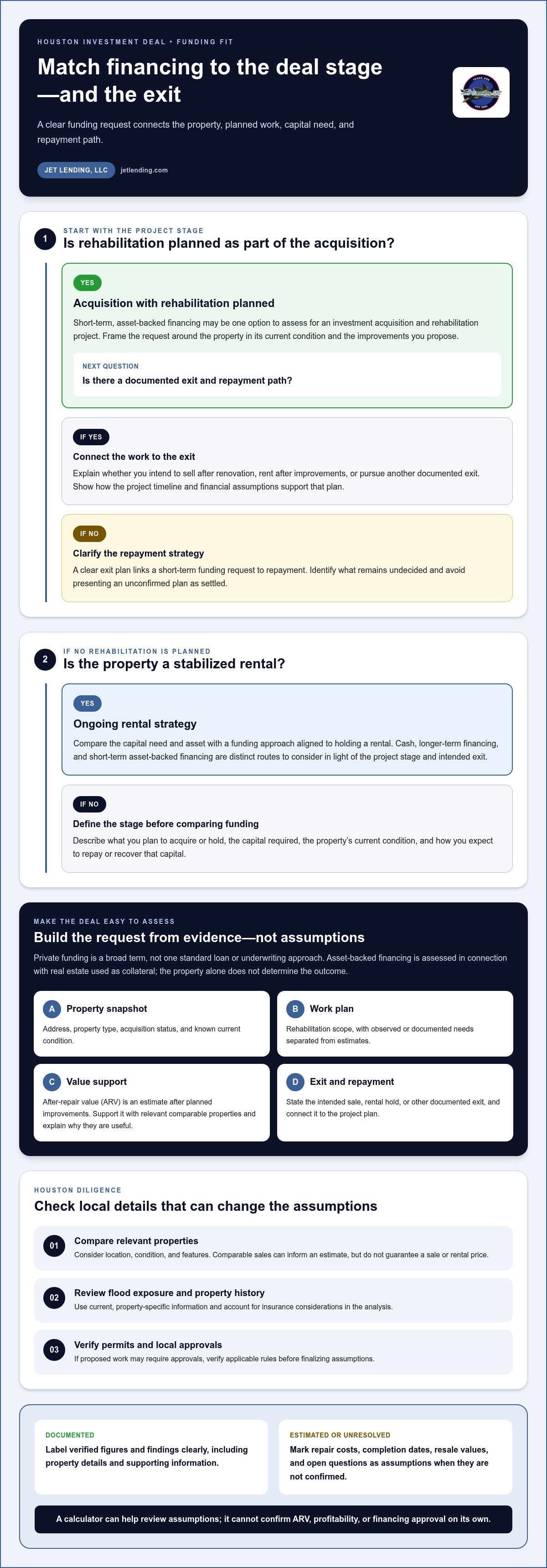
For private funding for real estate deals Houston investors are evaluating, clarity is more useful than presentation polish. A well-organized package connects the property, planned work, numbers, and repayment path. Start with a concise summary, add supporting details, and label what is known versus estimated.
List the property’s address, type, acquisition status, and current condition. State whether you plan to buy the property or have already acquired it, then describe the rehabilitation scope in practical terms. Organize relevant photos, property information, and estimates alongside the summary so the proposed work is easy to follow.
Separate documented facts from working assumptions. For example, identify which repair items have supporting estimates and which costs are preliminary. This makes it easier to see which parts of your analysis are established and where costs may change.
Lay out the main components of your deal analysis: acquisition, rehabilitation, expected holding period, and projected resale or rental outcome. Support projected value with relevant Houston comparable properties. Choose comparisons that resemble the subject property in location, condition, and features instead of relying on an unsupported citywide average.
After-repair value (ARV) estimates what a property may be worth after improvements. Read the ARV real estate guide for more on the concept and how to support your estimate. The fix-and-flip deal analysis guide offers another framework for reviewing the numbers.
Use Jet Lending’s investment property calculator to test assumptions and see how they affect your analysis. It can help organize your thinking, but it does not guarantee profitability or financing approval. Bring your summary, supporting information, key estimates, and intended exit together. Consider how your plan would change if costs, timing, or projected outcomes shift.
Jet Lending is a Texas-based asset-backed lender that provides short-term financing for real estate investors. Its financing supports investment property acquisitions and rehabilitation projects. The focus is the investment property and the deal behind it, not an owner-occupied home purchase.
If you’re exploring private funding for real estate deals Houston investors pursue, match the funding request to the project. An acquisition that needs rehabilitation calls for a clear account of the property, planned work, and intended exit. Present your assumptions plainly and show how they connect to the proposed investment.
Be ready to explain the property, acquisition plan, current condition, and proposed rehabilitation scope. Describe how you expect to repay the short-term financing, such as through a planned sale or another documented exit. Supporting information makes the project easier to understand. Keep confirmed details separate from estimates and explain the assumptions behind your analysis.
For more context on private funding in the Houston market, read the Houston hard money lender guide. It complements this deal-focused overview and provides background for the broader funding conversation.
Bring together your property summary, acquisition details, rehabilitation plan, supporting estimates, and intended exit. Jet Lending’s investment property calculator can help you review deal assumptions as you prepare. Use it to examine your numbers, not as a guarantee of profitability or approval.
A thoughtful, well-organized plan gives your financing discussion a practical starting point. Share what you know, identify what remains an estimate, and explain how you expect the investment to progress.
Choosing private funding for real estate deals Houston investors are considering starts with matching the financing structure to the property, project scope, and intended exit. A clear deal package brings those pieces together: outline the acquisition, distinguish verified figures from estimates, and explain how you plan to repay short-term financing.
Jet Lending provides short-term, asset-backed investment financing for acquisitions and rehabilitation. Its investment property calculator can help you review deal assumptions as you prepare. Use it as a planning aid, not a guarantee of profitability or approval. The financing is for investment purposes, and the property and project are evaluated as part of the deal.
Bring your property information, rehabilitation plan, supporting estimates, and exit strategy into the conversation. A well-organized starting point can help you discuss your investment opportunity with greater clarity.
Build your plan one clear step at a time, starting with a realistic view of the property, project costs, and intended exit.
Private funding is a broad term for capital from nontraditional sources used in real estate investing. The phrase “private funding for real estate deals Houston” does not identify one standard loan structure, so focus on the actual financing arrangement. Jet Lending provides short-term, asset-backed financing for investment-purpose acquisitions and rehabilitation. Consider how the property, planned work, and intended exit fit the deal. This differs from financing a home you plan to occupy.
Not necessarily. Private funding broadly describes capital sources, while hard money commonly refers to real estate financing secured by property. The terms may overlap in conversation, but labels alone do not explain a loan’s structure. For a Houston investment, focus on the collateral, project purpose, financing terms, and repayment plan. These details clarify what the arrangement involves and whether it aligns with the property and your investment strategy.
Some investment financing can be structured around both acquisition and rehabilitation, depending on the project and financing evaluation. Jet Lending provides short-term, asset-backed financing for investment acquisitions and rehabilitation. Organize the purchase details, describe the property’s current condition, outline the planned work, and gather supporting estimates. Explain how you expect to exit the investment, such as through a planned sale or another documented repayment strategy.
Funding timing depends on the transaction, property information, financing structure, and completion of review and closing requirements. Avoid building an acquisition schedule around an assumed turnaround. Organize property and project information early, respond promptly to requests, and make key deadlines clear in the financing discussion. For a Houston deal, account for the specific transaction and timeline rather than relying on a generic estimate.
A deal review may consider the property, acquisition plan, current condition, rehabilitation scope, supporting value assumptions, and intended exit. Houston investors can organize relevant comparable sales and property-specific diligence, including flood exposure and insurance considerations where applicable. Present verified information separately from estimates and explain the assumptions behind your numbers.
The amount available depends on the property, investment purpose, project plan, and financing evaluation. A general online rule may not reflect the details of your Houston transaction, so avoid assuming a particular percentage applies. Prepare your acquisition and rehabilitation figures, supporting property information, and intended exit. Jet Lending evaluates short-term, asset-backed investment financing in relation to the deal and property.
No. Jet Lending financing is for real estate investment purposes, including investment property acquisition and rehabilitation. It is not an owner-occupied residential mortgage or an unsecured personal loan. For a Houston investment property, organize the property details, project scope, and planned exit to keep the financing discussion focused on the investment, the asset, and your repayment plan.
Tags:

What if the financing that gets you into a Houston investment property becomes the biggest risk to getting out? A bridge loan can connect an acquisition or rehabilitation project to its next...

Your first flip doesn’t start with a loan application. It starts with a Houston deal whose numbers make sense. If you’re figuring out how to get funding for your first flip Houston, start by building...

The lender who says yes first may not be the right fit for your Houston deal. When searching for private money lenders for real estate Houston investors can trust, start with the property, project...