
Written By: Stephanie Rojas | August 24, 2026
Time to Read 12 Minutes
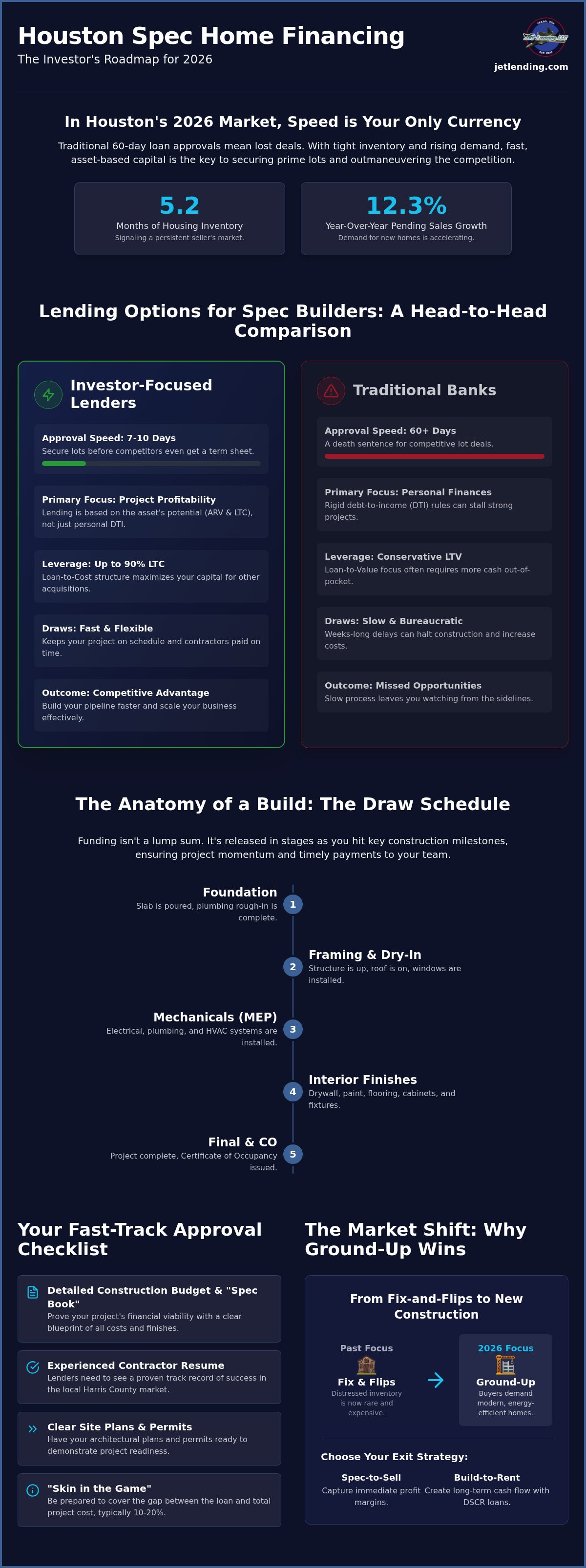
In 2026, the Houston real estate market isn't just normalizing; it's rewarding the fastest movers while leaving traditional bank borrowers stuck in the mud. If you're hunting for the best spec home financing Houston provides, you already know that a 60-day approval window is a death sentence for a competitive lot deal. You want to build, not wait on a bureaucracy that doesn't understand your timeline. Speed is the only currency that matters when inventory sits at 5.2 months and pending sales continue to climb.
We understand the grind. You've likely felt the sting of Houston Permitting Center delays or watched a project grind to a halt because a traditional lender's draw process took weeks to pay your framing crew. It's frustrating when capital bottlenecks keep you from the finish line. This guide changes that. You'll learn how to master the ground-up construction market with a clear roadmap to securing fast, flexible investor capital. We're diving into how to secure high-leverage funding up to 90% LTC, fast-track your closings to beat out the competition, and implement a smooth draw schedule that keeps your project on track and your contractors paid on time.
Houston's real estate market in 2026 is defined by a "progressive normalization," but inventory remains tight at just 5.2 months of supply. New construction financing for investors has shifted from a niche product to a primary tool for growth. This is asset-based capital designed specifically for the real estate development process, focusing on the value of the land and the finished product rather than just your personal credit score. With pending home sales up 12.3% year-over-year, the demand for fresh inventory is outstripping what the existing market can provide.
Traditional banks are struggling to keep up with this pace. While they might offer lower rates on paper, their 60-day approval cycles and rigid debt-to-income requirements don't work in a market where lots in Spring Branch or the Heights disappear in a week. Investors need spec home financing Houston solutions that close in 7 to 10 days. Speed allows you to secure the dirt before a competitor does, ensuring your pipeline stays full while others wait on a loan committee's signature.
Distressed inventory has dried up across the Houston metro. Finding a "diamond in the rough" that doesn't need a total foundation overhaul is rare and expensive. Buyers in 2026 prioritize energy-efficient systems and modern, open floor plans that older homes simply can't accommodate without massive structural costs. In this context, After-Repair Value (ARV) represents the projected market price of the newly constructed home once the certificate of occupancy is issued and the property is move-in ready. Building from the ground up gives you total control over this value.
Your exit strategy dictates your financing path from day one. Many investors are pivoting to Build-to-Rent (BTR) in suburbs like Katy or Cypress, where the demand for single-family rentals is surging. Others stick to the spec-to-sell model in infill areas to capture immediate profit margins. While BTR offers long-term cash flow, spec-to-sell projects provide the quick capital injections needed to scale. Decide on your exit early. It determines whether you'll eventually transition into a long-term DSCR loan or sell to an end-buyer using a traditional mortgage.
Securing spec home financing Houston requires a shift in how you view leverage. Traditional mortgages focus on the borrower's debt-to-income (DTI) ratio, but asset-based lending prioritizes the profitability of the project itself. In the world of ground-up construction, the two most important acronyms are LTC (Loan-to-Cost) and LTV (Loan-to-Value). While banks might cap you based on a conservative LTV, an asset-based lender often provides up to 90% LTC. This means your capital covers the gap between the loan and the total build cost, allowing you to keep your liquidity for the next acquisition.
The After-Repair Value (ARV) acts as the north star for your deal. With current Houston housing market data showing a flight to quality in new builds, your appraisal must reflect the future market, not just the current dirt value. We look at the "Spec Book" as more than a list of finishes; it's the financial blueprint that proves your project's viability. If your budget is tight and your ARV is strong, the deal moves forward regardless of your personal monthly car payment or student loans.
Construction funding isn't a lump sum. It's a staged process, usually involving five to seven draws. Money is released as you hit specific milestones: foundation, framing, dry-in, mechanicals, and final finishes. Speed is vital here. An inefficient draw process halts construction and frustrates your subcontractors. To keep the momentum, ensure your permits are visible and your work is ready for inspection before you request funds. You can use an investment property calculator to model how these interest payments affect your bottom line throughout the build cycle.
Preparation separates the pros from the amateurs. To secure a fast approval, you'll need a clean file containing your site plans, a detailed construction budget, and your contractor's resume. Lenders want to see that the team swinging the hammers has a track record of success in the Harris County area. Even with high leverage, you'll need "skin in the game" to cover the initial down payment and carrying costs. For a deeper dive into vetting your numbers, check out our guide on how to analyze a fix and flip deal, as many of those budgeting principles apply directly to ground-up projects.
Choosing between a local bank and an asset-based lender isn't just about interest rates. It's about how much of your own cash you want to keep in your pocket. Traditional banks typically cap their leverage at 70% of the land's current value (LTV). In contrast, private spec home financing Houston providers focus on the total project cost, often funding up to 85% or 90% LTC. This higher leverage allows you to spread your capital across multiple projects instead of burying it in a single foundation. When you're scaling a portfolio, liquidity is your most valuable asset.
Speed of execution is the second major differentiator. A bank's loan committee might take 45 to 60 days to approve a construction loan. During that window, your holding costs, including property taxes, insurance, and interest on the land, continue to eat your margins. Even worse, a slow closing can cause you to lose a prime lot to an investor who can close in a week. Asset-based lenders prioritize the profitability of the project, allowing for closings in as little as 7 to 10 days. This agility turns financing into a competitive advantage rather than a bottleneck.
Private capital is the right move when you're facing a competitive bidding war in high-demand Houston neighborhoods. If a seller has three offers on a lot, they'll pick the one with the fewest contingencies and the fastest closing date. It's also the superior choice for developers with complex tax returns. Traditional banks often struggle to verify income for self-employed investors with significant write-offs. We look at the deal's potential, not just your 1040 forms. This flexibility is essential for projects that require rapid pivots or budget adjustments once construction starts.
Don't let a higher interest rate scare you away from a profitable deal. Implementing expert housing market strategies requires capital that moves as fast as the market. Higher-interest short-term debt is often cheaper than a dead project or the opportunity cost of a lost lot. If private capital allows you to finish a build three months faster than a bank, the savings in holding costs and the ability to reinvest your profit sooner often outweigh the interest difference. You can model your potential net profit and see how different leverage levels impact your ROI using the Jet Lending Investment Property Calculator.
Ground-up development in Houston is a different beast than in other major metros. You're dealing with reactive clay and a bayou climate that demands rigorous soil testing before the first shovel hits the ground. Foundation and framing represent your most capital-intensive phases. If you don't get the dirt work right, your spec home financing Houston project will suffer from structural issues before the first draw is even released. We recommend getting a geotechnical report early to avoid expensive foundation redesigns mid-build.
Don't wait until the framing is done to talk to CenterPoint Energy. Utility hookups for electricity and City of Houston Water can take months if you aren't proactive. Coordinate these connections during the pre-development phase to avoid a finished house that can't be sold because it lacks power. Managing these "silent" delays is what separates the seasoned developers from the amateurs. You need a lender who understands these local quirks and doesn't halt your funding because a utility company is dragging its feet.
The Houston Permitting Center (HPC) remains a significant hurdle in 2026. Current lead times for new residential permits can stretch for several weeks, so you must factor this into your carrying costs. Smart investors focus on shovel-ready land to lower risk and secure funding faster. If the bureaucracy feels overwhelming, hire a local Houston expeditor. They know the system's specific requirements and can bypass common bottlenecks that keep your project in limbo. Shaving even two weeks off the permitting process can save you thousands in interest and holding costs.
Labor and material rates in 2026 require a healthy buffer in your budget. You can't rely on outdated pricing models if you want to keep quality crews on your site. Protecting your investment during the draw process stages is non-negotiable. Always collect signed lien waivers before releasing payments to subcontractors. This ensures that a dispute between a builder and a vendor doesn't result in a legal lien on your property. Your final build cost must align with the market's appetite, so check our guide on what is ARV in real estate to ensure your project's value supports your total investment.
Jet Lending has been a fixture in the Houston market since 2004. We don't just look at spreadsheets; we know the neighborhoods, the soil conditions, and the local builders. When you choose us for spec home financing Houston, you're getting a partner that values speed and transparency above all else. In a 2026 market where lot inventory is moving quickly, you can't afford a lender that operates like a slow-moving bureaucracy. We provide the "boots on the ground" expertise you need to navigate every stage of the build.
Scaling your portfolio requires a strategy that keeps your money moving. Once your first ground-up build is complete, you shouldn't have your capital locked in the walls. We help you leverage the equity created in your finished project to fund your next three acquisitions. This velocity of capital is what separates hobbyist builders from professional developers. We focus on the asset, which means we're ready to move as fast as you can find the dirt. Our in-house draw management ensures that your contractors stay happy and your project stays on schedule.
The biggest fear for many new construction investors is the "what now?" phase once the certificate of occupancy is issued. You have two primary paths. You can sell to an end-buyer and capture your profit immediately, or you can refinance into a long-term DSCR loan facility. This transition from construction debt to permanent financing is the engine of the BRRRR method for new builds. By holding the property as a rental, you benefit from Houston's rising rental demand while building long-term wealth. If you're still in the acquisition phase for your next lot, check out our guide on Hard Money Lenders Houston to keep your pipeline moving.
We don't believe in long, drawn-out applications that go nowhere. Our process starts with an initial deal review that we complete within your first 24 hours. We look for project viability, your budget's accuracy, and the projected ARV. Submit your project specs today for a rapid, asset-based funding quote. Whether it's your first spec build or your fiftieth, we're here to provide the capital and mentorship you need to succeed. Join the community of Houston’s top spec home developers and start building your legacy with a lender that understands the local market.
Houston's 2026 market doesn't wait for slow approvals or rigid banking committees. You've learned how to bypass traditional bottlenecks by leveraging asset-based capital that moves at the speed of the street. By focusing on project profitability and high-leverage LTC structures, you can keep your liquidity intact while scaling your development pipeline. Mastering the local lifecycle, from the Houston Permitting Center to CenterPoint utility hookups, ensures your builds stay on track and your profit margins remain protected.
Finding the right spec home financing Houston provides is the final piece of the puzzle for your next ground-up project. We've been Houston’s trusted partner since 2004, offering fast in-house draw inspections and up to 90% LTC for qualified projects.
Your next build is ready to break ground. We're here to make sure you have the capital to cross the finish line.
Investors typically need a down payment of 10% to 25% of the total project cost, depending on their experience and the deal's strength. While traditional banks often require more skin in the game, asset-based lenders can provide up to 90% LTC for qualified projects. This allows you to preserve your liquidity for other acquisitions. Using equity from land you already own is also a common way to meet these requirements in the Houston market.
You can absolutely secure a construction loan with less-than-perfect credit because asset-based lenders prioritize the project's profitability over your personal credit score. We focus on the hard asset and the potential return on investment. While a higher score might help you secure better terms, a strong deal with a solid budget and a high After-Repair Value (ARV) is the primary driver for our lending decisions.
Our in-house draw management is designed for speed, typically taking just 48 to 72 hours from the time you request an inspection to the release of funds. We understand that contractors need to be paid promptly to keep your project moving. By handling inspections internally, we eliminate the third-party delays that often plague traditional bank financing. This efficiency is a hallmark of the spec home financing Houston developers rely on to stay on schedule.
You don't personally need a builder's license to secure financing, but your project must be managed by a qualified General Contractor (GC). We review the contractor's resume and past project history to ensure they have the expertise to complete the build. If you're an experienced investor acting as your own GC, we'll look at your specific track record of successful ground-up projects in the Houston area before approving the loan.
A ground-up loan is designed for new construction on vacant land, while a fix-and-flip loan is intended for the renovation of existing structures. Ground-up financing involves more complex stages, such as soil testing, foundation pouring, and utility hookups. The draw schedule is also more extensive for new builds to account for the vertical construction phases. Both are short-term, asset-based loans, but the underwriting focuses on different risk factors and timelines.
Yes, you can use new construction financing to build small multi-family properties like duplexes, triplexes, or fourplexes. These projects are excellent for investors looking to maximize the density and cash flow of a single lot. Our programs cover residential builds up to four units, providing the same high-leverage LTC and fast draw processes we offer for single-family homes. It's a popular strategy for developers targeting the growing rental demand in Houston's urban core.
If your project goes over budget, you're generally responsible for covering the shortfall with your own capital. This is why we emphasize building a 10% to 15% contingency fund into your initial construction budget. If a major pivot is required, we work with you to analyze the impact on the final ARV. Proactive communication is essential. We act as a partner in your success and help you navigate financial hurdles to keep the project viable.
We evaluate the After-Repair Value (ARV) by analyzing recent sales of similar new construction homes in the immediate area. Our appraisers look at finished square footage, lot size, and the quality of materials listed in your Spec Book. In a fast-moving market like Houston, we focus on the most recent comps to ensure the valuation reflects current buyer demand. This precise evaluation ensures your spec home financing Houston project is built on a solid financial foundation.
Tags:

The "cheapest" interest rate in the 2026 Houston market is often the most expensive choice an investor can make. While a lower conventional rate looks good on paper, it doesn't matter if you lose the...

In Houston’s fast-moving 2026 market, the most expensive loan isn't the one with the highest interest rate; it's the one that fails to close on time. You've likely watched a perfect flip or rental...

Why are you letting a traditional bank's 12-month pre-sale requirement kill your next Houston spec build before the first shovel hits the dirt? It's frustrating to watch prime lots in Cypress or Katy...