
Written By: Stephanie Rojas | November 06, 2026
Time to Read 12 Minutes
A lender needs more than an attractive property; the investment case must add up. When presenting a real estate deal to a lender, organize the property evidence, repair scope, budget, timeline, and exit plan into one clear package. Support the value estimate with three highly comparable properties, including evidence for the property’s current condition and its projected value after repairs.
A promising deal takes more than a purchase price and a best-case projection to become a credible financing proposal. Lenders need to understand how the property will create value, what the project will cost, and how your plan accounts for risk. A clear, realistic presentation helps them assess the opportunity and gives you a stronger basis for discussing financing.
This guide covers the key steps: assemble rent, market, and condition evidence; estimate proceeds and closing costs; build projections with transparent assumptions; and lead with the investment thesis and essential deal metrics. You’ll also learn how an investment property calculator and short-term loans can support your analysis of an investment property.
Start with a single, well-labeled deal file. Separate current income, comparable sales, property condition, and local market evidence so the lender can follow your reasoning.
Build a proceeds schedule showing how sale revenue becomes cash available after transaction costs and debt payoffs. For an acquisition, show the cash required to close separately. Keep assumptions visible so the lender can trace each figure to a transaction document, payoff statement, or project estimate.
Build projections from documented assumptions, then show how changes could affect returns, timing, and repayment. This gives the lender a practical view of both the opportunity and its risks.
Start with a researched after-repair value estimate tied to the property’s market evidence. Lenders use ARV to assess a fix-and-flip project and the property’s potential as loan collateral. Show how the planned work supports the estimate, and avoid relying on a best-case sale price without comparable evidence.
Set out assumptions for rent growth, operating expenses, capital expenditures, and the project timeline. Explain why each fits the property and local market. For example, connect projected rent to current leases or relevant market evidence. Separate expected income from hoped-for opportunities, and show how repairs or vacancy affect the plan. Keep assumptions consistent across your budget, timeline, and written summary.
Test how the project performs when a key assumption changes. Review the effect of lower sale proceeds, slower rent growth, higher operating expenses, additional capital expenditures, or a longer project timeline. A sensitivity analysis should show which variables have the greatest effect on cash flow, profit, and repayment capacity.
Present a base case alongside less favorable scenarios, and explain the reason for each change. For instance, show how an extended renovation schedule affects carrying costs and the planned exit. Avoid changing several assumptions without explaining how they relate. The lender should be able to trace each result to a specific input, understand where the deal becomes tighter, and see which opportunities remain viable under different conditions.
List risks that could alter cost, timing, income, or the exit strategy, then state your response to each. What risks and contingencies should a real estate borrower disclose to a lender? Disclose unresolved repairs, possible delays, uncertain rent assumptions, contractor dependencies, and changes that could affect the sale plan. Explain what triggers each contingency and how it changes the projection.
Pair each risk with a practical response. A delayed repair schedule, for example, may require revised completion timing and updated carrying costs. If expected rent depends on a lease renewal, identify that dependency and show how the projection changes if renewal terms differ. Include capital expenditures that could affect cash needs. Don’t bury a downside in a footnote or present an alternative plan as certain. Clear disclosure helps the lender assess execution and repayment risks.
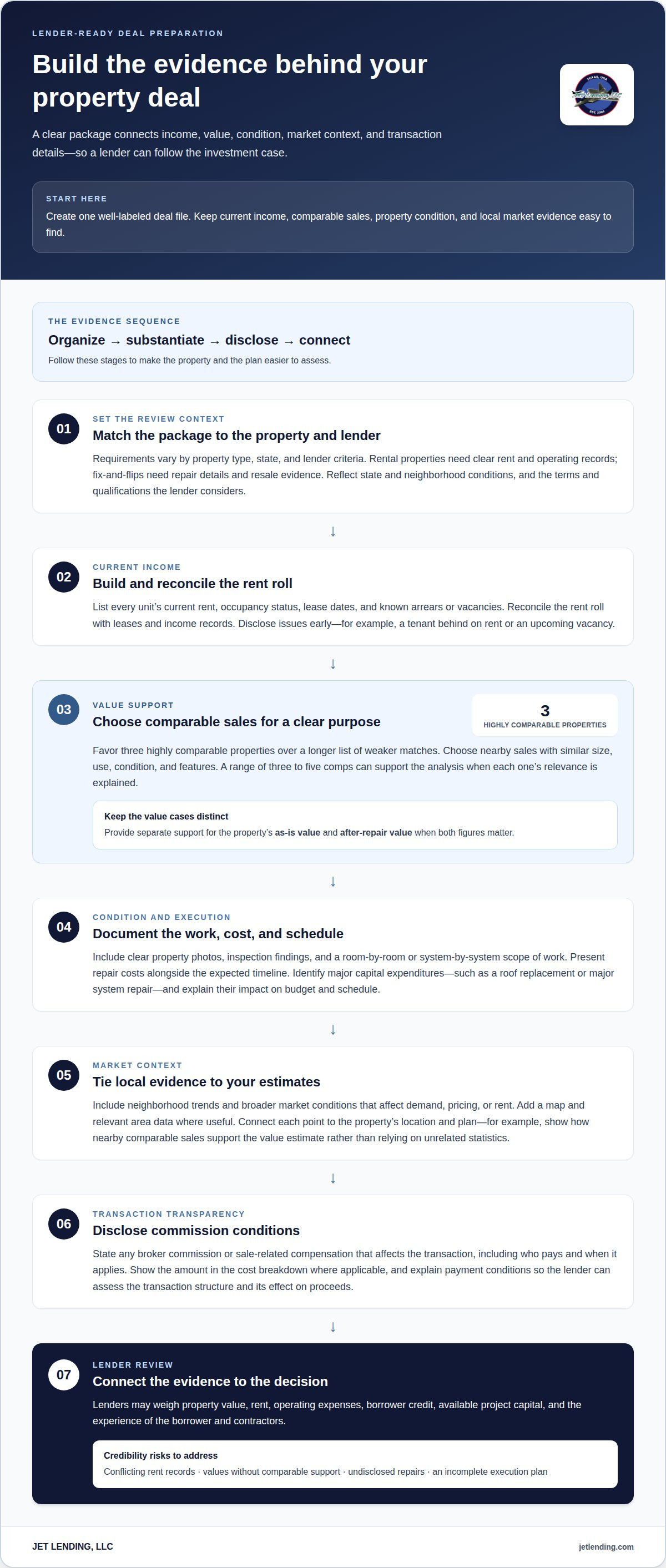
Lead with why the property makes sense as an investment, then connect the metrics to your plan. A lender should quickly see what you’re buying, how value will be created, and how the project is expected to repay financing.
Open with a concise explanation of what you’re purchasing, why it’s attractive, and how the plan creates value. For example, explain whether renovations support resale or property improvements support rental income. Put the thesis near the beginning of your presentation, then connect each claim to evidence and a project action. Avoid broad claims such as “strong upside” without explaining what drives it.
Make the investment case specific to the property. Explain how its location, condition, or income profile supports your chosen strategy. When presenting a real estate deal to a lender, show how the proposed timeline and exit plan follow logically from the thesis. The lender should be able to trace the story from acquisition through value creation to repayment, rather than having to infer how the project will succeed.
Summarize the figures that help a lender assess your plan: purchase price, repair budget, estimated after-repair value, loan-to-value, project timeline, and expected exit. Pair each metric with its basis, such as the scope of work supporting the repair budget. Keep the detailed budget, schedule, and exit strategy aligned with the summary so your documents don’t conflict.
For a fix-and-flip, explain the 70% rule as a screening guideline: purchase price plus repairs should be no more than 70% of the property’s after-repair value. Show the calculation using your deal’s actual figures, and identify which estimates support it. Don’t present the rule as a lender requirement or a guarantee of success. It’s one way to frame the investment case, not a substitute for assessing the full project.
Show the requested loan amount beside the property value used in your loan-to-value calculation. What down payment and loan-to-value ratios do lenders require for real estate deals? They vary by lender, property, and deal structure. The required contribution depends on the lender’s valuation and terms, along with your available capital and project plan.
Separate your cash contribution from loan proceeds and project costs. Explain the source of available capital and how it supports both closing and project execution. Avoid presenting a universal down payment or loan-to-value target. When presenting a real estate deal to a lender, state the figures requested for this transaction and show how they relate to the property value, budget, timeline, and exit strategy.
Document requests vary by lender, property, and financing structure. Build a clearly labeled package that explains the asset, borrower, and plan, then organize supporting records so each figure has context.
For subject-to transactions, disclose transfer risks. A due-on-sale clause typically allows a lender to require the borrower to repay the entire mortgage balance when the property interest is transferred to a third party. A seller in a subject-to transaction may remain tied to the buyer for 25-30 years, the possible remaining term of the loan. Article 13 of the REALTOR® Code of Ethics prohibits REALTORS® from engaging in activities that constitute the unauthorized practice of law and requires recommending legal counsel when a party’s interests require it.
An offering memorandum should open with the investment thesis, what is being purchased, why it is attractive, and the value-creation plan. A deal presentation can include loan-to-value metrics, a detailed budget and scope of work, a tentative schedule, an exit strategy, property-condition information, and required capital expenditures.
Jet Lending, LLC helps real estate investors assess opportunities with its Investment Property Calculator and offers Short-Term Loans for investment properties. Use the calculator to organize deal figures and evaluate whether your assumptions align with the project plan. If the numbers support moving forward and you’re considering short-term financing, explore how a short-term loan could fit your investment deal. A clear package of property evidence, costs, projections, and exit strategy gives you a strong starting point for a financing discussion. Contact Jet Lending, LLC to discuss your real estate investment financing needs.
A strong deal package can guide more than one financing conversation. Use it as a decision tool to clarify which terms fit your strategy, what tradeoffs matter, and how financing supports the project’s next stage. Keep your analysis current as property details or your plan changes.
Before reaching out, set a decision timeline and decide how you’ll evaluate proposals. Compare each option against the same project assumptions, repayment plan, and exit strategy. This gives you a consistent basis for choosing a path, rather than focusing on one attractive term in isolation.
Presenting a real estate deal to a lender is also an opportunity to demonstrate how you think through execution. Be ready to explain the choices behind your plan and what would prompt you to adjust it. A thoughtful conversation can help you move from analysis to a practical next step.
Stay focused on the investment case and take the next step with confidence.
A real estate loan proposal should state the financing request, repayment plan, and transaction structure, supported by documents that help a lender assess each. Identify the borrower and ownership entity, property use, loan purpose, and anticipated funding timing. For a Houston property, explain how its location fits your investment strategy. Add a concise contents page and label supporting files consistently so reviewers can trace the request and find current materials quickly.
Tailor the opening summary to the lender’s criteria, then arrange supporting material in a clear sequence. Banks and private lenders may emphasize different factors, so explain why your requested structure fits the asset and exit plan. For a Houston property, make the local context specific to its neighborhood and intended use. Keep the initial email to no more than two paragraphs, state your decision timeline, and follow up no more than once per week unless asked otherwise.
DSCR, LTV, and debt yield measure different aspects of an investment property deal. DSCR compares income available for debt service with required debt payments. LTV compares the loan amount with property value, while debt yield compares net operating income with the loan amount. Show the inputs behind each calculation and explain how rent, expenses, valuation, and requested financing affect the results. For Houston properties, use assumptions suited to the specific asset and market.
Tags:

Owning property in Texas and qualifying for a loan are separate matters. Property ownership generally does not depend on immigration status, so DACA recipients can own property. A real estate...

Financial freedom through real estate investing Houston investors can work toward starts with more than finding a promising property. It takes a strategy that fits your goals, available capital, and...

What if the funding partner that looks fastest on paper can’t keep pace with your property, rehabilitation scope, or exit plan? For Houston investors searching for reliable funding for real estate...