
Written By: Stephanie Rojas | November 23, 2026
Time to Read 12 Minutes
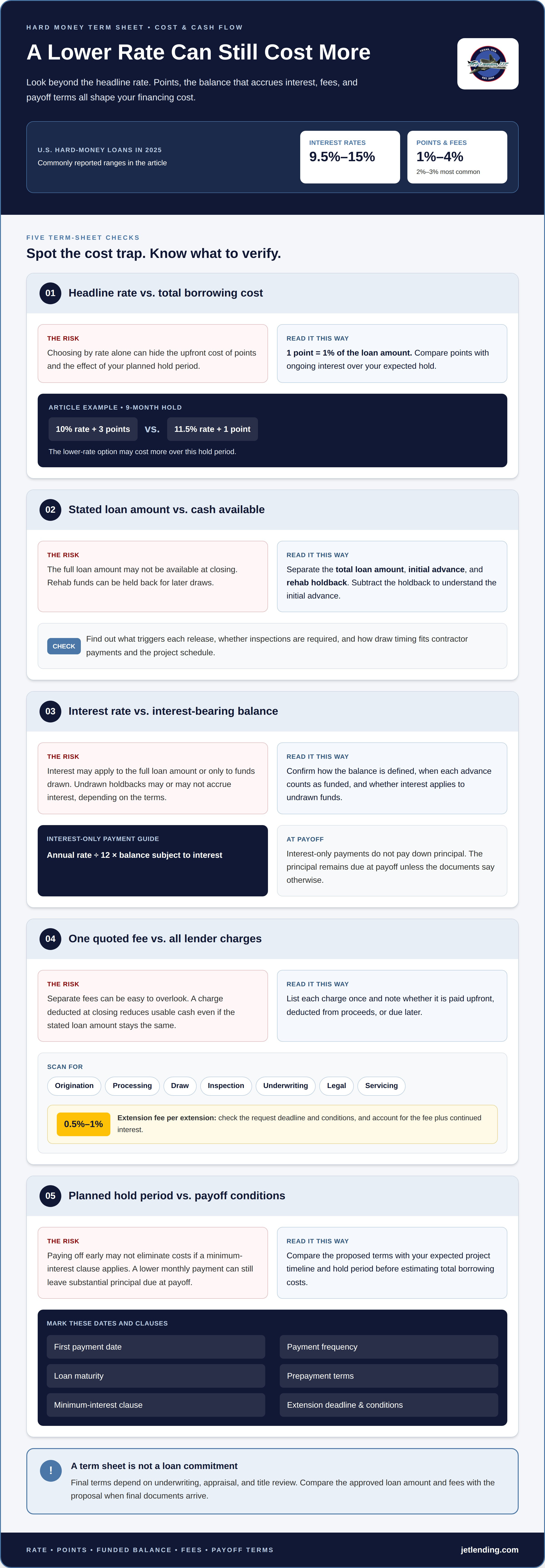
A lower interest rate doesn’t automatically make a hard money loan cheaper. Points, the amount funded at closing, rehab holdbacks, and prepayment terms can change what you pay over your planned hold period. Learning how to read a hard money term sheet means looking beyond the headline rate and calculating the full financing cost.
A term sheet summarizes proposed loan terms, but it isn’t a commitment to lend. Final terms depend on underwriting, appraisal, and title review. It’s easy to focus on the rate first, so take time to understand how the loan is funded and when interest starts accruing.
This guide explains how to assess the loan amount, initial advance, holdback, interest, points, fees, and early-payoff terms. You’ll also learn to estimate costs over your expected hold period and judge whether the proposed financing fits your project and timeline.
In 2025, U.S. hard-money loan rates commonly ranged from 9.5% to 15%. Points and fees commonly ranged from 1% to 4%, with 2% to 3% most common.
Key term-sheet sections identify the borrower, loan amount, interest rate, points, and term. They also explain payment timing, collateral, and any guarantee obligations.
A hard money term sheet outlines proposed financing, but it isn’t a loan commitment. Review each charge alongside the loan term, approval conditions, and expected total cost.
List origination, processing, draw, inspection, and lender fees separately. Check whether points apply to the full loan amount, and distinguish them from other charges.
Match the rehab holdback to the draw procedure. Find out what triggers a release, whether inspections are required, and how each draw is calculated. Include these costs in your project budget, since repeated draws can add fees.
Read the extension terms beside the loan term and maturity date. Hard money loan extensions often carry a fee of 0.5% to 1% per extension. Note the deadline and conditions for requesting an extension, then account for its fee and continued interest.
Hard money term sheets outline short-term, property-backed financing, with advances and rehab funds shown separately. They may specify how much is available at closing and how later construction funds are released.
Compare the stated loan amount with the cash advanced at closing. Don’t assume the full loan amount is immediately available.
Identify the rehab holdback and subtract it from the stated loan amount to understand the initial advance. Match expected contractor payments to the lender’s release process. If funds are released only after work is completed or inspected, account for that timing in your project schedule.
You can avoid a prepayment charge when the written terms allow penalty-free payoff or you negotiate that provision. Before signing, compare the payoff rules with your project timeline and likely sale or refinance date.
Read how interest accrues, what balance it applies to, and when payments are due. A minimum-interest clause can require three months of interest even after an earlier payoff. For example, a borrower who sells after 45 days may still owe three months’ interest. Include that amount in the expected payoff, not just monthly payments.
Find each clause describing early payoff, minimum interest, or an exit fee. Hard-money prepayment penalties or minimum-interest periods typically last 3-6 months. Some lenders may charge an exit fee of 0.5% to 1% of the loan amount at payoff.
Raise the payoff clause before approval becomes final, and propose terms that fit your expected hold. You might seek no prepayment charge, a shorter minimum-interest period, or a lower exit fee. Consider the trade-off: the lender may weigh the request against the rate, points, loan term, and property plan. Get any agreed revision in writing.
Ask when interest starts, whether it applies to drawn funds or the full balance, and how payoff is calculated. Confirm whether an early sale triggers minimum interest or an exit fee, and whether an extension fee applies if construction runs late. Ask how rehab draws work, including inspection timing and fees, so delays don’t disrupt your financing plan.
Estimate costs over your expected hold, not just one month. Include interest, points, draw charges, and any extension or payoff costs.
Jet Lending offers Short-Term Loans for real estate investors assessing property financing. After reviewing a term sheet, use the figures you’ve analyzed, including the advance, holdback, interest, and expected hold period, to determine how the financing fits your project.
Jet Lending’s Investment Property Calculator can help you analyze a deal alongside its financing assumptions. Use it to assess whether your projected project numbers align with the borrowing costs and timeline you’ve estimated. Short-term financing is most relevant when the property investment and repayment plan fit that structure.
Contact Jet Lending to discuss financing for your real estate investment in Houston.
Knowing how to read a hard money term sheet gives you a clearer basis for deciding whether the financing structure fits your investment plan. Use your project timeline and cash-flow expectations to assess how much flexibility you need and which terms matter most if costs or completion dates shift. Start with the numbers that affect your deal, not just the headline rate.
Before moving forward, bring your project assumptions and financing questions together. Consider how the loan aligns with your purchase, rehab plan, repayment strategy, and tolerance for delays. This gives you a practical framework for evaluating the opportunity and deciding whether it supports your goals. Jet Lending offers Short-Term Loans and an Investment Property Calculator for real estate investors evaluating financing and deal assumptions.
Take the next step with a clear plan and confidence in your analysis.
A June 2026 survey reports residential fix-and-flip leverage of 70% to 75% of ARV. Treat that as a market reference, not a guaranteed offer: the property, renovation plan, appraisal, and lender’s underwriting shape the actual advance. For a Houston project, compare the proposed loan with both the property’s current value and its projected after-repair value. Then check whether the required cash contribution fits your budget.
No. Compare projected total financing costs over your expected hold, not just the rate. A lower-rate offer may include more points, charge interest on undrawn funds, or impose less flexible payoff terms. Build a side-by-side estimate using the same expected timeline and draw schedule. Also consider whether the lender’s funding process fits the project’s purchase and construction milestones.
Default pricing provisions explain what happens after a defined loan default, such as a missed payment or another breach stated in the documents. Read the triggering events, any cure period, and how the rate or charges change afterward. A sample clause may allow a 10-day cure period for a missed payment. Confirm whether the provision applies automatically or after notice, and include the potential effect in your risk planning.
Read the interest rate as the ongoing charge for borrowing and points as an upfront charge based on the loan amount. Then identify whether interest applies to the full commitment or only the funds already drawn. Compare both charges over your expected hold period. For example, a longer project can make ongoing interest more influential, while an early payoff can make upfront points a larger share of total financing costs.
LTV compares the loan amount with the property value used by the lender. ARV is the estimated property value after planned repairs are completed. To see the relationship, divide the proposed loan by the value basis, then multiply by 100 for a percentage. The appraisal and rehab scope influence the value used, so review the lender’s calculation basis rather than relying only on your own resale estimate.
The loan term states the planned borrowing period, while the maturity date identifies when repayment is due. An extension may provide more time, but its availability, fee, and conditions depend on the written terms. Check whether you must request it before maturity and whether interest continues during the extension. Align the maturity date with construction completion, marketing, and your expected sale or refinance schedule.
A construction holdback is the portion reserved for later project funding rather than delivered at closing. A draw schedule sets the process for requesting those funds as work progresses. Review required documentation, inspection steps, release conditions, and how disputes or incomplete work affect timing. For a Houston rehab, match expected contractor payments to the draw milestones so a delayed release doesn’t disrupt the work sequence.
Terms may include a minimum-interest period, an exit fee, or another charge tied to early payoff. Some hard money loans require three months of interest even if repaid sooner; some lenders charge an exit fee of 0.5% to 1% of the loan amount at payoff. Read how the clause defines payoff and calculate its effect using your expected sale or refinance date.
Tags:

The best hard money lenders Houston TX investors consider aren’t automatically the ones with the fastest pitch or broadest claims. The right fit depends on whether the loan structure matches your...

What if the right loan for a Spring Branch investment depends less on a standard mortgage checklist and more on the property, project, and exit plan? Comparing real estate investment loans Spring...

Is EaDo safe enough for a real estate investment? Safety deserves a close look, but it is only one part of the decision. Houston real estate investment trends in EaDo reflect ongoing development,...