
Written By: Steve Skillern | July 14, 2026
Time to Read 13 Minutes
Most people think flipping houses is about picking paint colors and swinging hammers, but in 2026, it's actually a game of speed and precise math. Learning how to start flipping houses shouldn't feel like a high-stakes gamble with your life savings. You likely already know that Houston's market is shifting toward a buyer's landscape, with inventory hitting 5.6 months this summer. That creates massive opportunity for those who know where to look, but only if you can move faster than the competition and accurately estimate your margins before the first nail is driven.
We understand the fear of overestimating a property's resale value or getting stuck with a contractor who won't show up. You want to build wealth, not a collection of expensive mistakes. This guide gives you the exact steps to find, fund, and flip your first investment property in today's market while avoiding the common pitfalls that sink beginners. We'll walk through a clear checklist, show you how to calculate real-world profit, and explain how to find a reliable funding partner to bridge the capital gap so you can start your journey with confidence.
Forget the 30-minute transformations you see on cable TV. Real estate investing isn't a hobby; it's a high-speed logistics business where your success depends on your ability to manage people and capital. If you are looking into What is House Flipping? for the first time, understand that it's about identifying undervalued assets and executing a renovation plan with surgical precision. It's not about your personal taste in tile. It's about what the market demands and what the numbers allow.
Learning how to start flipping houses requires a fundamental shift from a DIY mindset to a business owner mindset. If you're the one swinging the hammer, you aren't growing your company. You're just working a construction job. Your goal is to build a "Core Four" team that allows you to scale: a lender for rapid capital, a contractor for execution, a realtor for market data, and a wholesaler for inventory. In 2026, with national ROI averaging around 23-25%, there's no room for learning as you go on your own dime.
Success in the Houston market depends on who you know. You need an investor-friendly agent who understands After Repair Value (ARV) better than they understand school districts. Keep in mind that as of January 2026, Texas law requires you to have a written agreement with your agent before they can show you a residential property. Don't just hire a cousin who does traditional residential sales. You need a partner who can spot a deal versus a dud. Connect with local wholesalers who specialize in off-market properties to avoid the bidding wars on the MLS, where Houston inventory has climbed to 5.6 months.
Deciding how to hold your assets is a critical first step. Most pros use an LLC to protect personal assets, but be aware of the federal reporting rules that went into effect in March 2026. These rules require legal entities to report beneficial owners for all-cash purchases. Beyond legal structures, you must set up a dedicated business bank account. Mixing personal and project funds is the fastest way to lose track of your margins. Remember that flipping is a short-term play. You'll need to budget for short-term capital gains taxes, which can significantly eat into your profit if you haven't planned for the IRS's share of your success.
Math doesn't have feelings, and in real estate, that's your greatest advantage. When you're learning how to start flipping houses, your primary goal is to remove emotion from the equation. The 70% Rule is the industry standard for ensuring you don't overpay for a property. It suggests that an investor should pay no more than 70% of the property's After Repair Value, minus the cost of renovations. After Repair Value (ARV) is the cornerstone of your profit calculation; it represents the estimated market value of a home once all repairs are finished and it's ready for a retail buyer.
Successful flippers look beyond the purchase price and the rehab budget. You must account for "hidden" costs that can quickly evaporate your margins. In the 2026 Houston market, this includes property taxes ranging from 1.8% to 2.5% and homeowners insurance that can exceed $6,000 annually due to hurricane risks. You also need to factor in loan origination points, which typically run between 1% and 3% of the loan amount. Using an investment property calculator allows you to plug in these variables so you can see your true potential profit before you ever sign a contract.
Your Maximum Allowable Offer (MAO) is the absolute ceiling for what you can pay for a deal to remain profitable. The formula is straightforward: (ARV x 0.70) - Rehab Costs = MAO. However, 2026 has brought tighter margins, so a 10% to 15% contingency buffer is non-negotiable. This protects you from unexpected price hikes in materials or labor. If the seller won't meet your MAO, walk away. There's always another house, but there isn't always another bank account to bail you out of a bad buy. To stay disciplined, you can run your numbers through a professional deal analyzer to verify your logic.
Don't rely on "ballpark" figures from a contractor's verbal quote. You need a detailed Scope of Work (SOW) that breaks down every item from baseboards to light fixtures. In Houston, basic remodels currently range from $50 to $150 per square foot. Be especially wary of structural items that are common in Texas, such as foundation leveling and aging HVAC systems. Cosmetic updates like paint and flooring are easy to price, but structural repairs require expert inspections. Always categorize your costs into "must-haves" for safety and "value-adds" that directly increase your ARV.
Finding a great deal in Houston requires more than just scrolling through a phone. While inventory rose to 5.6 months in June 2026, the most profitable opportunities rarely hit the open market. When you are learning how to start flipping houses, you must become a detective. Look for properties with "good bones" but terrible curb appeal. A house with a messy yard and peeling paint is an easy fix. A house with a cracked slab or major termite damage is a different story. In Houston's clay soil, foundation issues are a frequent reality that can sink your budget if you aren't careful.
Driving for dollars is still one of the most effective ways to find motivated sellers. Get in your car and look for signs of neglect: boarded windows, overgrown grass, or stacks of mail. These are signals of a homeowner who might be ready to sell quickly for cash. You can also leverage direct mail or targeted digital ads to reach these owners before they call a realtor. This proactive approach gives you the first shot at a deal without competing against dozens of other investors on the MLS. It puts you in the driver's seat of the negotiation.
The MLS can still work if you move fast. Set up automated alerts for keywords like "investor special" or "needs work." However, professional wholesalers are often a better source for consistent deal flow. They do the legwork of finding distressed properties and sell the contract to you for a fee. Just remember to verify their numbers. Never take a wholesaler's ARV as gospel. Always use your own data and local Houston knowledge to confirm the profit potential. Join local Houston Real Estate Investment Associations (REIAs) to meet these wholesalers and build your network.
Location drives your exit price. Look for pockets near major employment hubs like the Texas Medical Center or areas with new infrastructure projects. Gentrification signals are often subtle. Watch for a single renovated house on a block of older homes or new commercial developments like trendy cafes. These signs suggest that how to start flipping houses successfully involves buying in the path of progress. Check school district ratings and upcoming METRORail expansions to identify where demand will be highest when you're ready to sell your finished project.
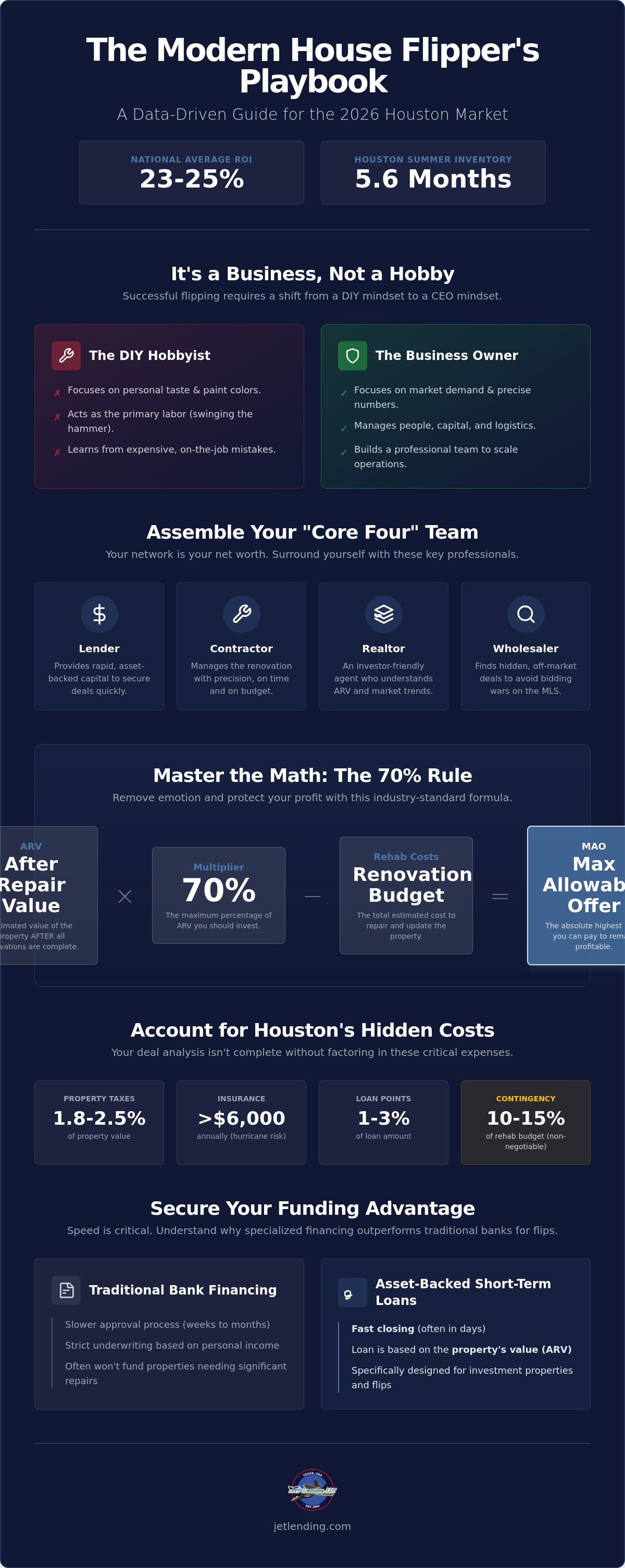
Traditional banks aren't built for speed or distressed assets. They want a pristine primary residence, not a project house in need of a full gut renovation. If you are researching how to start flipping houses, you'll quickly find that conventional mortgages take 30 to 45 days to close. In a competitive market like Houston, that delay will cost you the deal. This is where understanding what is a hard money loan becomes your secret weapon. These asset-based loans prioritize the property's potential over your personal debt-to-income ratio, allowing you to secure funding and close in just a few days.
Managing the money is just as important as securing it. Most short-term lenders use a "Draw Schedule" to release renovation funds. You don't get the full rehab budget upfront. Instead, you pay your contractors as they hit specific milestones, and the lender reimburses you after a successful inspection. This system keeps everyone accountable. It ensures the work is actually completed before the capital leaves your account. If you want to see how these numbers impact your bottom line, explore our short-term loan options to find the right fit for your project.
Asset-based lenders focus on the deal. While your credit matters, the property's After Repair Value is the primary factor. This provides a safety net for new investors. When a lender orders an appraisal, they are giving you a "second set of eyes" on your profit projections. If they won't fund the deal, it's a sign that your math might be off. To secure the best rates, which in 2026 typically range from 9.5% to 14%, prepare a professional Investor Bio. Highlight your team, your contractors, and your exit strategy to show you are a serious partner.
Renovations in 2026 require tight oversight and clear communication. A mid-range, full-home remodel on a 2,000-square-foot Houston house typically costs between $120,000 and $180,000. Without daily walk-throughs, these costs can balloon quickly. Stick to your original Scope of Work to avoid "scope creep," which is the tendency to add extra features that don't actually increase the resale value. Finally, always manage your permits and inspections through the City of Houston. Cutting corners on legal requirements will only lead to massive headaches and delays when you try to sell the property later.
The final stage of your project is where your planning pays off. When you're figuring out how to start flipping houses, the exit strategy is just as vital as the initial purchase. Staging your property is often the difference between a quick sale and a house that sits on the market. In 2026, buyers are looking for a lifestyle, not just a building. Empty rooms often feel smaller and cold. Staged homes help buyers visualize themselves living in the space, which can lead to higher offers and a faster closing timeline.
Pricing is your most powerful marketing tool. With Houston's inventory reaching 5.6 months in mid-2026, the market is becoming more balanced. Pricing your property "slightly under market" often triggers an emotional response from buyers. This frequently leads to multiple offers and bidding wars that drive the final price above your initial target. Once the deal is done, conduct an "Exit Interview" with your team. Compare your initial budget from the investment property calculator to your actual spending. This data is the only way to improve your efficiency for the next deal.
High-quality photography and 3D virtual tours are no longer optional. They are the 2026 standard for any professional flip. Your listing description should lead with the "big ticket" items we discussed earlier, like a new roof or HVAC system. These upgrades provide peace of mind to retail buyers and reduce the likelihood of heavy repair requests during the inspection period. Be prepared to negotiate, but keep your minimum profit margin in mind so you don't give away your hard-earned equity during the final hours of the deal.
One successful flip is a milestone, but multiple flips are a business. You can use your first win as a springboard for the BRRRR method strategy. This allows you to buy, rehab, rent, refinance, and repeat, building a long-term Houston portfolio while keeping your capital moving. As you grow, you'll need a lender who can handle multiple projects simultaneously and move at the speed of your ambitions. If you're ready to take that next step and fund your first or fifth deal, Get a Quote from Jet Lending, LLC today.
Success in the 2026 market isn't about luck. It's about having the right team and the right data. By now, you understand that learning how to start flipping houses is a process of mastering the math, securing off-market deals, and moving with the speed that only asset-based lending provides. You've seen how the 70% rule protects your margins and why a professional "Core Four" team is your greatest asset in the Houston landscape. Moving from the DIY mindset to a business owner approach is what separates a one-time project from a scalable investment portfolio.
Don't let the fear of the unknown hold you back from your financial goals. With over 20 years of local Houston lending experience, Jet Lending, LLC specializes in helping investors move fast. We can often close deals in as little as 48 hours, giving you the competitive edge you need. Before you make an offer, make sure your numbers are solid. Analyze your first deal with our Investment Property Calculator to de-risk your investment and ensure your path to profit is clear. You have the tools and the roadmap; now it's time to take action and build the future you've always wanted.
You typically need enough for a down payment and a liquid cash reserve. While asset-based loans cover the bulk of the purchase and rehab, most lenders require 10% to 20% down. In Houston, where median prices hover around $350,000, having $50,000 to $70,000 is a safe starting point. This ensures you can cover closing costs, carrying costs, and the initial contractor draws before your first reimbursement.
Yes, but you must act as a project manager rather than a laborer. Most successful part-time investors rely on a "Core Four" team to handle daily logistics. You'll manage the budget and timeline during your off-hours while your contractor executes the work. Speed is critical in 2026, so you need a reliable team that can work independently to keep the project on its 12 to 24-week schedule.
No, you don't need a license to buy and sell your own investment properties in Texas. However, a license provides direct MLS access and lets you keep the commission on your own deals. If you remain unlicensed, partner with an investor-friendly agent. Just remember that as of January 2026, Texas law requires a written agreement with your agent before they can show you any residential properties.
You'll incur "holding costs" like loan interest, property taxes, and insurance. Houston property taxes can reach 2.5%, and insurance costs are rising, so every extra month eats into your profit. If a flip stalls, consider a strategic price correction to trigger a bidding war. Alternatively, you can pivot to the BRRRR method by renting the property and refinancing into a long-term loan to protect your capital.
Start by attending local Houston REIA meetings and asking for referrals from active investors. Never hire the first person you find on a general search engine. Look for contractors currently working on other flips and ask to visit their active job sites. A reliable partner understands the importance of hitting draw schedule milestones and will respect the detailed Scope of Work you provide at the start.
It's absolutely profitable if you buy correctly and manage your margins. While hard money rates in 2026 range from 9.5% to 14%, these are short-term costs offset by the value you add through renovation. Successful investors focus on volume and speed rather than waiting for lower rates. Use accurate math to ensure your ROI remains in the 23% to 25% range despite the higher cost of capital.
Underestimating the rehab budget is the most frequent error. Beginners often use "best-case scenario" numbers instead of building in a 15% contingency buffer for unexpected issues like foundation leaks. When learning how to start flipping houses, many also over-improve the property for the neighborhood. Always stick to finishes that match local comparable sales to ensure you don't price yourself out of the market during the final sale.
Yes, because asset-based lenders focus primarily on the value of the deal rather than your personal credit history. While a higher score helps you secure the best possible rates, a solid property with a high After Repair Value is often enough to get funded. We prioritize the deal's profitability and the property's potential, making it possible for those with less-than-perfect credit to successfully enter the real estate market.
Tags:

Unanticipated Loan Activity Signals a Market Shift—Jet Lending Is Ready to Help You Capitalize According to the American Association of Private Lenders, 2024 brought a surprising surge in bridge loan...

2024 Flipping Report: What Investors Need to Know (and How to Profit in 2025) Real estate markets shift—but opportunity never disappears. According to ATTOM’s 2024 Year-End U.S. Home Flipping Report,...

Why are you letting a traditional bank's 12-month pre-sale requirement kill your next Houston spec build before the first shovel hits the dirt? It's frustrating to watch prime lots in Cypress or Katy...