
Written By: Stephanie Rojas | August 10, 2026
Time to Read 13 Minutes
In the 2026 Houston market, your cost of capital is actually less important than your speed of capital. It's frustrating to watch institutional buyers outbid you with cash while traditional banks spend months nitpicking a distressed property that has clear potential. You know the value is there, but the red tape and complex draw schedules are holding your portfolio back. You need a way to move faster than the competition without sacrificing your leverage.
This guide shows you exactly how to use multifamily rehab loans Houston investors rely on to beat cash offers, secure high-leverage bridge financing, and execute a flawless BRRRR strategy on assets that banks won't touch. We'll show you how to navigate 2026's 6.3% vacancy rates and new building codes while positioning yourself for a 10-day close. From analyzing deals with an investment property calculator to mastering construction draws, you're about to learn the roadmap to scaling your Houston portfolio with speed and confidence.
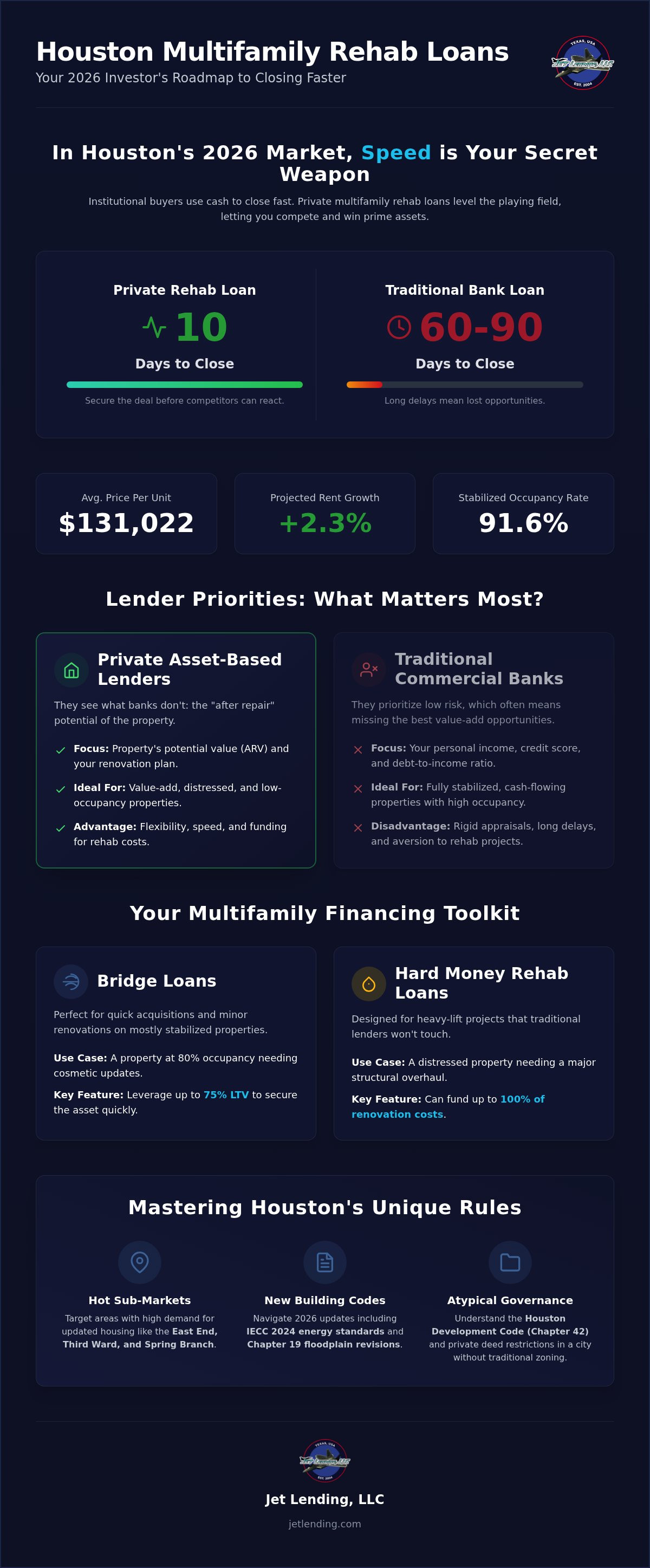
Multifamily rehab loans in Houston are specialized, short-term financing tools designed for properties with five or more units. Unlike a traditional mortgage that focuses on your personal income, these are asset-based loans. This means the lender prioritizes the property's potential value and your renovation plan. In 2026, Houston remains a powerhouse for value-add investors. With the average price per unit hovering around $131,022 and rents projected to climb by 2.3%, the math for "Class C to Class B" conversions is incredibly compelling. You're looking for older, distressed assets that need a facelift to command higher rents in a market where stabilized occupancy sits at a healthy 91.6%.
Traditional commercial banks often shy away from these deals. If a building is half-empty or has significant deferred maintenance, it's considered too risky for a standard 30-year note. Asset-based lenders see what the bank doesn't: the "after repair" potential. Mastering real estate investing fundamentals allows you to use these high-leverage tools to bridge the gap between a run-down acquisition and a stabilized, cash-flowing asset that is ready for long-term refinancing.
Success in Houston requires knowing more than just the neighborhood; you have to know the rules. Houston doesn't have traditional zoning, so land use is governed by the Houston Development Code (Chapter 42) and private deed restrictions. In 2026, new building code updates, including the IECC 2024 energy standards and Chapter 19 floodplain revisions, have changed how you must approach renovations. Investors are finding the best opportunities in sub-markets like the East End, Third Ward, and Spring Branch, where demand for updated housing is high. In the Houston market, After Repair Value (ARV) represents the estimated market value of a multifamily property after it's been fully renovated to meet 2026 building codes and has achieved stabilized occupancy at current market rates.
When a prime 10-unit building hits the market, you aren't just competing with other locals. You're competing with institutional buyers who show up with cash. If you're waiting 60 to 90 days for a bank appraisal, the deal is already gone. Using multifamily rehab loans Houston experts provide allows you to close in as little as 10 days. This speed levels the playing field. It's about avoiding the "lost opportunity" cost. Every month your capital sits on the sidelines is a month of missed rental growth. These loans provide the agility you need to secure the asset, execute the rehab, and move toward your exit strategy before the competition even gets an inspection scheduled.
Every multifamily deal is unique. A 10-unit complex in the East End with minor cosmetic needs requires a different financial engine than a 50-unit distressed asset in Spring Branch. Choosing the right structure determines your profitability. Most successful investors utilize three primary paths: bridge loans, hard money rehab loans, and DSCR loans. These tools allow you to move with the speed of a cash buyer while keeping your own capital liquid for the next deal. Understanding which one fits your project is the first step toward a successful close.
Bridge loans are your best friend for properties that are mostly stabilized but need a quick injection of capital. If a building is 80% occupied and just needs fresh paint and landscaping, this is your go-to. In Houston, you can typically find bridge financing with leverage ratios up to 75% LTV. This speed is critical when competing for assets near the $131,022 per unit average. Once the minor repairs are done and occupancy hits the 91.6% market average, you can transition into permanent financing. To see how the numbers stack up for your specific project, you can use an investment property calculator to model your exit strategy.
When a property is truly distressed, traditional banks won't even look at it. Hard money multifamily rehab loans Houston investors use are designed for these heavy-lift projects. These loans often cover a significant portion of the acquisition and up to 100% of the renovation costs. You need to understand the difference between Loan-to-Cost (LTC) and Loan-to-Value (LTV). LTC focuses on your total project budget; LTV looks at the final appraised value. Jet Lending evaluates the asset-backed potential of the deal itself rather than fixating on your personal credit score or debt-to-income ratio. This approach allows you to tackle major structural overhauls or energy code updates required by 2026 standards.
The final piece of the puzzle is your exit. Debt Service Coverage Ratio (DSCR) loans are the standard for long-term holding. These loans focus on the property's ability to cover its own debt through rental income. In 2026, Fannie Mae Tier 2 loans require a minimum 1.25 DSCR with up to 75% LTV. If you've executed your rehab correctly, your new rental income will easily exceed these requirements. This allows you to pay off your short-term debt and lock in a fixed rate, which currently ranges between 5.96% and 6.91% for smaller multifamily assets. This "refinance" step is how you pull your initial capital back out to fund your next Houston acquisition.
Investors often get stuck comparing interest rates without looking at the total cost of the deal. A traditional bank might offer a lower rate, but they also bring a mountain of red tape and a closing timeline that can stretch past 60 days. In a fast-moving market where multifamily rehab loans Houston lenders provide a 10-day close, that 50-day delay is a massive hidden cost. Cheap money isn't profitable if it causes you to lose the property to a faster buyer. Traditional lenders also struggle with "distressed" assets. If the occupancy is low or the roof is failing, a bank appraisal will likely kill the deal before it even starts.
There are specific moments when private capital is the only logical choice for your portfolio. If a 10-unit building in Clear Lake has a 40% vacancy rate, a traditional bank will reject it based on current cash flow. Private lenders look at what that property will become once you've stabilized it. You should prioritize private financing when:
Speed is a quantifiable metric in real estate. Starting your rehab 30 days sooner doesn't just save you a month of holding costs; it gets your units on the market a month earlier. In a city where average rents are projected to hit $1,410, that's thousands of dollars in "found" revenue for a small complex. Flexible draw schedules also keep your contractors motivated. When your lender releases funds quickly, your crew stays on-site and finishes the project on time. You can model these scenarios using our investment property calculator to see exactly how a faster exit impacts your annual IRR. Moving quickly allows you to compound your wins and move your capital into the next deal while your competitors are still waiting for a bank's loan committee to meet.
Securing multifamily rehab loans Houston investors use to scale is a systematic process. It's not about hoping for a bank's approval; it's about presenting a deal that makes sense for an asset-based lender. This starts with a clear data set and ends with a finished project that meets 2026's higher standards for energy efficiency and flood resilience. If you follow a proven roadmap, you can move from an initial lead to a funded project in as little as 10 days. This speed is what allows you to beat institutional cash buyers who are often slower than they appear.
Your first step is deep deal analysis. You need to evaluate the unit mix, current market rents, and expense ratios. In Houston's 2026 market, you're looking for properties where you can push the rent toward that $1,410 average through strategic updates. Before you sign a term sheet, you must understand what a hard money loan is and how it differs from traditional debt. You'll need to prepare a detailed Scope of Work (SOW) that outlines every repair, from HVAC upgrades to 2024 IECC insulation requirements. A professional SOW shows the lender you've accounted for every dollar and every day of the construction timeline.
Once your math is solid, the application process moves quickly. Local asset-based lenders look for the property's potential and your experience rather than just your credit score. They'll order a specialized appraisal to evaluate the "As-Is" value versus the "After Repair Value" (ARV). This appraisal is critical because it confirms the loan-to-value (LTV) ratios that determine your funding amount. In Houston, this often includes a review of flood zone compliance and wind load enhancements for 140 mph gusts, ensuring the property is a safe bet for both you and the lender.
The draw process is where many investors struggle, but it's actually your best tool for managing cash flow. Most multifamily rehab loans Houston providers use a reimbursement model. You complete a specific phase of work, such as the roof or interior plumbing, and then request a "draw" from the lender. To keep the cash flowing, structure your draws to align with your contractor's milestones. This keeps your crew on-site and motivated because they know they'll be paid as soon as the work is verified.
A third-party inspector will visit the site to confirm the work matches your SOW before funds are released. This might seem like an extra step, but it's actually a layer of protection for you. It ensures your contractors are following the 2026 building codes correctly. Tips for maintaining a compliant budget include keeping a 10% contingency fund for "hidden" issues common in older Houston apartments and using digital tracking to manage your receipts. When you master this cycle, you can finish your rehab on time and move toward your long-term exit strategy with confidence.
Success in 2026 requires more than just capital. It requires a partner who understands the nuances of the Houston market. Jet Lending, LLC has been based here since 2004. We know that an appraisal in Pearland looks very different from one in the Heights. When you use multifamily rehab loans Houston investors trust, you're tapping into two decades of local data. This expertise ensures your ARV is realistic and your exit strategy is solid. Jet Lending, LLC doesn't just lend money; we act as a mentor to help you navigate the complexities of 5+ unit assets. We want to see you succeed because your growth is our growth. Our team maintains a proactive, can-do attitude that keeps your project moving forward while others are stuck in bank committees.
Our localized insight is why Jet Lending, LLC can offer 100% financing options in Texas for certain projects. We understand why a value-add play in the Third Ward is different from a stabilized acquisition in Clear Lake. We don't just look at a spreadsheet; we look at the neighborhood. Whether you're tackling your first 10-unit building or managing a massive renovation, our straightforward communication keeps you informed. We're here to help you bridge the gap from your first small multi to a 50-unit portfolio with speed and efficiency.
Many lenders operate from a distance. They don't know about the recent Chapter 19 floodplain revisions or the IECC 2024 energy code updates affecting your budget. Jet Lending, LLC does. Our investment property calculator helps you filter out "Bad Deals" before you waste time on inspections. By modeling your expenses and market rents accurately, you can see the true potential of a distressed property before you ever put a deposit down. If you're just starting out, check out our guide on how to start flipping houses to build your foundation. As you grow, Jet Lending, LLC provides the specialized multifamily rehab loans Houston investors need to scale quickly and beat institutional buyers to the best deals.
Ready to move? The process is streamlined to match the speed of the 2026 market. You don't need a perfect credit score to get started. We prioritize the asset. To begin, gather your entity documents and a preliminary rehab budget. This doesn't have to be perfect yet; Jet Lending, LLC will help you refine the Scope of Work. Requesting a soft quote is the best way to verify your deal's viability without a hard credit pull. Our team provides same-day reviews for Houston projects, giving you the confidence to make an offer that sticks. Stop waiting for traditional banks and start building your legacy with Jet Lending, LLC — a lender that knows Houston as well as you do.
Houston's multifamily market in 2026 doesn't wait for bank committees or slow appraisals. You now have the roadmap to secure high-leverage financing and execute complex rehabs with confidence. Success comes down to your ability to analyze deals accurately and move with the speed of a cash buyer. By focusing on asset-backed potential rather than just credit scores, you can unlock properties that your competition is forced to pass over.
We've served as a Houston-based direct lender since 2004. We specialize in the type of fast, transparent closing process that turns a distressed building into a stabilized, cash-flowing portfolio asset. Using multifamily rehab loans Houston experts provide gives you a distinct advantage in every negotiation. It's time to stop letting red tape hold back your scaling strategy and start building the portfolio you've envisioned.
Your next big deal is waiting in the Houston sub-markets. We're ready to help you fund it and grow your legacy.
Down payments often range from 20% to 25% of the total project cost. However, specialized programs can provide 100% financing for qualified Texas investors. We look at the strength of the deal and your track record to determine the best leverage for your specific Houston project. This flexibility helps you keep more capital liquid for other acquisitions.
Yes, low occupancy is exactly why these loans exist. Traditional banks require a property to be stabilized, but multifamily rehab loans Houston lenders prioritize the asset's future value. We look at what the property will be worth after you renovate it to meet 2026 building codes and stabilize the tenant base. This allows you to acquire distressed assets that others can't fund.
We can close in as little as 10 days. Because we're a direct, Houston-based lender, we don't have to wait for third-party institutional approvals. This speed allows you to beat cash buyers and secure distressed assets before they hit the open market. Our localized team understands the urgency of the 2026 real estate landscape.
Yes, most of our rehab loan structures fund 100% of your construction budget. This capital is typically held in escrow and released through a draw process as you complete specific milestones. It's a powerful way to manage your cash flow while updating older Class C properties to modern Class B standards without draining your personal savings.
Private bridge loans are asset-based, so your credit score isn't the primary factor. We focus on the property's value and your ability to execute the renovation plan. While we do review your financial history, a lower score won't automatically disqualify you from a strong multifamily deal. We prioritize the math of the asset over your personal debt-to-income ratio.
Draws for large complexes are managed in phases. Once you finish a major component like the HVAC or interior flooring, a third-party inspector verifies the work. Funds are then released to reimburse you for those costs. This cycle repeats throughout the project, ensuring your contractors stay motivated and the work meets 2026 standards for energy efficiency and safety.
Most multifamily financing starts at 5 units. Properties with 1 to 4 units fall under residential lending rules. If you're looking to scale into the commercial space, our multifamily rehab loans Houston programs are built specifically for these larger, 5+ unit assets that require professional management and specialized deal analysis to maximize your return on investment.
Refinancing into a long-term DSCR loan is the most common exit strategy. Once your rehab is complete and the property is stabilized at the 91.6% market average occupancy, you can transition into a 30-year fixed-rate loan. This allows you to pay off the short-term debt and hold the asset for long-term cash flow while rates for smaller apartment buildings stabilize.
Tags:

Why do most new investors lose their entire profit margin before the first wall even comes down? It usually happens because they're guessing on the numbers. You know the feeling of standing in a...

Your ability to close a deal in the 2026 Houston market depends less on your personal credit score and more on the speed of your capital. You've likely felt the sting of losing a prime investment...

Why are some Houston developers breaking ground on their third project this year while you're still waiting for a bank callback on your first? You've likely felt the sting of a lost deal because a...