
Written By: Stephanie Rojas | September 18, 2026
Time to Read 13 Minutes
A Houston house flip isn't won at the closing table. It is won in the crawlspace and the tax office. You already know that the Bayou City offers incredible potential, but you need to know how to avoid losing money on a house flip Houston before you sign your next contract. One overlooked foundation crack or a miscalculated tax bill can evaporate your margins in weeks. It's a high-stakes environment where local knowledge is your best defense against financial loss.
You're likely worried about unpredictable repair costs or high Texas property taxes eating your profits, and you aren't alone. This guide will show you how to master the specific market nuances and financial frameworks required for success in 2026. We're here to help you move from uncertainty to total confidence in your investment numbers so you can scale your business with ease.
We'll provide a comprehensive due diligence checklist, updated math for the 2026 market, and a strategy for finding financing partners who understand our local streets. Let's dive into the frameworks that protect your capital and maximize your returns in the competitive Houston landscape.
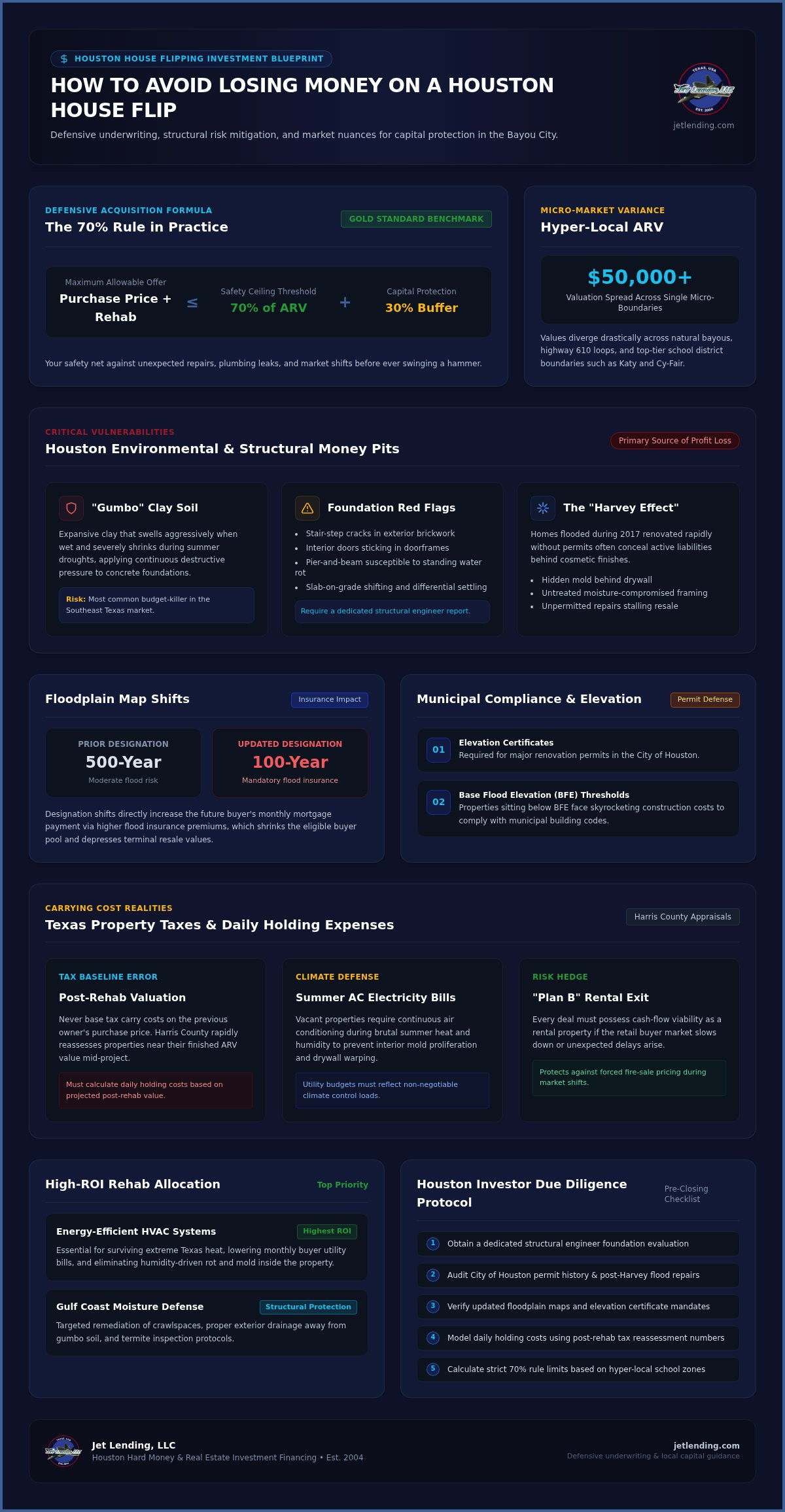
Houston soil isn't just dirt; it's a moving target. The region's famous "gumbo soil" is an expansive clay that swells when wet and shrinks during our brutal summer droughts. This constant movement puts immense pressure on concrete foundations, making structural failure the most common budget-killer for local investors. Learning how to avoid losing money on a house flip Houston starts with understanding the ground beneath your feet. If you ignore the soil, you're gambling with your entire profit margin.
Beyond the soil, you must account for the "Harvey Effect." Many properties flooded during the 2017 storm and were renovated quickly without proper permits. These homes often hide mold behind new drywall or have compromised framing that hasn't been treated for moisture. If you don't verify the permit history, you're inheriting a liability that could stall your resale or fail a future buyer's inspection. Success in house flipping requires a keen eye for these hidden structural costs, including the humidity-driven rot and termite damage common along the Gulf Coast.
Don't rely on a general home inspector for foundation health. You need a dedicated structural engineer report to protect your capital. Look for stair-step cracking in exterior brickwork or interior doors that stick in their frames. These are classic signs of shifting. In the 2026 market, the cost of repairing a pier-and-beam foundation often differs significantly from slab-on-grade repairs. While pier-and-beam systems offer easier access for plumbing, they are highly susceptible to wood rot from Houston's standing water. Always get a professional estimate before you finalize your acquisition math to ensure the numbers actually work.
Flood maps are not static. By 2026, many Houston neighborhoods have seen their designations shift from 500-year to 100-year floodplains. This change isn't just a label; it dictates your insurance requirements and your future buyer's monthly mortgage payment. High flood insurance premiums can shrink your buyer pool and lower your eventual sale price. Most 2026 Houston permits now require a current elevation certificate for major renovations. If the property sits below the base flood elevation, your rehab costs could skyrocket to meet new municipal codes. Check the maps early to ensure your margins stay intact.
The math of a Houston flip is less about addition and more about defensive subtraction. You must account for every penny before you ever swing a hammer. The 70% rule remains a gold standard in 2026. It suggests your purchase price plus rehab costs shouldn't exceed 70% of the property's final value. This buffer is your safety net. It's exactly how to avoid losing money on a house flip Houston when the market shifts or unexpected repairs arise. Without this margin, a single plumbing leak can turn a profitable project into a liability.
Houston is a patchwork of micro-markets. A house on one side of a bayou or a major road like 610 might sell for $50,000 more than its neighbor. You can't just pull a three-mile radius and call it a day. Focus on neighborhood boundaries and school district lines. A property zoned to a top-tier school in Katy or Cy-Fair will always command a premium. To get your valuation right, consult HUD home buying guidance on general market standards. Then, dive deeper into our specific guide on What is ARV in Real Estate? to master the local nuances that national software often misses.
Texas property taxes are among the highest in the country. They can easily evaporate your profits if you use the previous owner's tax bill as your baseline. In 2026, Harris County appraisals are faster and more aggressive than ever. Expect the county to reassess the property based on your much higher finished value almost immediately. You must calculate your daily carry costs with precision to keep your project on track. Every day the house sits empty, you're paying for those taxes, insurance, and utilities.
Your project timeline is your profit. If you don't have a clear picture of your holding costs, you don't have a deal. It's a good idea to run your numbers through a professional Investment Property Calculator before you commit. This ensures your math is grounded in the reality of the 2026 Houston market, helping you spot the difference between a winning deal and a financial trap.
Houston flips aren't just about aesthetics. They are about survival in the Gulf Coast climate. Your renovation strategy must prioritize features that withstand 100-degree days and high humidity. Curb appeal is your first chance to impress, but it needs to be sustainable. Don't waste money on delicate landscaping that will wilt by mid-July. Instead, use native, drought-resistant plants and automated irrigation systems. This ensures the house looks as good on closing day as it did on listing day. Understanding these local preferences is how to avoid losing money on a house flip Houston by preventing price drops during the hot summer months.
Buyers in 2026 are looking for a balance between open-concept living and functional privacy. While removing walls to create a flow between the kitchen and living room is still popular, the "work-from-home" trend remains strong. If you can carve out a dedicated, quiet office space, you'll see a higher return than by simply creating one massive, echoing room. Consult the U.S. Department of Housing and Urban Development home buying guidance for general standards, but keep your focus on what local families actually need in their daily lives.
Energy efficiency is no longer a luxury; it's a requirement. A modern, high-efficiency SEER2 HVAC system is the single best investment you can make in a Houston rehab. Buyers will check the age of the unit before they even look at the backsplash. Pair this with double-pane windows to keep utility costs low. In the kitchen, aim for finishes that compete with new construction in Katy or Cypress. Think large islands with deep sinks and under-cabinet lighting. Smart home features like Wi-Fi thermostats and keyless entries also provide a high perceived value for a relatively low cost.
Don't let your ego dictate the finishes. You must match your materials to the neighborhood's median price point to protect your margins. If the surrounding homes feature granite, installing expensive waterfall quartz might lead to an appraisal gap. The appraiser won't give you dollar-for-dollar credit for luxury features that exceed the area's standard. Focus on durability and clean lines. Choose neutral palettes that appeal to the widest possible audience. Remember, your goal is a quick sale, not a design award. Stick to the math and the local comps to ensure your rehab costs stay aligned with your final ARV.
Risk management is the difference between a professional investor and a hobbyist. In 2026, labor and material costs are more volatile than ever. You must build a 15% contingency buffer into every budget. This extra cushion is exactly how to avoid losing money on a house flip Houston when a subcontractor walks off the job or lumber prices spike mid-project. If you don't plan for the unexpected, you're planning for a loss.
Navigating the City of Houston building department requires patience and precision. Never start work without the proper permits. While it's tempting to save time by bypassing the red tape, an unpermitted flip is a major liability during the resale phase. Buyers and their inspectors will check for city records. If the work isn't on file, you might have to tear out finished walls to show the wiring to an inspector. Vetting your contractors is equally critical. "Cheap" is often the most expensive word in this business. A low bid usually means the contractor is cutting corners or doesn't understand the full scope of the project.
Your SOW must be a detailed, line-item document. Don't settle for a "lump sum" estimate from a contractor. You need to know exactly what you're paying for, from the number of recessed lights to the specific grade of flooring. Use a fix and flip deal analysis guide to verify that your costs align with current market averages. This level of detail prevents "scope creep," where small changes during demolition balloon into massive expenses.
Protect your investment with a strict draw schedule. Never pay for work that isn't finished. Payments should only be released once specific milestones are met and inspected. In Texas, lien waivers are non-negotiable. Every time you cut a check, ensure the contractor signs a waiver to protect the property title. You also need the right insurance coverage. General liability is a start, but builders risk insurance is essential for properties undergoing significant renovation. It covers the structure during the most vulnerable phases of the flip.
Your financing strategy is the engine of your investment business. While some investors prefer using all cash, smart leverage is often the superior path. Using short-term loans allows you to keep your liquidity intact. This cash reserve is your lifeline when you encounter the structural surprises or tax hikes we discussed in previous sections. By using asset-backed financing, you can scale your business and handle multiple projects simultaneously without draining your personal savings. It's a proactive way to manage risk while maintaining the momentum needed for growth.
In the 2026 market, speed is your greatest currency. Closing a deal in days rather than weeks is how you beat out the competition for the best distressed properties. Traditional banks often move at a glacial pace, but a dedicated short-term lender understands that time is money. Understanding how to avoid losing money on a house flip Houston requires you to have a reliable financial partner who can move as fast as the market does. When you have capital ready to deploy, you're a buyer, not just a browser.
Precision is the enemy of risk. You shouldn't guess your margins. Our Investment Property Calculator is designed to give you a clear, honest look at your deal's potential. It allows you to input real-world Houston data, including those high Harris County property taxes and specific rehab costs. You can't ignore the math if you want to stay profitable.
Stress-test your numbers before you commit any capital. What happens if your contractor disappears and the project takes two months longer? What if the market dips and your ARV drops by 5%? By identifying your break-even point early, you learn how to avoid losing money on a house flip Houston before the first dollar leaves your pocket. This tool isn't just for math; it is for peace of mind and strategic protection.
National "big box" lenders see a zip code on a screen. A local Houston lender sees the street, the bayou, and the neighborhood history. Local expertise is a massive competitive advantage. We can often spot a bad deal or a declining neighborhood that a national algorithm would miss. We know which areas are prone to permitting delays and which ones have the highest buyer demand in 2026. This boots-on-the-ground knowledge is vital for your due diligence.
When you work with a local partner, you get more than just a check; you get a mentor. Take the next step by exploring our Hard Money Lenders Houston: The 2026 Investor’s Guide to see how fast capital can transform your strategy. Getting pre-approved now ensures that when the right deal hits your desk, you are ready to move with total confidence and a partner who has your back.
Success in the 2026 Houston market requires a blend of local intuition and hard data. You've learned to identify structural traps in gumbo soil and account for the high carry costs of Texas property taxes. By focusing your rehab budget on energy efficiency and vetting every contractor with a strict scope of work, you're already ahead of the competition. Mastering how to avoid losing money on a house flip Houston isn't about avoiding risk entirely. It's about managing it with professional tools and local expertise.
Jet Lending, LLC has supported local investors since 2004. With over 20 years of Houston real estate lending experience, we provide asset-based loans that focus on the strength of your deal rather than just your credit score. We're here to help you move fast and close with confidence. We understand the local landscape because we live and work here too.
The Bayou City is full of opportunity for those who do the work. Take the lessons from this guide, trust your math, and start building your legacy one deal at a time. You've got the roadmap; now it's time to take action.
House flipping remains profitable in Houston for 2026, but success requires more precision than in previous years. High demand for renovated homes in suburbs like Cypress and Sugar Land continues to drive the market. You must focus on distressed properties where you can add significant value through smart renovations. Using an investment property calculator helps you verify that the potential profit justifies the risk before you commit your capital to any deal.
The 70% Rule suggests that an investor should pay no more than 70% of the after-repair value (ARV) of a property, minus the cost of repairs. In the 2026 Houston market, this rule serves as a critical benchmark for risk mitigation. While some high-demand neighborhoods might see slightly compressed margins, sticking close to this formula is a proven way for how to avoid losing money on a house flip Houston.
The amount of capital needed depends on your financing strategy. While you don't need the full purchase price in cash, you should typically have enough for a 10% to 20% down payment on a short-term loan, plus a 15% contingency reserve for repairs. Having liquid cash for holding costs like high Texas property taxes and utilities is also essential. This liquidity ensures you can handle the project without stalling due to a lack of funds.
Most Houston flips fail due to three main factors: unestimated foundation repairs, high property tax carry costs, and poor contractor management. The region's expansive clay soil can cause structural issues that eat your budget if missed during inspection. Additionally, projects that take too long suffer from high daily holding costs. Vetting your deal with local expertise and a professional calculator can prevent these common financial traps from ruining your expected margins.
Finding a reliable contractor starts with seeking referrals from other local investors and checking trade associations in the Greater Houston area. Always ask for proof of general liability insurance and recent project references you can visit in person. Never pay the full amount upfront; instead, use a milestone-based draw schedule. This approach ensures work is completed to your standards before funds are released, protecting your investment from common contractor pitfalls.
Using a hard money loan is often the preferred choice because it preserves your liquidity for other opportunities. While cash avoids interest, it ties up your capital in a single asset, which can be risky if the project hits delays. Short-term asset-backed loans allow you to leverage your funds to handle multiple flips at once. This strategy increases your overall return on investment while keeping a cash safety net for unexpected costs.
If a property doesn't sell quickly, your best "Plan B" is often to pivot to a long-term or short-term rental strategy. Houston's strong job market makes it a viable area for rental income. You can refinance your short-term debt into a more permanent solution to cover the costs while the property appreciates. Having this exit strategy in place is a core part of how to avoid losing money on a house flip Houston when market conditions shift.
Flood zones significantly impact resale value because they dictate the cost of mandatory flood insurance for your future buyer. A property in a 100-year floodplain may have a smaller buyer pool due to these higher monthly carrying costs. Always check the most recent 2026 flood maps and obtain an elevation certificate during your due diligence. Buyers are increasingly cautious about flood history, so providing transparent documentation of past repairs is vital for a sale.
Tags:

In the 2026 Houston real estate market, your ability to close a deal isn't determined by your credit score, but by how fast you can move. While a traditional bank spends sixty days scrutinizing your...

In a market where the median sale price has hit $796,000, waiting 45 days for a traditional bank loan isn't just a delay; it's a lost deal. You've likely seen prime historic properties in The Heights...

In a Houston market where active listings have surged by over 16% this year, the real challenge isn't finding a property; it's securing the capital before the competition does. You need a financing...