
Written By: Stephanie Rojas | November 11, 2026
Time to Read 11 Minutes
A Houston rental’s rent isn’t the same as its return. When calculating ROI on a Houston rental property, subtract operating expenses from rental income, then divide the net return by your total investment.
That calculation is a useful starting point, but vacancy and ownership costs can change the result. Account for Houston’s local market conditions when estimating rent and weighing an investment’s potential.
This guide walks through the numbers step by step. Learn how to estimate net operating income, account for vacancy, calculate cap rate, and assess Houston-specific factors to compare rental properties more clearly.
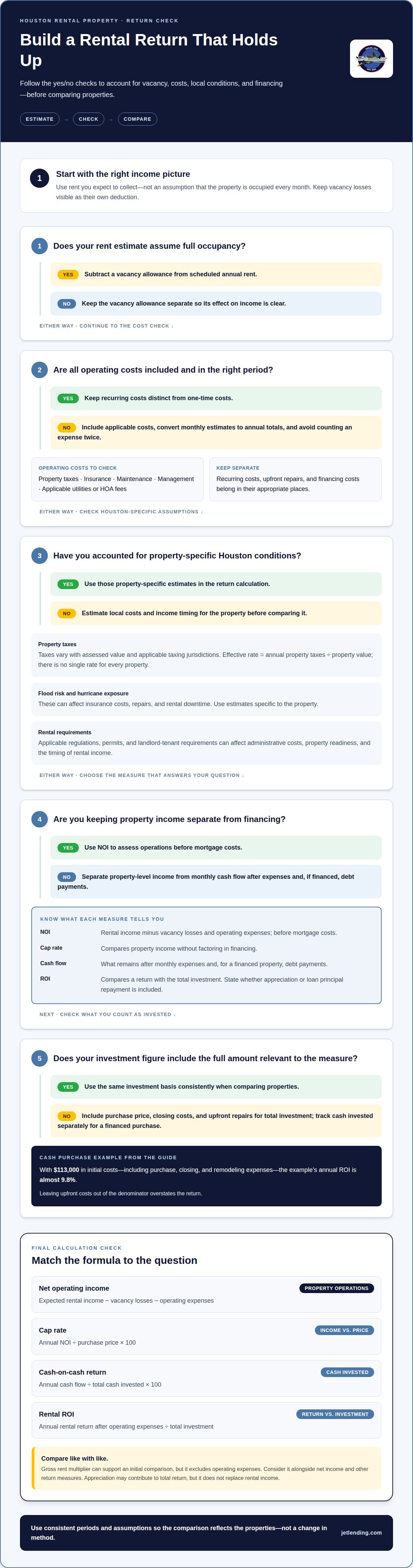
Start with annual rental income, subtract operating costs and vacancy losses, then divide by the total invested. For a useful comparison, separate property-level income from financing, monthly cash flow, and any appreciation included in your return estimate.
Use the cash-purchase example to calculate a straightforward annual return. Divide that profit by $113,000 in initial costs, including purchase, closing, and remodeling expenses. The result is an annual ROI of almost 9.8%. Include upfront costs in your denominator; leaving them out overstates the return.
Track each measure separately. ROI compares a return with the total investment, while cap rate divides net operating income by the purchase price and multiplies by 100. Net operating income (NOI) is rental income minus operating expenses and vacancy losses, before mortgage costs. Monthly cash flow shows what remains after monthly expenses and, for a financed property, debt payments. Appreciation can contribute to total return, but it does not replace rental income.
For cash-on-cash return, divide annual cash flow by total cash invested and multiply by 100. For cap rate, divide annual NOI by the purchase price and multiply by 100. These measures answer different questions: cash-on-cash return reflects your cash invested, while cap rate compares property income without financing.
Include property taxes, insurance, maintenance, and applicable utilities or HOA fees in your expenses. Houston property taxes vary with assessed value and the taxing jurisdictions that apply. Calculate an effective rate by dividing annual property taxes by the property’s value; there is no single rate that fits every property. Flood risk and hurricane exposure can also affect insurance costs, repairs, and rental downtime, so use property-specific estimates when assessing returns.
Use the same assumptions and time period for every rental comparison. Even small changes to expenses, financing, or the amount invested can shift the result and make a property look stronger than it is.
Use a rental property ROI calculation as a decision aid, not a substitute for checking whether your assumptions fit the property. List expected income and costs, identify uncertain estimates, and consider how the result changes if they prove less favorable. Apply the same method when comparing properties, so differences in the results reflect the properties rather than a change in approach. A clear worksheet also makes it easier to revisit your decision when new information becomes available.
Gross rent multiplier excludes operating expenses, so consider it alongside other metrics. Use it for an initial comparison, then assess whether expected income after costs supports the investment. Keep financing assumptions visible and distinguish cash invested from the property’s full price, so the calculation answers the question you intend to ask. If you present multiple return measures, label what each includes and use consistent periods and assumptions. This makes the strengths and limits of each result clear, without letting a rent-based comparison replace a fuller review of the investment.
Estimate rental income from the rent you expect to collect, not from an assumption of full occupancy. Subtract vacancy losses and operating expenses to calculate net operating income (NOI).
Start with the monthly rent you expect, then calculate scheduled rent for the year. Subtract a vacancy allowance for periods without rental income. Keep that allowance separate from operating costs so you can see how unoccupied time affects income and projected profit.
Subtract vacancy losses and operating expenses from expected rental income. Include property taxes, insurance, maintenance, management, and applicable utilities or HOA fees. NOI excludes mortgage expenses, measuring the property’s operating performance before financing.
Use cap rate to compare a rental property’s operating income with its value. Examine financing and equity separately because cap rate excludes loan costs.
Divide annual net operating income (NOI) by the property’s purchase price, then multiply by 100. For example, $7,200 in NOI divided by a $215,000 property value produces a 3.35% cap rate. Use the same value basis when comparing properties, and remember that cap rate measures operating performance before mortgage payments.
Model the mortgage rate, down payment, and financing expenses in the cash-flow and cash-on-cash calculations. How do Houston mortgage rates, down payments, and financing costs affect rental ROI? Higher borrowing costs can reduce monthly cash flow, while a larger down payment increases cash invested and changes the cash-on-cash result. Keep these effects separate from cap rate.
For total capital outlay, include the purchase, closing costs, and renovations. How should you account for closing costs, renovations, and resale appreciation in Houston rental ROI? Add closing costs and upfront renovation expenses to invested capital; show possible resale appreciation separately from rental income and operating return.
Houston’s rental demand has local drivers, but demand alone doesn’t establish a property’s return. Connect market conditions to rent, vacancy, operating costs, and financing assumptions.
Jet Lending, LLC’s Investment Property Calculator helps organize the assumptions behind a rental property analysis. Enter the purchase price, down payment, mortgage interest rate, property taxes, and insurance costs to estimate monthly expenses. The calculator also projects cash flow from income and expenses and calculates ROI and cap rate. Use it to compare scenarios that account for vacancy, operating costs, and financing.
Use the calculator when reviewing a Houston investment to see how changing an assumption affects projected returns. If short-term financing is part of your plan, Jet Lending, LLC offers Short-Term Loans for real estate investors. Contact Jet Lending, LLC to discuss financing for your investment.
Treat your return estimate as a working decision tool, not a fixed verdict. Update the analysis as your assumptions change, before committing to a purchase. A disciplined approach to calculating ROI on a Houston rental property keeps your decision grounded in the numbers that matter to your investment plan.
In your next review, identify which assumption most affects the projected outcome. Then decide whether the opportunity fits your goals and your risk tolerance. If you’re considering financing, weigh it alongside your property analysis.
Jet Lending offers short-term, asset-backed financing for real estate investors considering their next investment.
Keep refining your plan and asking clear questions. A thoughtful next move starts with knowing what you want your investment to achieve.
Subtract the costs associated with the investment from its return, then divide by the total amount invested. Multiply by 100 to express the result as a percentage. For a rental, decide which returns you’re including, such as operating profit, principal repayment, or appreciation. Keep the period consistent: an annual return should be compared with costs and investment measured on an annual or upfront basis.
Return on investment, or ROI, expresses an investment’s gain or loss relative to the capital committed. Real estate investors use it to assess whether rental income and other gains justify the purchase and related expenses. ROI depends on what you count as a return and how much capital you include. State those assumptions clearly to compare properties on the same basis.
The 2% rule is a quick screening guideline: monthly rent equal to at least 2% of the purchase price may indicate potential for positive cash flow. It isn’t a full profitability calculation. A property that meets the benchmark can still have substantial taxes, insurance, repairs, vacancy, or financing costs. Use it to flag a property for closer analysis, not as a substitute for calculating actual income and expenses.
ROI relates an investment’s return to the amount invested and is expressed as a percentage. A positive result indicates a gain under the calculation’s assumptions; a negative result indicates a loss. For a Houston rental, the result differs depending on whether you measure rental operations alone or include financing and changes in property value. State the return period and included components to make the result meaningful.
When calculating ROI on a Houston rental property, estimate collected rent, subtract vacancy losses and operating expenses, then divide the resulting return by total invested capital. Include applicable Houston-area costs, such as property taxes, insurance, maintenance, and HOA fees or utilities. If the property is financed, also calculate cash flow after debt payments. Keep projected appreciation separate from rental income.
Include recurring operating expenses such as property taxes, insurance, maintenance, management, utilities, and applicable HOA fees. Account for vacancy losses, too: empty periods reduce collected rent while some costs continue. Add purchase-related outlays, including closing costs and upfront repairs, when calculating total capital invested. Keep mortgage payments separate from operating expenses when calculating NOI, then include debt payments in a cash-flow analysis.
Houston purchase prices and rents vary by neighborhood, property type, condition, and rental setup, so a citywide average may not reflect a specific deal. For a useful comparison, look at similar properties in the same area and distinguish asking rent from the income your property can reasonably collect. Compare that estimate with the actual purchase price and expenses to see how local assumptions affect projected returns.
These costs depend on the property’s condition, coverage needs, repair history, size, and management arrangement. Estimate insurance and management as separate budget lines, and account for maintenance based on the property’s systems and anticipated upkeep. For investors also exploring hospitality or short-term accommodations, full-service property management companies such as Crucial Hospitality offer an example of how professional management is factored into operating expenses. For Houston properties, consider flood exposure and any related insurance costs. Include these estimates in operating expenses rather than treating gross rent as available profit.
Tags:

The practical guide to real estate investor mistakes to avoid in Houston starts with one rule: budget for the full deal, not just the purchase. Set aside 3-6 months of expenses as reserves, and...

A Houston portfolio should match your goals, combine suitable property types and neighborhoods, and rest on careful deal analysis. Building a real estate investment portfolio in Houston means...

Owning property in Texas and qualifying for a loan are separate matters. Property ownership generally does not depend on immigration status, so DACA recipients can own property. A real estate...